.svg&w=384&q=75 "naujapitch logo")
Cagliari vs Udinese: Tactical Analysis of Serie A Defeat
Cagliari’s 2–0 home defeat to Udinese at the Unipol Domus was a study in contrasting efficiency. Fabio Pisacane’s side controlled territory, possession and shot volume in this Serie A Round 36 fixture, yet Kosta Runjaic’s compact 3-5-2 absorbed pressure and struck decisively in transition. With Udinese winning the expected goals battle 2.17 to 1.41 despite having just 37% of the ball and nine total shots, the match hinged on how each team translated structure into penalty-box clarity rather than on who dictated the ball.
I. Executive Summary
Cagliari lined up in a 5-3-2 under Fabio Pisacane, seeking to build patiently from the back and dominate central zones. Udinese, in Kosta Runjaic’s 3-5-2, accepted a lower share of possession and focused on verticality through the wing-backs and front two. Cagliari’s 63% possession, 22 shots and 8 corners reflected territorial control, but Udinese’s more clinical shot profile and better exploitation of transitions produced a 2–0 away win, with both goals arriving after the interval as the visitors’ compact block repeatedly forced Cagliari into low-quality, crowded shooting positions.
II. Scoring Sequence & Disciplinary Log
The first half was shaped by a major turning point on 34 minutes: a VAR intervention cancelled a Cagliari penalty initially awarded with Michel Adopo at the heart of the incident. That decision preserved Udinese’s defensive game plan and kept the match at 0–0 going into the break.
Disciplinary events followed a clear chronological pattern:
- 44' Kingsley Ehizibue (Udinese) — Off the ball foul
- 53' Zé Pedro (Cagliari) — Foul
- 90+2' Keinan Davis (Udinese) — Argument
These three yellow cards defined the only disciplinary actions of the match: Cagliari finished with one booking, Udinese with two, for a total of three.
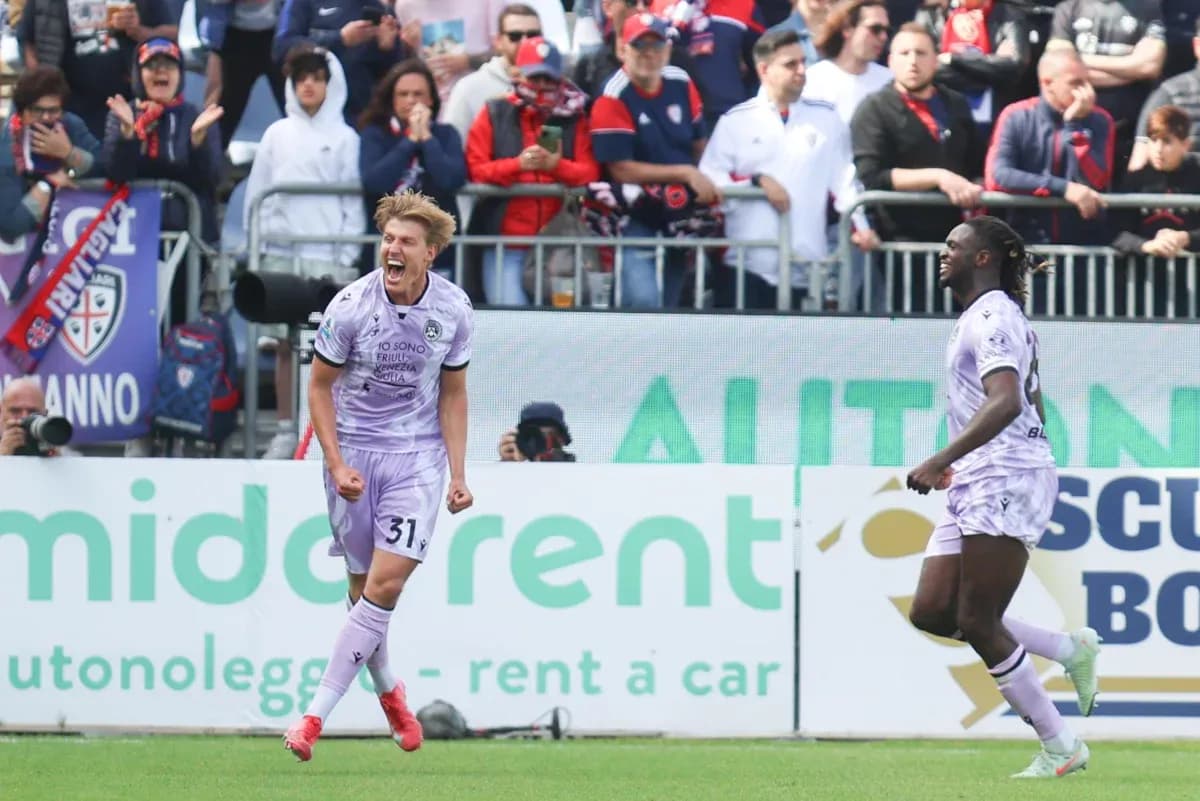
The scoring opened at 56', immediately after Runjaic’s first structural changes. A. Buksa finished a move assisted by H. Kamara, a classic example of Udinese’s quick vertical release from midfield into the channels behind Cagliari’s wing-backs. That goal shifted the tactical landscape, forcing Pisacane to push his wing-backs and midfielders higher.
The second goal came at 90', with I. Gueye scoring from a Keinan Davis assist. Again, Udinese punished Cagliari in a late transition as the hosts committed numbers forward, sealing a 2–0 away victory that aligned with their superior xG despite fewer overall shots.
III. Tactical Breakdown & Personnel
Pisacane’s 5-3-2 was built on a back five of M. Palestra, Zé Pedro, A. Dossena, J. Rodriguez and A. Obert in front of goalkeeper E. Caprile. The structure aimed to create a three-man first line in possession, with the wide defenders stepping high to form a pseudo-3-4-1-2. In midfield, M. Adopo, G. Gaetano and M. Folorunsho provided a blend of ball progression and physicality, while S. Esposito and P. Mendy led the line.
Cagliari’s statistical dominance was clear: 537 total passes at 86% accuracy versus Udinese’s 331 at 76%, and 63% possession. Their 22 total shots, with 15 inside the box, suggest they consistently reached advanced zones. However, the shot quality and execution were lacking. Only 5 of those 22 attempts hit the target, and Udinese blocked 1 shot while forcing many others from suboptimal angles or under pressure. The hosts’ xG of 1.41 reflects volume without truly clear-cut chances.
Udinese’s 3-5-2, with M. Okoye behind a back three of B. Mlacic, T. Kristensen and O. Solet, was compact and vertically oriented. Wing-backs K. Ehizibue and H. Kamara were key outlets, while the central trio of J. Piotrowski, J. Karlstrom and A. Atta balanced screening duties with quick forward distribution. Up front, N. Zaniolo and A. Buksa initially led the line, providing targets for direct balls and outlets for counters.
The first major tactical inflection point came with Runjaic’s double change on 55':
- L. Miller (IN) came on for J. Piotrowski (OUT)
- N. Bertola (IN) came on for B. Mlacic (OUT)
Fresh legs in midfield and defense immediately preceded the 56' opener, as H. Kamara’s assist to A. Buksa highlighted Udinese’s improved ability to break Cagliari’s press and exploit the space behind advanced wing-backs.
Pisacane responded at 62' by reshaping his right side and midfield:
- G. Zappa (IN) came on for M. Palestra (OUT)
- I. Sulemana (IN) came on for J. Pedro (OUT)
This shifted Cagliari towards a more aggressive posture, effectively turning the back five into a back four in many phases, with Zappa higher and Sulemana adding ball-carrying in midfield. Later, at 73', M. Folorunsho made way for A. Albarracin (IN), adding attacking thrust from midfield, and at 88' A. Belotti (IN) replaced M. Adopo (OUT) while Y. Trepy (IN) came on for A. Obert (OUT), leaving Cagliari in a very front-loaded structure.
Runjaic, meanwhile, managed energy and preserved counter-threat:
- 65' K. Davis (IN) came on for A. Buksa (OUT)
- 78' I. Gueye (IN) came on for N. Zaniolo (OUT)
- 78' J. Arizala (IN) came on for K. Ehizibue (OUT)
These changes kept Udinese dangerous in transition even as they dropped deeper to protect the lead. The late 90' goal by I. Gueye from a K. Davis assist underlined the success of this rotation: fresh forwards attacking a stretched, numbers-committed Cagliari back line.
In goal, E. Caprile made 4 saves and posted a goals-prevented figure of 0.82, indicating that despite conceding twice, he did mitigate additional danger. M. Okoye, with 3 saves and the same 0.82 goals prevented, benefitted from Udinese’s compactness, facing fewer but higher-quality shots and dealing with them efficiently.
IV. The Statistical Verdict
The raw numbers tell a story of control versus clarity. Cagliari’s 63% possession, 537 passes and 22 shots (15 in the box) demonstrate sustained pressure and territorial dominance. Yet their 1.41 xG and 5 shots on target reveal a failure to convert that control into high-probability chances, despite winning the corner count 8–4 and committing fewer fouls (10 to Udinese’s 13).
Udinese, with just 9 shots and 6 on target, generated 2.17 xG, a far more efficient attacking output. Their 37% possession was by design, not by weakness: the 3-5-2 block compressed central spaces, forcing Cagliari wide and into crowded shooting lanes. Discipline also mirrored the tactical balance: Udinese’s two yellows (Kingsley Ehizibue — Off the ball foul; Keinan Davis — Argument) contrasted with Cagliari’s single booking for Zé Pedro (Foul), reflecting a visiting side operating on the edge in duels and transitions.
In sum, Cagliari’s overall form in this match showed structural ambition but blunt attacking execution, while Udinese’s defensive index and transition efficiency were decisive, turning fewer touches into a deserved 2–0 away win.