.svg&w=384&q=75 "naujapitch logo")
Cagliari vs Udinese: Tactical Analysis of the 2–0 Defeat
The afternoon at Unipol Domus ended with a stark verdict. Cagliari, desperate to edge clear of danger, were picked apart 2–0 by a clinical Udinese side whose season-long numbers had hinted they were far more dangerous than their mid‑table label suggested. Following this result, the table snapshot tells a clear story: Cagliari sit 16th on 37 points with a goal difference of -15 (36 scored, 51 conceded), while Udinese consolidate 9th on 50 points, their own goal difference a tight -1 (45 for, 46 against). Over 36 matches, this was a clash between a side fighting to survive and another quietly refining a winning identity.
Cagliari’s seasonal DNA had always been about thin margins. At home they had averaged 1.1 goals for and 1.2 against, with 6 wins, 4 draws and 8 defeats in 18 games. The clean-sheet count at Unipol Domus (6) underlined that when their defensive block held, they could suffocate opponents; but 7 home matches without scoring betrayed a chronic lack of cutting edge. Udinese, by contrast, arrived as one of Serie A’s more dangerous travellers: on their travels they had 8 wins, 3 draws and 7 defeats, scoring 27 and conceding 26, an away average of 1.5 goals for and 1.4 against. The away goal profile alone suggested that if this opened up, the visitors had the weapons to punish.
Fabio Pisacane’s response to that threat was structural. Cagliari lined up in a conservative 5‑3‑2, with E. Caprile shielded by a back five of M. Palestra, J. Pedro, A. Dossena, J. Rodriguez and A. Obert. In front, a compact midfield of M. Folorunsho, G. Gaetano and M. Adopo was tasked with compressing space between the lines, while S. Esposito and P. Mendy offered vertical runs rather than a classic target presence.
The absences only deepened Cagliari’s reliance on structure over spontaneity. G. Borrelli and L. Pavoletti were both missing with thigh and knee injuries respectively, stripping Pisacane of traditional penalty‑box reference points. Creative and wide options such as M. Felici and R. Idrissi, along with J. Liteta and L. Mazzitelli, were also unavailable. It left the bench heavy on youth and utility rather than proven Serie A decision‑makers: A. Belotti and S. Kilicsoy were the main attacking alternatives, but both entered the afternoon more as gambles than certainties.
Kosta Runjaic, meanwhile, embraced Udinese’s attacking identity with a 3‑4‑3. M. Okoye anchored a back three of O. Solet, T. Kristensen and B. Mlacic, with K. Ehizibue and H. Kamara as aggressive wing‑backs. The double pivot of J. Karlstrom and J. Piotrowski provided the platform for a front line built to stretch and torment: A. Atta and A. Buksa flanking N. Zaniolo, whose season had already marked him out as one of Serie A’s most influential creators.
If there was a tactical void for Udinese, it came in defence. C. Kabasele’s suspension for yellow cards removed an experienced organiser from the back line, and A. Zanoli’s knee injury deprived Runjaic of another defensive option. Higher up, the absence of J. Ekkelenkamp slightly reduced their rotational options between midfield and attack. Yet the squad depth in the final third remained imposing: K. Davis, Udinese’s leading scorer with 10 league goals and 4 assists, waited on the bench, along with the direct threat of I. Gueye.
The “Hunter vs Shield” duel in this fixture was defined less by an individual marksman and more by a clash of profiles. On their travels, Udinese’s attack had been one of the more productive in the division, while Cagliari at home conceded at 1.2 per game and often relied on volume defending. A. Obert, one of Serie A’s most card‑prone defenders with 9 yellows and a yellow‑red this season, embodied that edge-of-the-knife style: 63 tackles, 18 blocked shots and 40 interceptions spoke of a defender constantly in the line of fire. But the disciplinary trend hinted at risk. Cagliari’s yellow‑card distribution peaked late, with 26.92% of their cautions arriving between 76–90 minutes, and all their red cards this season coming in that same 76–90 window. This was a team that often finished games stretched and emotional.
Udinese’s own card map suggested a different rhythm: 26.87% of their yellows came between 61–75 minutes, followed by 22.39% from 76–90. They tended to absorb and then foul as they reset under pressure, rather than unravel completely. The one red card they had taken all season arrived in the opening 0–15 minutes, an anomaly that did not repeat itself here.
In the “Engine Room” battle, two playmakers framed the narrative. For Cagliari, S. Esposito had been the creative heartbeat all campaign: 6 goals, 5 assists, 65 key passes and 916 total passes at 74% accuracy, with a willingness to work both ways (49 tackles, 15 interceptions). His duel with Udinese’s midfield screen of Karlstrom and Piotrowski was central to Cagliari’s hopes of progressing through the thirds. On the other side, N. Zaniolo arrived as Udinese’s top assist provider with 6, adding 5 goals and 53 key passes. His 94 dribble attempts and 61 fouls drawn made him the natural “Hunter” between the lines, testing the timing and discipline of Obert, Dossena and J. Pedro.
Runjaic’s decision to keep K. Davis in reserve only strengthened the sense of a layered threat. Davis’s profile — 10 goals, 4 assists, 24 shots on target from 37 attempts, plus 44 dribbles with 30 successes — made him the ideal late‑game weapon against a Cagliari side that historically accumulated cards and fatigue in the final quarter of matches. Even without explicit xG data, the structural trends were clear: Udinese’s away average of 1.5 goals, their 5 clean sheets on the road, and Cagliari’s 14 total matches failing to score overall pointed towards a contest where the visitors’ defensive solidity and vertical threat would gradually tilt the balance.
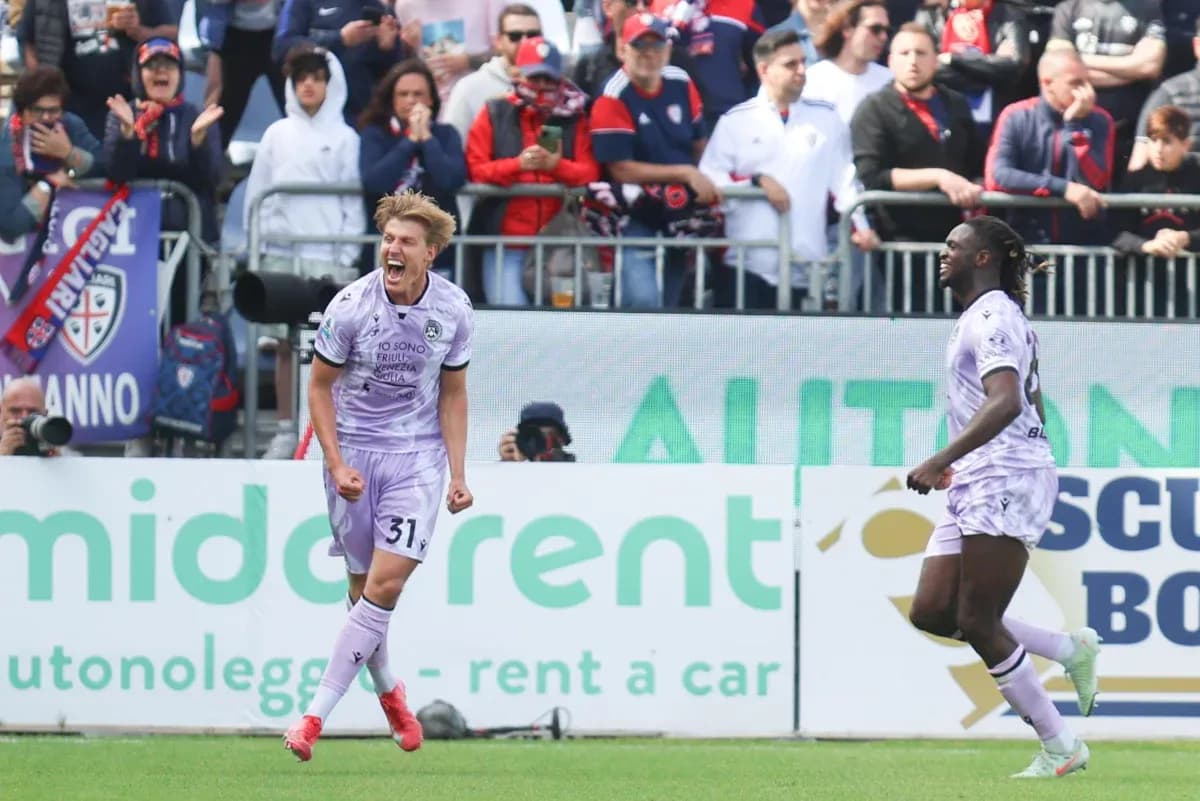
Following this result, the 2–0 scoreline felt like the logical expression of those season‑long currents. Cagliari’s five‑man line and hard‑working midfield could delay but not deny a side whose attacking patterns and bench depth outstripped their own. Udinese, even shorn of Kabasele and Ekkelenkamp, showed why their statistical profile has belonged to the upper half of the table all season: a team capable of managing risk, exploiting tired legs, and turning structural superiority into goals when it matters most.