.svg&w=384&q=75 "naujapitch logo")
Bayern München vs Paris Saint Germain: Champions League Semi-Final Analysis
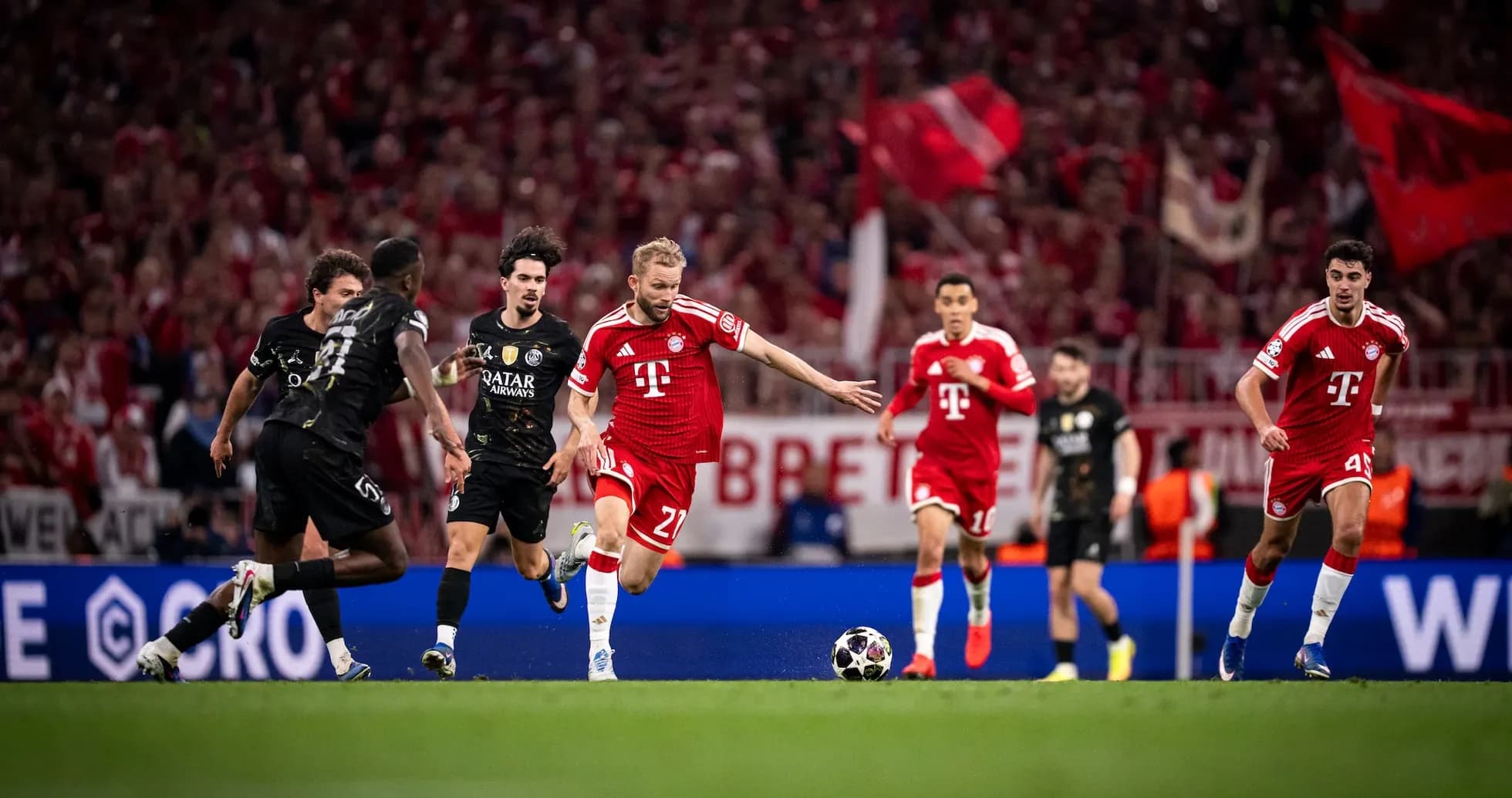
Bayern München and Paris Saint Germain produced a finely balanced Champions League semi-final first leg at the Allianz Arena, ending 1–1 after 90 minutes. PSG struck immediately through Ousmane Dembele, but Bayern’s territorial dominance and late pressure were finally rewarded by Harry Kane’s equaliser on 90’. With no extra time or penalties, the tie remains perfectly poised, yet the underlying tactical patterns were sharply defined: Bayern’s 4-2-3-1 asserted control of possession and territory, while PSG’s 4-3-3 prioritised vertical transitions and compact defending, leaning heavily on structure and individual quality in wide areas.
First Half
PSG’s opener at 3’ set the tactical tone. From their 4-3-3, K. Kvaratskhelia, starting on the left, found space early and delivered the assist for Dembele’s “Normal Goal”. That early lead allowed Enrique Luis’ side to compress the pitch in a mid-to-low block, narrowing the three midfielders — J. Neves deepest, with Vitinha and F. Ruiz stepping out selectively — and inviting Bayern to have the ball. Bayern’s 4-2-3-1, with Joshua Kimmich and A. Pavlovic as a double pivot, was forced into a patient, circulation-heavy approach, reflected in their 66% possession and 570 total passes at 87% accuracy.
Out of possession, Bayern’s structure was a 4-4-2 press, with J. Musiala stepping up alongside Kane and the wingers M. Olise and Luis Díaz dropping into the line of four. The early goal, however, meant PSG could be more selective with risk. Their front three pressed on triggers — back passes to M. Neuer or slow switches to the full-backs — but otherwise dropped into a compact 4-5-1, with Dembele and D. Doue (before his substitution) tracking Bayern’s full-backs. The first PSG yellow card, Nuno Mendes at 8’ for a foul, underlined how aggressive the full-backs had to be stepping out to Bayern’s wide players.
Second Half
Bayern’s main problem phase was early progression into the final third. Kimmich often dropped into the first line, creating a 3+1 rest defence with D. Upamecano and J. Tah, while J. Stanisic held the width on the left but rarely overlapped. This gave Bayern stability against transitions, but initially limited overloads wide of PSG’s block. Still, Bayern generated 18 total shots (13 inside the box), an xG of 1.4 and forced 6 saves from M. Safonov, a sign that once they cracked the block, they arrived in high-quality zones.
PSG’s attacking plan after the opener was clear: verticality through Kvaratskhelia and Dembele, supported by underlapping runs from Vitinha and F. Ruiz. Their 15 total shots (8 inside the box) and 7 shots on goal (xG 1.03) show they were not purely reactive; they were dangerous when they broke Bayern’s counter-press. The yellow card for Khvicha Kvaratskhelia at 45+3’ for time wasting illustrated how PSG leaned into game management once ahead, slowing restarts and accepting long phases without the ball.
The disciplinary pattern reflected the emotional stakes. Jonathan Tah’s yellow at 33’ for argument rather than a foul showed Bayern’s frustration with the early deficit and PSG’s tempo control. Later, Luis Díaz’s yellow at 78’ for argument and Joshua Kimmich’s at 90+7’ for argument further underlined Bayern’s sense of urgency as the clock ran down. For PSG, beyond Mendes and Kvaratskhelia, Marquinhos’ yellow at 86’ for a foul was a classic last-ditch intervention from a centre-back under heavy late pressure.
Substitutions
Substitutions were pivotal in reshaping the final phase. For PSG, B. Barcola (IN) came on for O. Dembele (OUT) at 65’, maintaining vertical threat on the right but with fresher legs to chase counters and press Bayern’s build-up. At 76’, L. Hernandez (IN) replaced D. Doue (OUT), and L. Beraldo (IN) replaced F. Ruiz (OUT), effectively reinforcing the left flank and defensive line to protect the lead, while slightly sacrificing central progression. Later, S. Mayulu (IN) for N. Mendes (OUT) at 85’ added energy at left-back to cope with Bayern’s right-sided surges.
Kompany’s changes for Bayern were more aggressively tilted toward breaking PSG’s block. A. Davies (IN) came on for J. Stanisic (OUT) at 67’, instantly increasing left-sided depth and overlapping threat. One minute later, Kim Min-Jae (IN) for J. Tah (OUT) kept the back line fresh and more mobile against transitions. At 79’, N. Jackson (IN) replaced J. Musiala (OUT), shifting Bayern toward a more direct, dual-threat front line, with Jackson attacking depth and Kane dropping to link. Finally, L. Karl (IN) for D. Upamecano (OUT) at 85’ preserved legs at centre-back while allowing Bayern to keep a high line and sustained pressure.
Equaliser
The equaliser at 90’ was the logical culmination of those adjustments: Davies’ introduction directly paid off as he provided the assist for Kane’s “Normal Goal”. With Davies bombing on from left-back, PSG’s reshaped defensive line was finally stretched enough for Kane to find the decisive pocket in the box. The timing — right at 90’ — confirms that Bayern’s late structural gamble, with full-backs higher and more bodies in advanced zones, eventually broke PSG’s resistance.
Goalkeeper Performance
From a goalkeeper and defensive perspective, both sides were near their expected levels. Neuer faced 7 shots on target and produced 6 saves, with PSG’s xG at 1.03 and Bayern’s defensive performance roughly in line with that figure. Safonov, with 5 saves against Bayern’s 6 shots on target and an xG of 1.4, also aligned with expectations; the “goals prevented” metric of 0.23 for each team suggests neither keeper dramatically overperformed, but both were solid in high-pressure situations.
Statistical Overview
Statistically, Bayern’s Overall Form in this match was that of a dominant possession side: 66% of the ball, 570 passes at 87% accuracy, and 18 shots, yet only one goal. Their Defensive Index in this single game was acceptable — allowing 15 shots but limiting PSG to 1.03 xG and conceding just once. PSG’s Overall Form profile was the opposite: 34% possession, 301 passes at 71%, but efficient shot creation and robust defensive work, including 8 corners and disciplined box defending.
Card totals were perfectly balanced at three yellows each, reflecting a contest high in intensity but controlled in terms of discipline. The 1–1 final score mirrors the statistical and tactical equilibrium: Bayern imposed the game, PSG managed it, and over 90 minutes neither side’s structure or execution was sufficiently superior to tilt the semi-final definitively in their favour.