.svg&w=384&q=75 "naujapitch logo")

Arsenal Defeats Atletico Madrid in Champions League Semi-Final
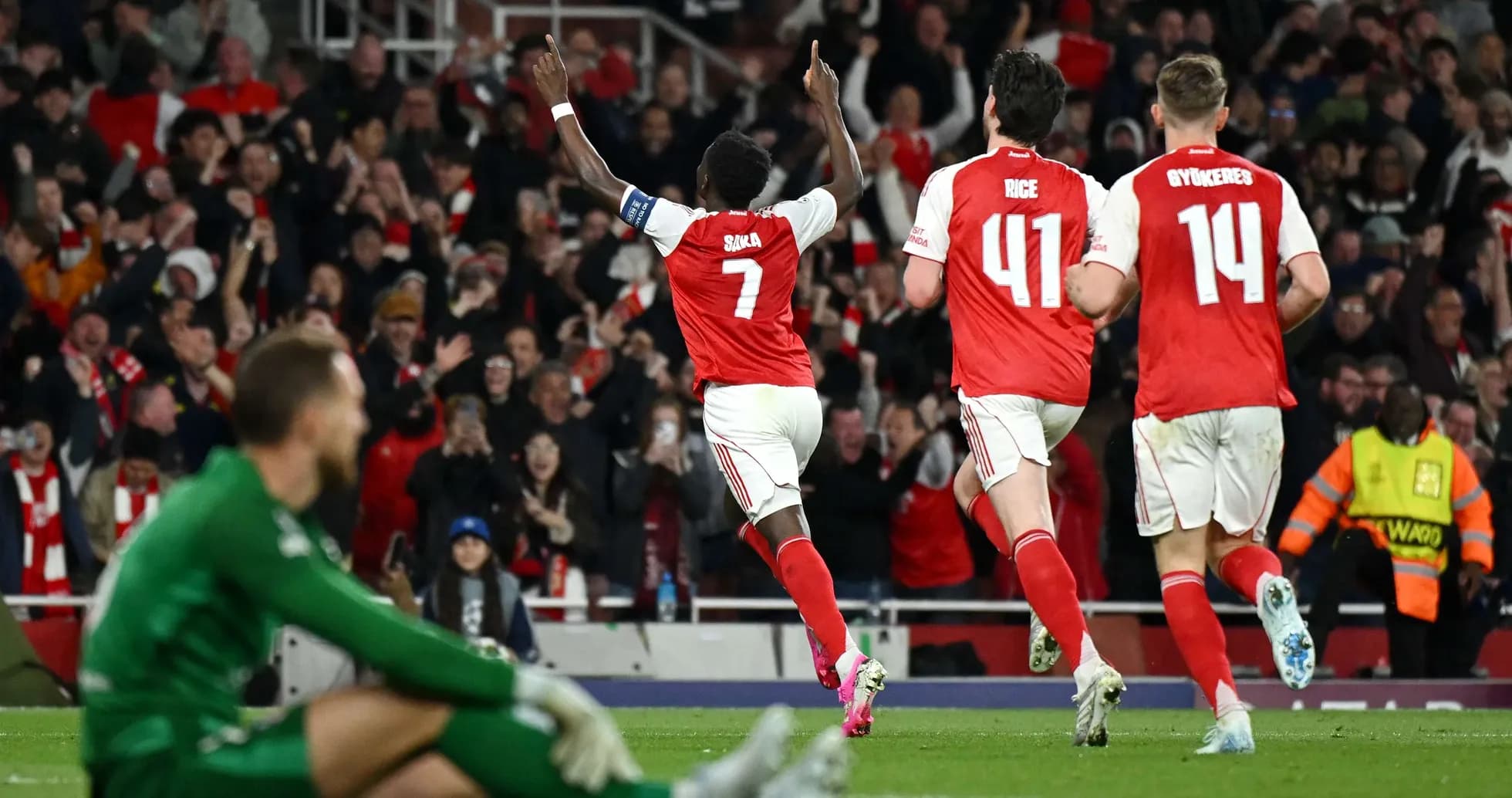
Under the lights of Emirates Stadium, a semi‑final in the UEFA Champions League was always going to be about nerve as much as nuance. Arsenal, the competition’s form side, arrived as the tournament’s benchmark: heading into this game they were unbeaten overall, with 14 matches played, 11 wins, 3 draws and 0 defeats. Their goal difference in total was a commanding +23, built from 29 goals for and just 6 against. Atletico Madrid, ranked 14th in the wider Champions League standings with 13 points and a total goal difference of +2 (17 scored, 15 conceded), came to London as the awkward outsider – dangerous, but flawed on their travels where they had 1 win, 1 draw and 2 defeats, scoring 6 and conceding 10.
The 1-0 scoreline feels entirely in keeping with Arsenal’s season‑long defensive DNA. At home in the competition, heading into this match they had 4 wins from 4, with 12 goals scored and 3 conceded; in the broader Champions League campaign their average goals against at home stood at just 0.4, mirrored by 0.4 away. This is a side that has built an unbeaten run on control, not chaos. Atletico, by contrast, arrived with a split personality: at home they averaged 2.8 goals for and 1.4 against, but away that shifted to 1.6 scored and 2.1 conceded – a far more porous version of Diego Simeone’s team.
Mikel Arteta’s choice of a 4‑2‑3‑1 was a deliberate tilt toward dominance between the lines. With D. Raya behind a back four of B. White, W. Saliba, Gabriel and R. Calafiori, Arsenal had their now-familiar blend of distribution and duel-winning. In front, the double pivot of D. Rice and M. Lewis‑Skelly offered both security and progression. B. Saka, E. Eze and L. Trossard floated behind V. Gyökeres, a front four designed to stretch Atletico’s 4‑4‑2 both horizontally and vertically.
If there was a tactical void for Arsenal, it lay in the absences. M. Merino (foot injury) and J. Timber (ankle injury) were both confirmed as Missing Fixture. Merino’s absence removed a high‑volume passer and late‑arriving threat from midfield, while Timber’s injury reduced Arteta’s flexibility to invert a full‑back or shift seamlessly into a back three in possession. The bench still carried quality – M. Odegaard, Gabriel Jesus, K. Havertz, G. Martinelli and M. Zubimendi among others – but those two injuries narrowed Arsenal’s options for in‑game structural change.
Atletico’s own injury list shaped their approach. P. Barrios and N. Gonzalez, both out with muscle injuries, stripped depth from Simeone’s midfield rotation and ball‑winning options. With a 4‑4‑2 built around J. Oblak, a back four of M. Pubill, R. Le Normand, D. Hancko and M. Ruggeri, and a midfield line of G. Simeone, M. Llorente, Koke and A. Lookman behind A. Griezmann and J. Álvarez, Atletico leaned on experience and individual quality rather than pure athletic density in the centre.
The disciplinary landscape added a second layer of tension. Arsenal’s yellow card profile this season shows a clear late‑game spike: 31.82% of their bookings arrive between 61‑75 minutes, with another 18.18% between 76‑90 and 13.64% in 91‑105. Atletico’s peak comes slightly earlier but is similarly back‑loaded: 25.93% of their yellows between 46‑60 minutes, 18.52% from 61‑75, and 14.81% in both the 76‑90 and 91‑105 windows. In a semi‑final defined by fine margins, those numbers foreshadowed a second half in which both teams would be walking a disciplinary tightrope rather than tearing into reckless tackles.
The key attacking “Hunter vs Shield” duel centred on J. Álvarez against Arsenal’s collective defensive record. Álvarez entered this tie as one of the Champions League’s standout forwards: 10 goals and 4 assists in 15 appearances, 37 shots with 22 on target, and 3 penalties scored from 3 attempts. He is not just a finisher but a creator, with 34 key passes and 454 total passes at 81% accuracy. Yet he was running into a unit that, heading into this game, conceded only 0.4 goals on average both at home and away, had kept 9 clean sheets overall, and had never lost in the competition this season.
The Arsenal shield was multi‑layered. W. Saliba and Gabriel anchor a back line that has allowed only 6 goals in 14 Champions League outings. In front of them, D. Rice’s positioning and M. Lewis‑Skelly’s energy close the central channels Álvarez likes to drift into. Behind, D. Raya’s calm distribution helps Arsenal bypass Atletico’s first line of pressure, denying Álvarez the transition moments he thrives on.
In the “Engine Room” battle, Koke and M. Llorente were charged with disrupting Arsenal’s rhythm against Rice and the advanced craft of Eze and Trossard. Simeone’s 4‑4‑2 relied on Koke’s ability to dictate tempo and switch play into the half‑spaces for A. Lookman, while Llorente’s surges were meant to pin back Calafiori and Trossard. But Arsenal’s midfield depth loomed over this contest: M. Zubimendi, one of the Champions League’s leading yellow‑card collectors with 4 bookings, offers Arteta a different profile off the bench – a metronomic passer (633 passes at 87% accuracy) who has also blocked 5 shots and made 10 interceptions. His presence in the squad, even unused, underlines the physical and tactical steel Arsenal can introduce to protect a narrow lead.
On the flanks, B. Saka against M. Ruggeri and M. Pubill was another decisive channel. Pubill, who has blocked 6 shots and made 18 tackles in the competition, is Atletico’s most card‑prone defender with 4 yellows. His duel with Trossard and the overlapping Calafiori was always likely to be attritional, and any booking risk would limit his aggression in stepping out to press.
From a statistical prognosis perspective, this semi‑final always leaned towards Arsenal control. Heading into the match, they averaged 2.1 goals for at home and conceded only 0.4, while Atletico’s away profile of 1.6 scored and 2.1 conceded suggested they would struggle to both contain and out‑gun Arteta’s side over 90 minutes. Both teams were perfect from the spot in the tournament – Arsenal with 3 penalties scored from 3, Atletico also 3 from 3 – so any penalty on the night would likely tilt heavily towards the taker.
The 1‑0 result ultimately mirrored the underlying numbers: Arsenal’s defensive solidity suffocated a prolific J. Álvarez, while their own attacking ceiling was just high enough to pierce an Atletico side that has kept only 1 clean sheet away from home in the Champions League this season. Following this result, the narrative of the tie is clear: Arsenal’s unbeaten, structurally sound machine has out‑manoeuvred Atletico’s more volatile, travel‑worn unit, and the tactical story of the semi‑final is one of control rewarded and risk punished.