.svg&w=384&q=75 "naujapitch logo")
Arsenal Defeats Atletico Madrid 1-0 in Champions League Semi-Final
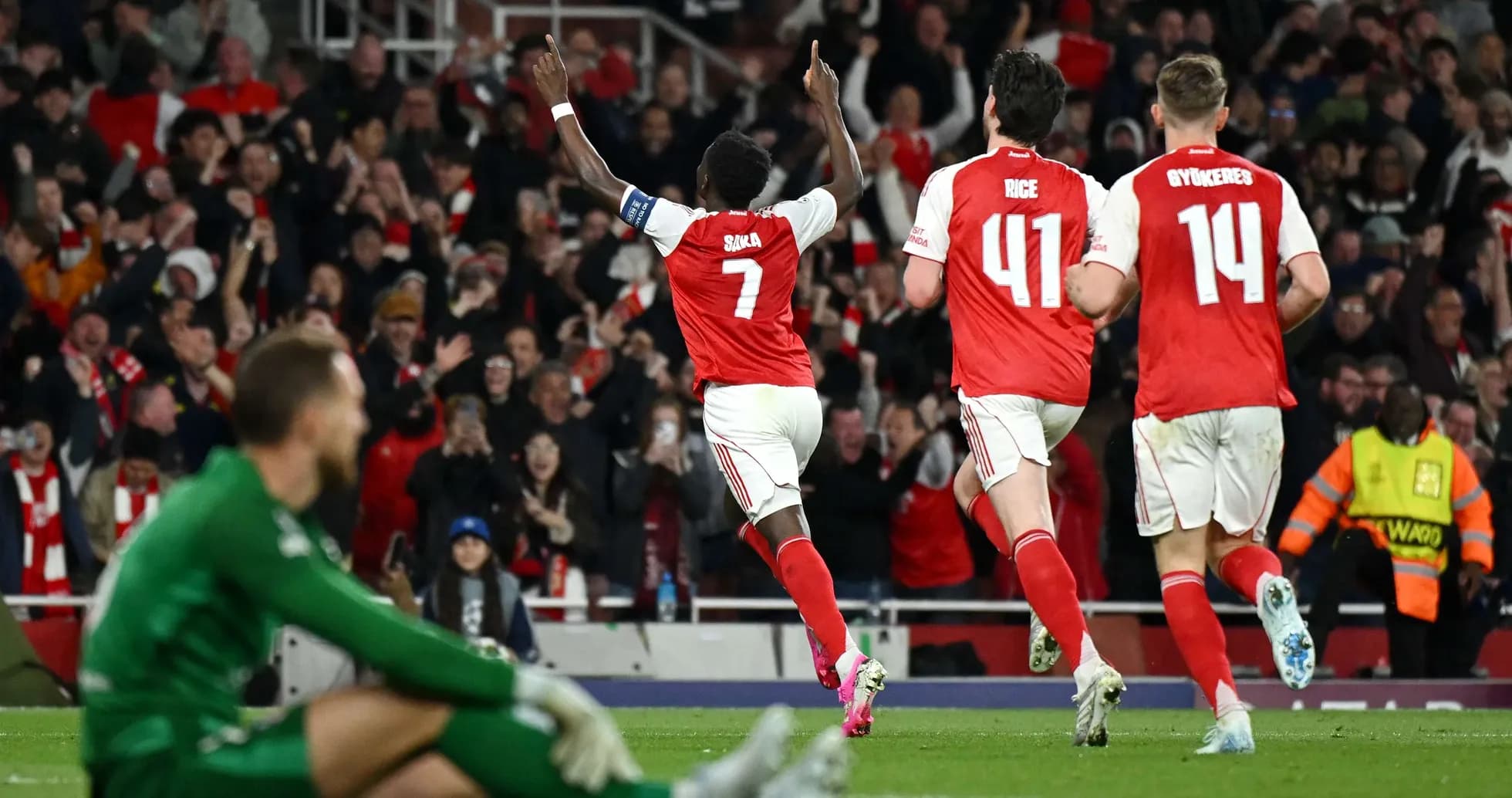
Arsenal edged a tight UEFA Champions League semi-final first leg at the Emirates Stadium, beating Atletico Madrid 1–0 in a match defined by control without excess risk. Bukayo Saka’s 44' strike separated the sides, and the pattern of the night was clear in the numbers: Arsenal’s 54% possession, 13 total shots and xG of 1.58 against Atletico’s 9 shots and 0.53 xG. Mikel Arteta’s 4-2-3-1 imposed structure and tempo, while Diego Simeone’s 4-4-2 stayed compact and reactive, threatening mainly through transitions and late attacking substitutions. Both goalkeepers made two and one saves respectively, underlining a game more about territorial and structural dominance than constant goalmouth chaos.
The only goal arrived at 44', when B. Saka finished a move that reflected Arsenal’s positional superiority. With 6 shots inside the box overall, this moment crystallised their ability to progress into advanced zones against Atletico’s first block. The halftime score was 1–0 to Arsenal, fully aligned with the shot and xG balance at the 45' mark.
The disciplinary story began unusually early and off the pitch: at -5', Kepa Arrizabalaga received a yellow card for time wasting, a technical booking against the Arsenal substitute goalkeeper before kickoff. It did not affect the on-field numerical balance but is part of the formal card count.
Second Half Changes
In the second half, Simeone moved aggressively on 57'. R. Le Normand (OUT) made way for A. Sorloth (IN), A. Lookman (OUT) for N. Molina (IN), and G. Simeone (OUT) for J. Cardoso (IN). These three simultaneous changes shifted Atletico from a more conservative 4-4-2 into a more front-loaded shape, adding a classic target presence in Sorloth and extra dynamism from Molina and Cardoso.
Arteta responded almost immediately. At 58', B. Saka (OUT) was replaced by N. Madueke (IN), a like-for-like change on the right but with fresh legs to press and carry in transition. Also at 58', R. Calafiori (OUT) came off for P. Hincapie (IN), keeping the left-sided build-up profile but adding a slightly more conservative defensive presence to protect the lead. On 59', E. Eze (OUT) was replaced by M. Odegaard (IN), trading some direct ball-carrying for more control between the lines and improved pressing triggers from the No. 10 space.
Atletico’s final major attacking reshuffle arrived on 66': A. Griezmann (OUT) was substituted by A. Baena (IN), and J. Alvarez (OUT) by T. Almada (IN). This double change recalibrated the forward line towards more mobile, technically oriented attackers, aiming to find pockets between Arsenal’s midfield and defence rather than relying on pure striker presence.
Arsenal’s last midfield adjustment came on 74', when M. Lewis-Skelly (OUT) was replaced by M. Zubimendi (IN), reinforcing the defensive midfield screen and tightening rest-defence for the closing phase.
The remaining changes were more about energy and wide protection. On 83', L. Trossard (OUT) made way for G. Martinelli (IN), providing fresh running on the left flank to stretch Atletico’s back line and offer an outlet on counters.
Atletico’s discipline frayed late. On 81', Marc Pubill received a yellow card for a foul, a reflection of Atletico’s increasing urgency and higher defensive line leaving them exposed to duels in wide areas. In added time, at 90+5', Koke was also booked for a foul, underlining the intensity of Atletico’s late press as they chased an equaliser. Across the match, Arsenal finished with 1 yellow card (Kepa Arrizabalaga, time wasting) and Atletico with 2 (Marc Pubill, Koke, both for fouls).
Tactical Analysis
Tactically, Arsenal’s 4-2-3-1 was built on a stable double pivot of D. Rice and M. Lewis-Skelly in front of a back four of B. White, W. Saliba, Gabriel and R. Calafiori. With D. Raya in goal, they prioritised secure circulation (444 total passes at 85% accuracy) and controlled progression. The full-backs, especially White on the right, could step into midfield when Arsenal had settled possession, knowing Rice was anchoring transitions.
In attack, V. Gyökeres served as the central reference, supported by Saka wide right, L. Trossard left and E. Eze as the central creator. The 6 shots inside the box indicate that Arsenal’s positional play succeeded in getting the ball into high-value central spaces, even if only 2 of their 13 shots hit the target. Their xG of 1.58 aligns with one clear goal plus several half-chances, rather than a barrage of clear one-on-ones.
Atletico’s 4-4-2, with J. Oblak in goal, M. Pubill, R. Le Normand, D. Hancko and M. Ruggeri at the back, and a midfield of G. Simeone, M. Llorente, Koke and A. Lookman behind A. Griezmann and J. Alvarez, was initially conservative. They allowed Arsenal marginally more of the ball (46% possession for Atletico) but tried to funnel play wide and compress the central lane where Koke and Llorente could engage.
Their 7 shots inside the box out of 9 total show that when Atletico did progress, they reached threatening zones, but the overall xG of 0.53 and only 2 shots on target reveal that Arsenal’s box defending—Saliba and Gabriel in particular—forced low-quality angles and rushed finishes. D. Raya’s 2 saves were routine rather than spectacular, while Oblak’s single save reflects that many of Arsenal’s efforts missed the target or were blocked (3 blocked shots each side).
The substitutions marked a tactical duel: Simeone’s shift to more attackers and creative midfielders (Sorloth, Molina, Cardoso, Baena, Almada) was met by Arteta adding control (Odegaard, Zubimendi) and defensive stability (Hincapie), plus direct outlets (Madueke, Martinelli). The match gradually tilted from Arsenal’s controlled possession to a more transitional final 20 minutes, but Arsenal’s structure held.
Statistically, Arsenal’s 13–9 shot edge and higher xG (1.58 vs 0.53) support the 1–0 scoreline as a fair reflection. Both keepers’ goals prevented are listed at 0.02, indicating that neither was required to make high-difficulty stops; the game was decided more by shot quality and defensive organisation than goalkeeping heroics. Arsenal committed 10 fouls to Atletico’s 13, with the card count 1–2, matching the slightly more aggressive defensive posture Atletico adopted as they chased the game.
Overall, Arsenal’s overall form on the night was that of a side comfortable managing a narrow lead at Champions League semi-final level: efficient in possession, structurally sound, and capable of generating the game’s best chance, which Saka converted. Defensively, their index of performance was high—limiting Atletico to low xG despite 7 box shots, protecting Raya, and seeing out a late aerial and transitional push without conceding. Atletico, by contrast, showed resilience and a capacity to adjust, but their attacking reconfiguration could not break Arsenal’s compact block, leaving them with a deficit to overturn in the second leg.