.svg&w=384&q=75 "naujapitch logo")
World Cup Night Serenade: Mexico Fans Disrupt England's Sleep
In Mexico City, the World Cup started long before kick-off.
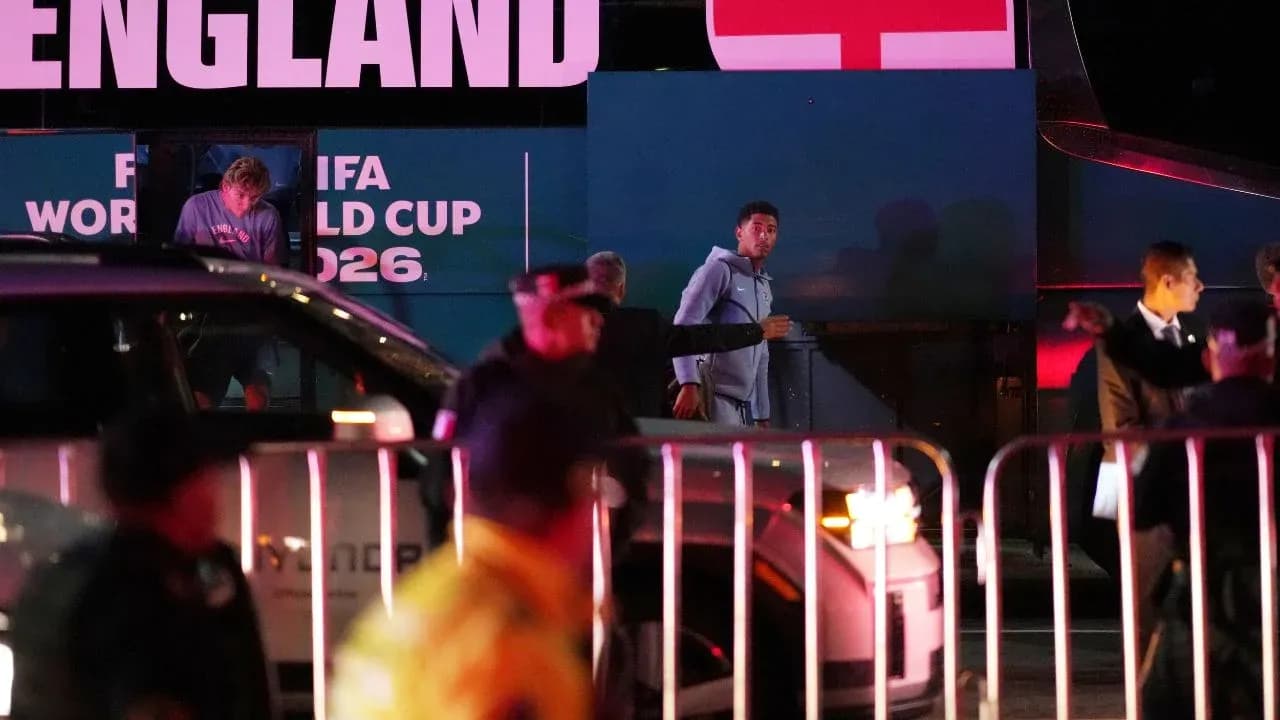
On the western edge of the capital, outside the JW Marriott in Santa Fe, the night belonged to the horns, loudspeakers and fireworks. Dozens of Mexican fans pushed up against police blockades and turned the quiet business district into a makeshift stadium, their target clear: England’s sleep.
They came in waves late on Saturday and stayed into the early hours of Sunday, refusing to let the night settle. Car horns blared in staccato bursts. Fireworks cracked above the hotel towers. Portable speakers blasted songs for “El Tri,” chants rolling up toward the rooms where England’s players tried to rest before their round-of-16 clash with co-hosts Mexico.
Police lines held the crowd at a distance, but not far enough to mute it. This was not a spontaneous party. It was calculated.
Mexico’s fans had already tested the tactic earlier in the week. Before a crucial group-stage match against Ecuador, they staged a similar late-night “serenade.” Mexico won 2–0. Ecuador’s federation responded with a formal complaint to tournament organizers, arguing the noise barrage crossed a line.
That did nothing to cool Mexican enthusiasm for the ritual.
These nocturnal ambushes have deep roots in Latin American football culture. They started as raw, unfiltered devotion — fans gathering outside team hotels to sing, to bless the night before a big game, to make sure their heroes felt the city’s heartbeat. Over time, the tone hardened. The serenade turned into siege.
Now it is a psychological weapon. Sleep becomes part of the contest.
England walked straight into that tradition. The team chose a modern, insulated hotel in a business district rather than a central, more chaotic neighborhood, but geography only did so much. Mexico City’s passion travels.
Thomas Tuchel knew it was coming. The England manager addressed it with a shrug rather than outrage.
“We have a 6 p.m. (Sunday) kickoff, so if we miss some hours of sleep, we’ll make them up in the late morning,” he said on Saturday, attempting to strip the noise of its power.
His message was clear: England would not be rattled, at least not publicly.
Whether his players managed to sleep through the horns and explosions is another matter entirely. At this stage of a World Cup, where recovery and routine are guarded with almost obsessive precision, even a couple of lost hours can gnaw at preparation. Sports science departments plan hydration schedules down to the minute; Mexico’s fans answered with fireworks at midnight.
For the home crowd, this is part of the bargain. You host, you push every legal advantage to its limit. For the visitors, it is another test layered on top of altitude, travel, and the raw weight of knockout football.
Outside the hotel, the scene captured the collision of those worlds: police cordons trying to impose order, fans leaning into a long-standing custom, and a visiting giant attempting to rest in the middle of it all.
By sunrise, the streets around the JW Marriott had emptied, the echoes of the night drifting away between office blocks and hotel facades. The damage, if any, was already done.
The real verdict will arrive under the floodlights, when England step out to face a Mexico team backed not just by a stadium, but by a city that refused to let them sleep.