.svg&w=384&q=75 "naujapitch logo")
Switzerland's Tactical Dominance Over Algeria in World Cup Round of 32
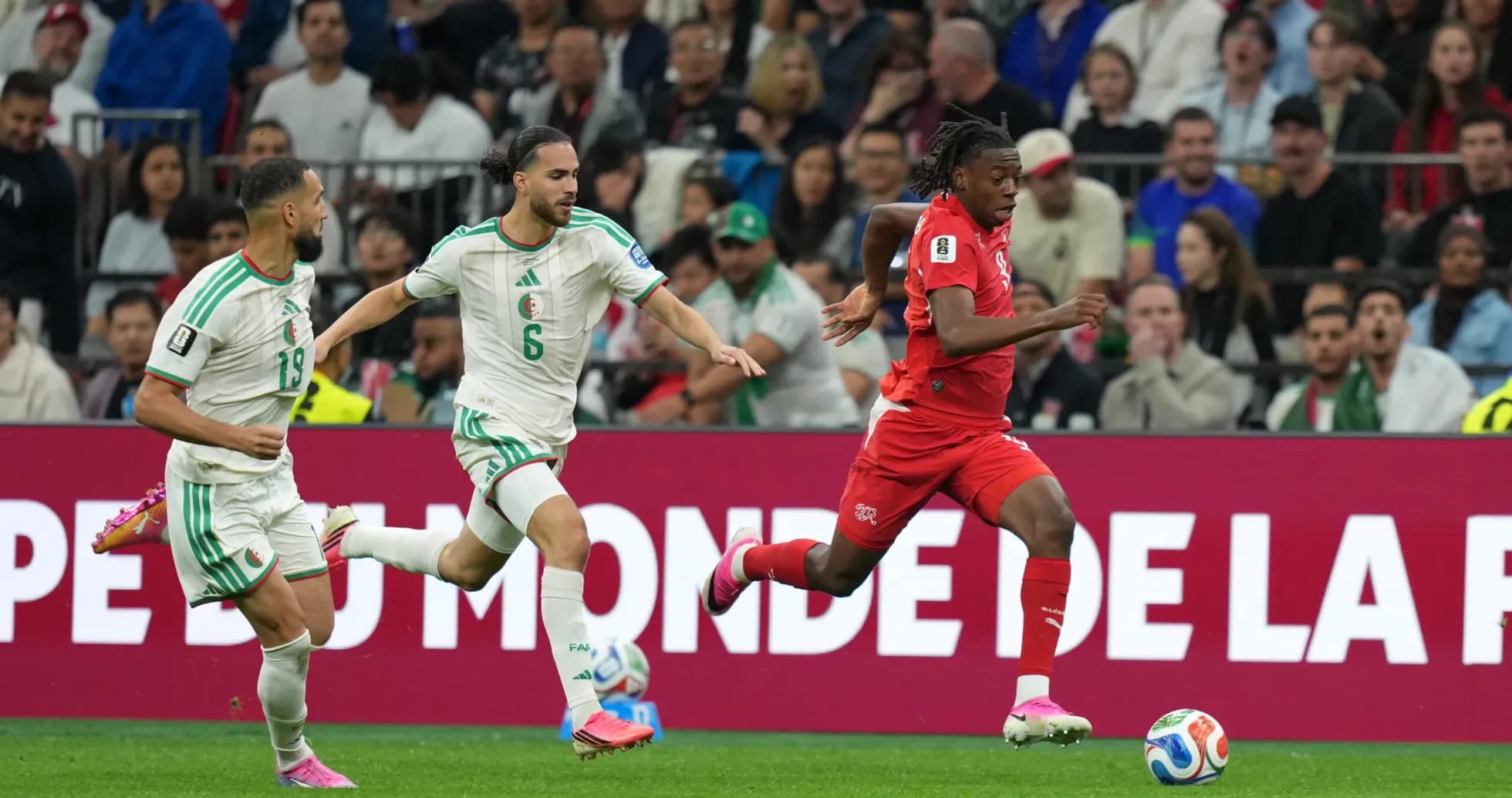
Under the roof of BC Place, Switzerland’s 2–0 win over Algeria in the Round of 32 felt less like a one-off knockout tie and more like the logical extension of two very different tournament trajectories.
Switzerland arrived as the quietly efficient machine of Group B. Heading into this game, they had taken 7 points from 3 group matches, with a total goal difference of +4 built from 7 goals scored and 3 conceded. Over the whole tournament to this point, they had played 4 fixtures in total, winning 3 and drawing 1, and crucially had not lost yet. Their attacking numbers were those of a side that knows how to construct chances: overall they had 9 goals in total, with 8 at home and 1 on their travels, at an overall scoring rate of 2.3 goals per game. Defensively, they had allowed just 3 goals overall, 2 at home and 1 away, at 0.8 conceded per game.
Algeria, by contrast, came into Vancouver as a more volatile proposition. In their group campaign they had finished 3rd in Group J with 4 points from 3 matches, their total goal difference a negative -2, the product of 5 goals scored and 7 conceded. Across 4 matches in total this World Cup, Algeria had managed just 1 win, 1 draw and 2 defeats. Their attack produced 5 goals in total, 3 at home and 2 away, at 1.3 per game overall, but the defence had been porous: 9 goals conceded overall, 3 at home and 6 away, at 2.3 per game.
This Round of 32 tie, then, was set up as a clash between a side that controls games and protects leads, and one that lives closer to the edge. The final scoreline – 2–0 to Switzerland, 1–0 by half-time – confirmed the pattern.
Tactical Setup
Tactically, Murat Yakin doubled down on Switzerland’s tournament identity with a 4-2-3-1 that looked almost like a chessboard once it settled. Gregor Kobel anchored the back, shielded by a back four of Denis Zakaria, Nico Elvedi, Manuel Akanji and Ricardo Rodriguez. In front of them, Remo Freuler and Granit Xhaka formed a double pivot designed for control more than chaos, while the line of three – Dan Ndoye on the right, Johan Manzambi centrally, Ruben Vargas on the left – floated behind Breel Embolo.
Vladimir Petkovic’s Algeria answered with a 4-3-3 that promised technical quality and width. Lukman Zidane started in goal, with a back four of Rayan Belghali, Aïssa Mandi, Ramy Bensebaini and Rayan Ait-Nouri. In midfield, Ramiz Zerrouki sat deepest, with Nabil Bentaleb and Farès Chaibi given license to connect the thirds. Ahead, Riyad Mahrez and Houssem Aouar flanked Iliès Maza in a front three that, on paper, could hurt anyone.
Yet the structural differences between the sides were stark. Switzerland’s season statistics showed a team that, at home, scores 2.7 goals per game and concedes only 0.7, with one clean sheet already in the bank and no fixture in which they had failed to score. Algeria, on their travels, averaged just 0.7 goals for and 2.0 against, with no clean sheets and two away matches where they did not score at all. The match at BC Place simply followed those lines.
Key Duels
The “Hunter vs Shield” duel was most obvious in the space between Embolo and the Algerian centre-backs. Embolo came into this tie as one of the competition’s most productive forwards, with 2 goals and 2 assists overall, plus 6 total shots and 4 on target. He thrives on occupying both centre-backs at once, and against an Algerian defence that had already shipped 6 goals away from home, his movement between Mandi and Bensebaini constantly stressed the line. Each time Algeria tried to step out, Embolo’s ability to drop off and link with Manzambi or spin into the channels made the back four hesitate.
Behind him, Manzambi was the tournament’s emerging conductor. With 3 goals and 2 assists overall from midfield, and a 7.7 average rating across 4 appearances, he arrived in Vancouver as one of the World Cup’s most effective young attacking midfielders. His 55 passes overall, with 3 key passes and 78% accuracy, show a player who not only finishes moves but stitches them together. In this match, stationed as the central “10” in the 4-2-3-1, he repeatedly found pockets between Zerrouki and the Algerian centre-backs, turning Algeria’s midfield line into a decision-making trap: step to him and leave Xhaka and Freuler free, or hold shape and let him turn.
The “Engine Room” battle, meanwhile, revolved around Xhaka and Freuler against Zerrouki and Bentaleb. Switzerland’s double pivot is built for balance. Xhaka’s left-footed distribution and Freuler’s metronomic positioning allowed Switzerland to recycle possession and keep Algeria chasing. Algeria’s midfield, which in the group stage had often been forced into transition battles by a defence that conceded 3 goals at home and 6 away, struggled to impose its rhythm. Bentaleb and Chaibi had to shuttle wide to help Ait-Nouri and Belghali against Vargas and Ndoye, which only opened more central lanes for Manzambi.
Flank Battles
On the flanks, Mahrez against Rodriguez and Ndoye against Ait-Nouri were the two key duels. Mahrez, nominally Algeria’s primary “hunter,” needed isolated 1v1s to tilt the tie. But Switzerland’s structure, with Zakaria tucking in and Ndoye working both ways, reduced those moments. At the other end, Ndoye’s willingness to run beyond Embolo forced Ait-Nouri to defend deeper than he would have liked, blunting Algeria’s left-sided build-up.
Discipline was another quiet fault line. Across the tournament, Switzerland’s yellow cards had clustered between 31 and 45 minutes (66.67% of their cautions) and 61 to 75 minutes (33.33%). Algeria’s distribution was eerily similar: 66.67% of their yellows also arrived between 31 and 45 minutes, with 33.33% between 61 and 75. This shared tendency to pick up cards around half-time and just after the hour created a predictable window of volatility. In Vancouver, Switzerland’s ability to manage those emotional spikes – helped by the experience of Xhaka and Akanji – contrasted with an Algerian side that, chasing the game, grew more stretched as those minutes ticked by.
Penalty Area Margins
In the penalty area, the margins were clear even if spot-kicks did not decide this tie. Overall, Switzerland had taken 2 penalties this World Cup and scored both, with no misses. Algeria had not yet taken a penalty in the tournament. While no shootout or spot-kick drama materialised at BC Place, the underlying numbers pointed to a Swiss side more comfortable under those high-pressure moments.
From a statistical prognosis perspective, this result was heavily foreshadowed. Switzerland’s overall attacking output of 2.3 goals per game meeting an Algerian defence conceding 2.3 per game overall was always likely to tilt in the European side’s favour. At the same time, Algeria’s overall 1.3 goals per game ran into a Swiss defence that had allowed only 0.8 per match. The 2–0 scoreline sits neatly at the intersection of those curves: Switzerland hitting close to their attacking average, Algeria held below theirs by a disciplined block and a goalkeeper in Kobel who, even without headline-grabbing numbers in this data, benefits from the structure in front of him.
Following this result, Switzerland’s unbeaten run at this World Cup extends, their clean sheet tally climbs from 1 to 2 overall, and their identity as a knockout-tournament problem for anyone is reinforced. Algeria exit with flashes of quality from Mahrez, Aouar and Chaibi, but their broader statistical story remains unchanged: a side whose attacking promise could not consistently outrun its defensive fragility.