.svg&w=384&q=75 "naujapitch logo")

Aston Villa's Tactical Masterclass Against Liverpool: A 4-2 Victory
Under the Villa Park floodlights, this felt less like a routine league fixture and more like a statement of intent from two sides jostling for the same patch of Champions League turf. Following this result, Aston Villa’s 4-2 win over Liverpool not only preserved their edge in the table – 4th with 62 points and a goal difference of 6 (54 scored, 48 conceded) – it also underlined the distinct identities Unai Emery and Arne Slot have carved out over a long, bruising Premier League season.
Liverpool remain 5th on 59 points with a goal difference of 10 (62 scored, 52 conceded), but the gap in styles was sharper than the three-point difference suggests. Heading into this game, Villa had been a ruthless home outfit: 12 wins from 19 at Villa Park, with 32 goals for and 22 against, an average of 1.7 goals for and 1.2 against at home. Liverpool, by contrast, came in as a volatile travelling side – 7 away wins but 9 defeats from 19, scoring 29 and conceding 33, an away profile of 1.5 goals for and 1.7 against. This was always likely to be open; Villa simply managed the chaos better.
Both coaches mirrored each other on the whiteboard, deploying 4-2-3-1s that said as much about their injury lists as their philosophies. Emery’s double pivot was improvised: with B. Kamara sidelined by a knee injury and A. Onana also missing, V. Lindelof stepped up as a makeshift holding midfielder alongside Y. Tielemans. That shift allowed J. McGinn, M. Rogers and E. Buendia to form an aggressive, narrow band of three behind O. Watkins, compressing the central lanes and inviting the full-backs, M. Cash and L. Digne, to provide width.
Slot’s own selection was shaped by absences. Alisson’s muscle injury handed the gloves to G. Mamardashvili, while the spine of Liverpool’s depth chart – S. Bajcetic, C. Bradley, W. Endo, H. Ekitike and G. Leoni – remained unavailable. The result was a high-skill but slightly unbalanced midfield of R. Gravenberch and A. Mac Allister at the base, with C. Jones and D. Szoboszlai as dual eights in all but name, R. Ngumoha drifting in from the left and C. Gakpo leading the line.
The tactical voids were most obvious in the defensive phases. Villa’s season-long yellow-card profile – a pronounced spike between 46-60 minutes, where 29.31% of their bookings arrive – reflects a side that often has to recalibrate aggression after half-time. Liverpool, meanwhile, save their indiscipline for the closing stretch: 30.91% of their yellows come in the 76-90 minute window, a late-game surge that hints at fatigue and tactical stretching under pressure. Here, as Villa accelerated in the second half, Liverpool’s back line began to fray, with I. Konate and V. van Dijk repeatedly exposed by transitions triggered by Rogers and McGinn.
O. Watkins’ Stage
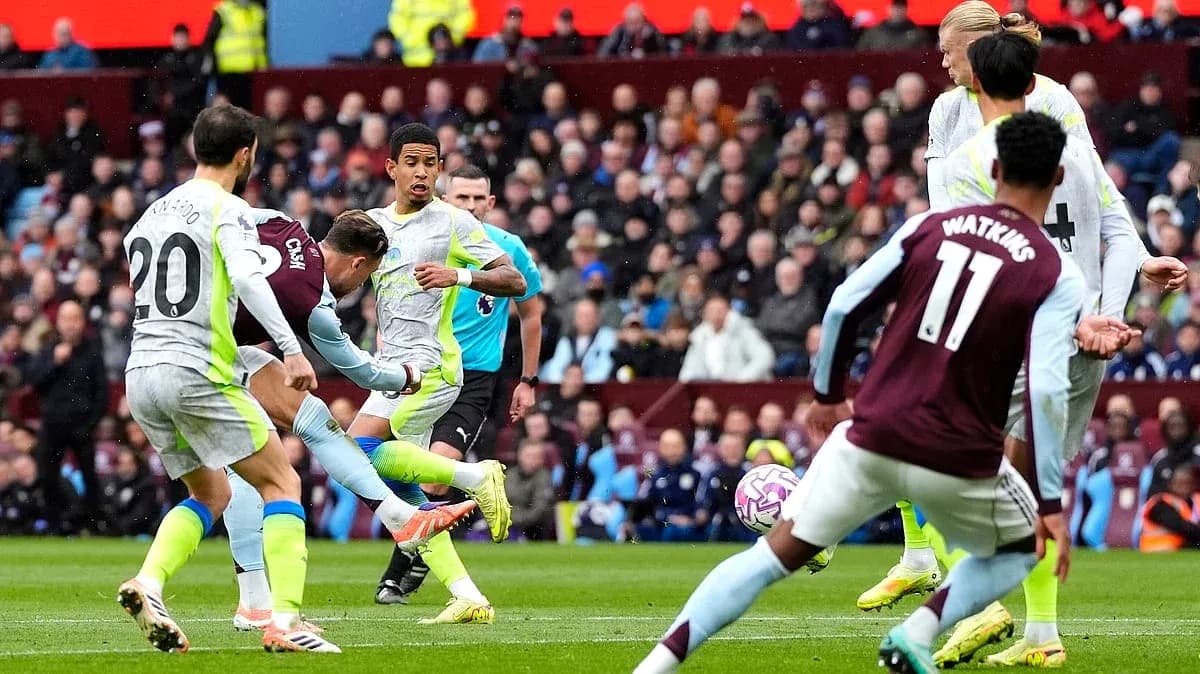
In attack, this was always going to be O. Watkins’ stage. Heading into this game, Watkins had 14 league goals and 3 assists in total, built on 57 shots (36 on target). His movement between the lines, drifting off the shoulder of van Dijk into the half-spaces, dovetailed with Rogers’ relentless vertical running. Rogers himself has been Villa’s all-season metronome: 37 appearances, 37 starts, 10 goals and 6 assists, plus 47 key passes and 118 dribble attempts. Together, they formed the “Hunter” axis in Emery’s plan – one attacking the box, the other attacking the spaces that Liverpool’s adventurous full-backs left behind.
Liverpool’s “Shield” against that threat was supposed to be their collective structure, but Slot’s double pivot was more progressive than protective. Gravenberch and Mac Allister are both ball-players first, screeners second, and once Villa’s press forced the ball wide, the distances between Liverpool’s lines grew. Mac Allister’s passing range – part of a side that averages 1.7 goals for and 1.4 against overall – is designed to launch quick counters; instead, it often left the centre-backs defending large swathes of grass against Watkins’ and Rogers’ direct runs.
On the other side of the ball, Liverpool’s creative engine room ran through Szoboszlai. His season numbers tell the story: 6 goals, 7 assists, 74 key passes and 2,125 total passes at 87% accuracy, plus 52 tackles and 8 successful blocks. He is both playmaker and first presser, and his presence between the lines forced Lindelof and Tielemans into constant adjustment. Yet Szoboszlai also carries Liverpool’s disciplinary edge – 8 yellows and 1 red, plus a missed penalty this season – emblematic of a side that lives on the edge in high-intensity zones.
Out wide, the duel between Digne and Ngumoha was quietly decisive. Digne’s season – 6 assists, 26 key passes and 36 tackles – has been built on timing his overlaps and then recovering into the back four. Against a young, drifting winger like Ngumoha, his experience allowed Villa to push their left side higher without completely losing defensive balance. On the opposite flank, Cash’s profile is more aggressive still: 3 goals, 3 assists, 66 tackles and 13 successful blocks underline a defender who relishes front-foot duels. His willingness to step into midfield compressed the space for Jones and Szoboszlai to turn.
The bench options only added layers. Emery could call on the incision of L. Bailey and the penalty-box presence of T. Abraham, plus the control of Douglas Luiz and the dribbling of J. Sancho. Slot’s counter was pure firepower: M. Salah, F. Chiesa and W. Wright, with F. Wirtz as an additional creative conduit. Salah’s season output – 7 goals and 6 assists in total – remains elite, and his introduction tilted Liverpool’s shape towards a more direct 4-2-4 at times, stretching Villa’s back line but also leaving even more space for counter-attacks.
From a statistical prognosis, the pattern of the season always pointed to goals. Heading into this game, Villa’s overall profile of 1.5 goals for and 1.3 against, combined with Liverpool’s 1.7 for and 1.4 against, suggested a high-xG encounter rather than a cagey one. Villa’s nine clean sheets and Liverpool’s ten indicated both sides can lock games down, but Liverpool’s 33 away goals conceded betrayed a structural fragility on their travels.
Following this result, the numbers and the narrative converge: Villa look like a side whose 4-2-3-1 has matured into a coherent, high-ceiling system, even when patched together by necessity in midfield. Liverpool remain explosive, but their away defensive profile and late-game disciplinary spikes continue to undercut their attacking brilliance. In a race for Champions League positions defined by fine margins, Villa’s balance – and their ability to lean on the Hunter duo of Watkins and Rogers without losing their Shield – may yet prove decisive.