.svg&w=384&q=75 "naujapitch logo")
Arsenal Dominates Burnley with Tactical Mastery in 1-0 Win
Arsenal’s 1-0 win over Burnley at Emirates Stadium was a controlled, possession-heavy performance built on Mikel Arteta’s 4-3-3 structure and an aggressive high line, against Mike Jackson’s compact 4-2-3-1 that rarely translated into threat.
In possession, Arsenal’s back four of Riccardo Calafiori, Gabriel, William Saliba and C. Mosquera operated almost as a three-plus-one base. With Burnley’s lone striker Zian Flemming unable to press across the width, Gabriel and Saliba could circulate under minimal pressure, allowing Declan Rice to step into advanced zones rather than sit as a permanent pivot. Arsenal’s 61% ball possession and 510 passes (440 accurate, 86%) underline how often they were able to establish settled structures in Burnley’s half.
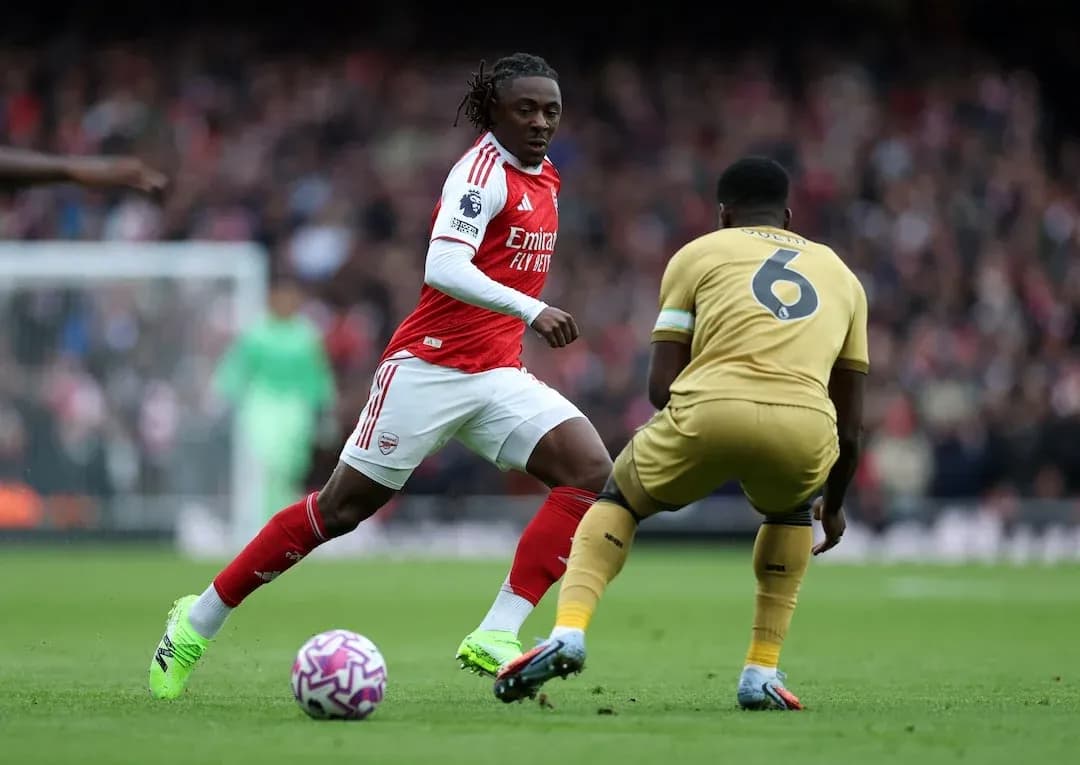
The key to progression was the interior triangle of Rice, Martin Odegaard and Eberechi Eze. Odegaard, starting as the right-sided No. 8, frequently drifted into the right half-space, combining with Bukayo Saka and Kai Havertz. Eze mirrored that on the left, dovetailing with Leandro Trossard and Calafiori. This staggering of three central midfielders against Burnley’s double pivot of Florentino and L. Ugochukwu regularly created a 3v2 inside. As soon as one of Burnley’s wide midfielders (L. Tchaouna or H. Mejbri) jumped inside to help, Arsenal could immediately find the free full-back and attack the flanks.
The numbers reflect this territorial dominance: 13 total shots, 9 from inside the box, and an xG of 1.03. The decisive moment came in the 37th minute, when K. Havertz scored for Arsenal, assisted by B. Saka. The pattern behind the goal fits the broader tactical theme: right-side overloads, Saka receiving with time due to Arsenal’s superior passing structure, and Havertz attacking central spaces between centre-backs. Burnley, pinned deep, struggled to compress the box quickly enough once the ball entered the final third.
Out of possession, Arsenal defended with an aggressive rest defence. The front three led a high press, with Havertz screening passes into Florentino and Ugochukwu, while Saka and Trossard locked onto Burnley’s full-backs. Behind them, Rice often stepped into the first line to create a 4-2-3-1 pressing shape, with Odegaard as a situational No. 10. The effect was to funnel Burnley into either long balls toward Flemming or low-percentage switches. Burnley finished with just 5 total shots, 2 inside the box, and crucially 0 shots on goal, which explains why David Raya recorded 0 goalkeeper saves. Arsenal’s defensive line, led by Saliba and Gabriel, was consistently proactive in stepping in front of Flemming and contesting first balls, while Calafiori and Mosquera squeezed play to keep Burnley far from goal.
Burnley’s attacking plan was necessarily more direct and transitional. With only 39% possession and 325 passes (254 accurate, 78%), they focused on quick outlets through H. Mejbri and J. Anthony once possession was won. However, Arsenal’s counter-press, especially from Rice and the nearest full-back, repeatedly smothered these attempts. The visitors’ xG of 0.21 is a clear indicator that, even when they reached the final third, they were pushed into low-quality shooting positions outside the box (3 of their 5 shots came from distance).
Discipline also reveals tactical stress points. Burnley committed 16 fouls to Arsenal’s 7, a byproduct of late challenges in midfield and emergency defending against overloads. The first yellow card at 28' went to Hannibal Mejbri (Burnley) — Time wasting, an early sign that Burnley were already leaning into game management rather than chasing the ball aggressively. As Arsenal continued to dominate territory after the break, desperation crept into Burnley’s challenges: at 90+1' Zian Flemming (Burnley) — Foul, and at 90+4' Lucas Pires (Burnley) — Foul, both bookings arriving as Arsenal looked to close out the game in Burnley’s half. Arsenal’s only caution, at 67', was Kai Havertz (Arsenal) — Foul, reflecting an isolated defensive action rather than a systemic issue.
The substitution patterns reinforced the tactical story. For Burnley, the changes were largely like-for-like, aimed at refreshing energy rather than altering structure: at 70' Z. Amdouni (IN) came on for H. Mejbri (OUT), at 71' J. Laurent (IN) came on for L. Ugochukwu (OUT), at 78' J. Ward-Prowse (IN) came on for Florentino (OUT), and at 82' J. Bruun Larsen (IN) came on for L. Tchaouna (OUT) while B. Humphreys (IN) came on for M. Esteve (OUT). The late introduction of Ward-Prowse hinted at a desire for better delivery and set-piece quality, but Burnley’s 3 corner kicks did not translate into shots on target.
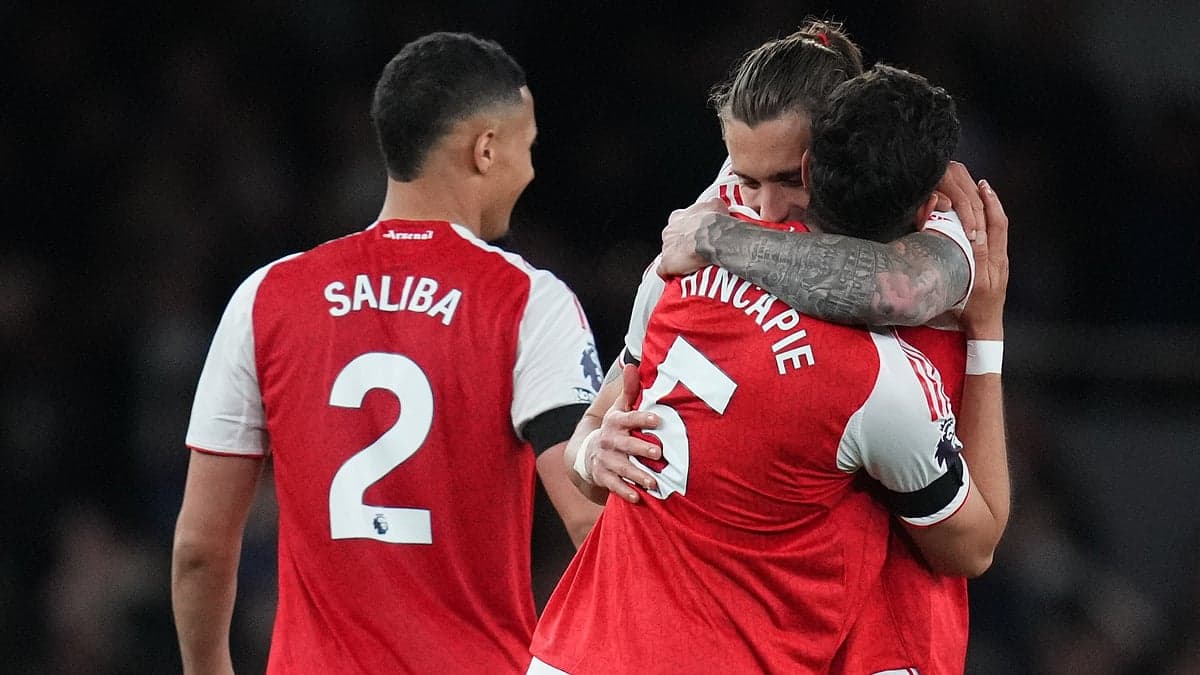
Arteta’s substitutions were more about game-state management and defensive stability. At 72' P. Hincapie (IN) came on for R. Calafiori (OUT), adding fresh legs and defensive aggression on the left. At 73' V. Gyökeres (IN) came on for K. Havertz (OUT), giving Arsenal a more direct outlet to run channels and relieve pressure, while at the same minute M. Lewis-Skelly (IN) came on for E. Eze (OUT), adding energy and defensive coverage in midfield. In added time, with the 1-0 lead intact, Arteta doubled down on control: at 90+3' G. Martinelli (IN) came on for L. Trossard (OUT) to offer pace on the break, and M. Zubimendi (IN) came on for M. Odegaard (OUT) to reinforce central stability and ball retention.
Statistically, Arsenal’s performance aligns closely with the scoreline. An xG of 1.03 against Burnley’s 0.21 and a shots-on-goal count of 3-0 suggest a match where the hosts created just enough to win while completely denying their opponents clear chances. Both goalkeepers posted 0.85 goals prevented, indicating that the main defensive work was done by the structures in front of them rather than spectacular saves. Arsenal’s Overall Form in this fixture was that of a mature, possession-dominant side capable of closing out narrow leads without conceding high-quality chances, while Burnley’s Defensive Index was respectable in terms of limiting Arsenal to one goal, but their inability to transition that defensive work into meaningful attacking threat ultimately defined the match.