.svg&w=384&q=75 "naujapitch logo")
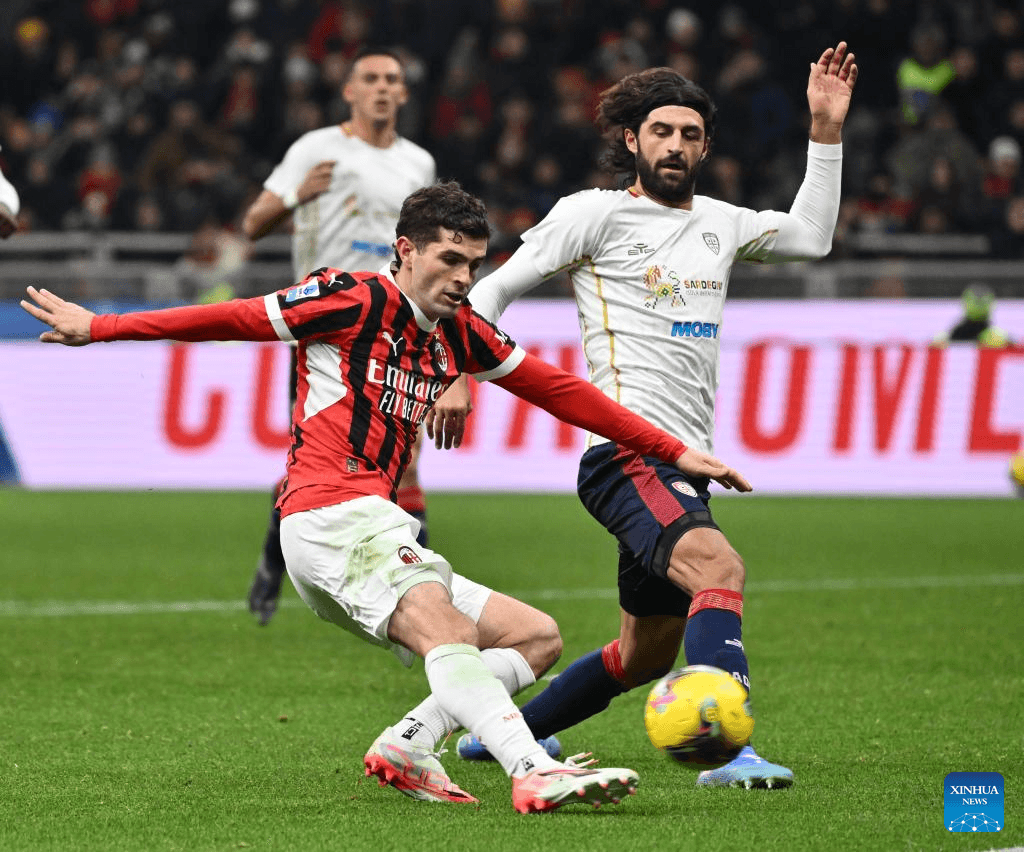
AC Milan vs Cagliari: Serie A Final Round Preview
AC Milan host Cagliari at Stadio Giuseppe Meazza in the final round of Serie A 2025, a match with asymmetric stakes: Milan are consolidating a strong top‑three position and Champions League qualification push, while Cagliari, sitting in the lower half, need points to definitively close out any lingering relegation risk.
Head-to-Head Tactical Summary
The most recent meeting on 2 January 2026 at Unipol Domus ended Cagliari 0–1 AC Milan in Serie A (Regular Season - 18), with a 0–0 score at half-time and Milan edging it late. On 11 January 2025 at Stadio Giuseppe Meazza in Serie A (Regular Season - 20), AC Milan drew 1–1 with Cagliari, again 0–0 at half-time before both sides scored after the interval. On 9 November 2024 at Unipol Domus in Serie A (Regular Season - 12), Cagliari and AC Milan played out a 3–3 draw, with Milan leading 2–1 at half-time in a high‑variance attacking contest. On 11 May 2024 at Stadio Giuseppe Meazza in Serie A (Regular Season - 36), AC Milan beat Cagliari 5–1, having already been 1–0 up at half-time, underlining a clear gap when Milan’s attack clicks at home. In cup play, on 2 January 2024 in the Coppa Italia 1/8 final at Stadio Giuseppe Meazza, AC Milan defeated Cagliari 4–1, leading 2–0 at half-time, confirming a pattern of Milan dominance in Milan and more balanced, open games in Cagliari.
Global Season Picture
- League Phase Performance:
AC Milan: In the league phase they are 3rd with 70 points from 37 matches, scoring 52 goals and conceding 33 (goal difference +19). At home they have 9 wins, 5 draws, 4 losses, with 24 goals for and 19 against.
Cagliari: In the league phase they are 16th with 40 points from 37 matches, scoring 38 goals and conceding 52 (goal difference −14). Away from home they have 3 wins, 6 draws, 9 losses, with 16 goals for and 29 against. - Season Metrics:
Scope detection shows team statistics and standings both at 37 games, so these figures are also in the league phase.
AC Milan: They average 1.4 goals scored and 0.9 conceded per match (52 for, 33 against in 37), reflecting a controlled, efficient profile. Discipline-wise, they accumulate yellow cards steadily across the match, with a spike from minutes 61–90 (12 + 16 yellows, 45.16% of their total), and have 3 red cards spread across the 16–30, 46–60, and 91–105 minute ranges, indicating some late‑game and transitional risk. Their clean sheet count (15) and only 7 matches without scoring underline a consistent baseline on both sides of the ball.
Cagliari: They average 1.0 goals scored and 1.4 conceded per match (38 for, 52 against in 37), pointing to a vulnerable defense relative to their attack (1.4 goals conceded per game). They have 8 clean sheets but fail to score in 14 matches, showing a low‑margin attacking structure. Their yellow cards cluster heavily between minutes 46–90 (19 + 12 + 22 yellows, 67.09% of their total), and both red cards arrive in the 76–90 range, highlighting late‑game disciplinary fragility that can be punished by a team like Milan that sustains pressure. - Form Trajectory:
AC Milan: In the league phase their recent form string “WLLDW” shows a mixed run: two straight losses followed by a win, a draw, and another win. This suggests resilience after a dip, but also that they are not at flawless closing‑stretch momentum.
Cagliari: Their league form “WLDWL” is volatile: alternating wins and defeats with a draw in between. They are capable of picking up results but lack sustained positive streaks, consistent with a side hovering near the lower mid‑table and trying to stay clear of the bottom.
Tactical Efficiency
With no explicit Attack/Defense Index values provided in the comparison block, the efficiency picture must be inferred from the league-phase statistics. AC Milan’s goal profile (1.4 scored vs 0.9 conceded per match) combined with 15 clean sheets and only 7 matches without scoring indicates a balanced, high‑efficiency side: they convert possession and territory into enough goals while maintaining a compact structure that rarely allows more than one goal. Their biggest wins (3–0 home, 0–3 away) and the 5–1 home win over Cagliari in May 2024 underline their ceiling when they dominate field position.
Cagliari’s metrics (1.0 scored vs 1.4 conceded per match) reveal a negative efficiency gap: the attack does not generate enough output to compensate for a defense that concedes regularly, especially away (1.6 goals conceded per away match, 29 in 18). Their inability to score in 14 league matches, alongside only 8 clean sheets, shows that they often need to overperform in both boxes simultaneously to get results. In the context of this matchup, Milan’s consistent scoring and defensive baseline give them a structural advantage in any modeled Attack/Defense Index comparison, while Cagliari’s reliance on sporadic bursts (e.g., the 3–3 in November 2024) makes them more dependent on game‑state swings and Milan errors than on repeatable patterns.
The Verdict: Seasonal Impact
For AC Milan, a positive result here would likely lock in or strongly reinforce a top‑three finish and secure Champions League qualification from a position of strength, validating a league phase where they have combined a solid defense (33 goals against) with enough attacking output (52 goals for) to stay in the upper tier. Dropped points, especially at home against a bottom‑half opponent, would not only risk marginal slippage in final ranking but also raise questions about their ability to consistently convert dominance into wins against lower‑table sides, a key factor in future title ambitions.
For Cagliari, any point gained at Stadio Giuseppe Meazza would be disproportionately valuable. Given their 16th place, 40‑point position and −14 goal difference in the league phase, even a draw would push them closer to safety thresholds and provide psychological leverage heading into the next year as a side capable of competing away at elite venues. A defeat, especially a heavy one, would fit the season‑long pattern of defensive vulnerability and poor away metrics, leaving them safe only if other results go their way and underlining the need for structural defensive upgrades and more reliable attacking production to avoid another relegation‑threatened campaign in 2026.