.svg&w=384&q=75 "naujapitch logo")
Iran's World Cup Journey: A Struggle Beyond Football
On Monday night at SoFi Stadium, Iran will walk out to start a World Cup campaign unlike almost any other – a football team carrying the weight of a war, a fractured diaspora and a global spotlight that refuses to look away.
Until this week, the host nation, the United States, had been at war with Iran. An agreement to halt hostilities and reopen the Strait of Hormuz was only announced on Sunday. It has calmed fears of immediate escalation, but not the mood. The tension hangs over this World Cup like coastal haze over Los Angeles.
The players have felt it from the moment they set foot on American soil. Or, more accurately, from the moment they realised they might not.
A team in transit, a camp in limbo
Iran’s route to this tournament has been a logistical and psychological obstacle course. Visa problems dogged the squad. Security concerns multiplied. Months of uncertainty ended with a late decision to move their base camp from Tucson, Arizona, to Tijuana, just over the Mexican border.
It was hardly a seamless World Cup build-up.
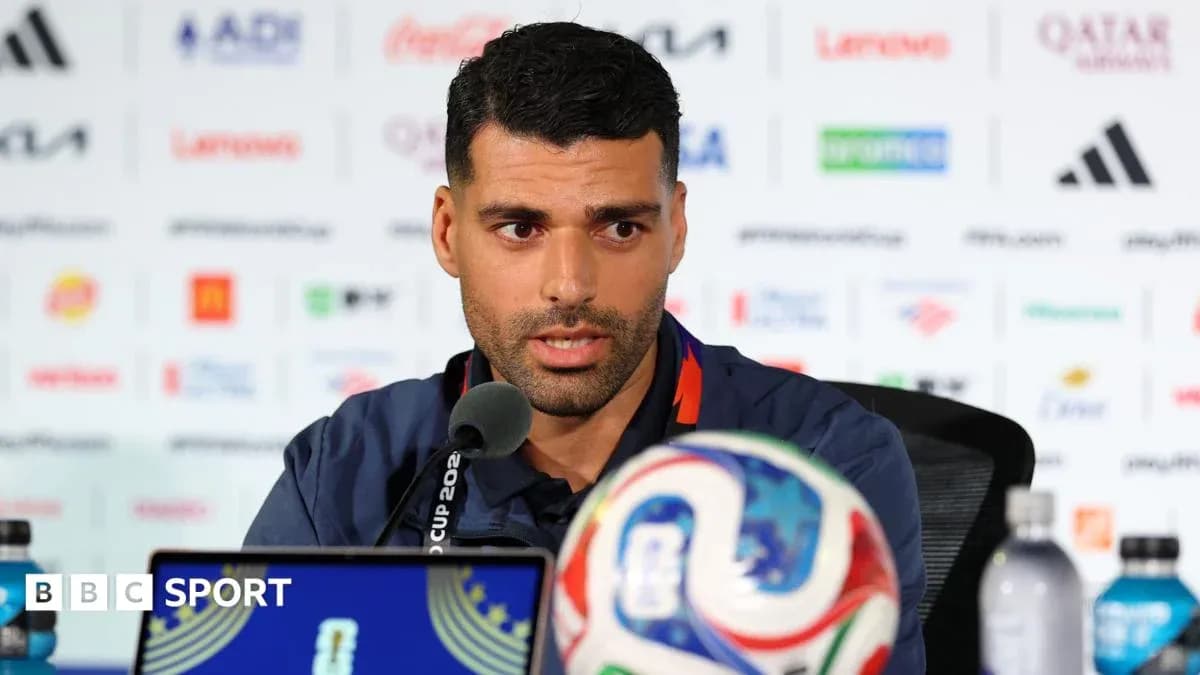
Manager Amir Ghalenoei did not try to dress it up when he spoke to the BBC. The disruption, he said, has inevitably seeped into his team’s preparations and into the very spirit of the competition.
“Without any doubt, this kind of behaviour has impacted the spirit of football,” he said. “Football is supposed to bring nations and cultures together. It is about bringing joy. These conditions have affected our focus, but I have tried to make sure the players concentrate on strategy and performance.”
They arrived late. They have had little time to adjust. Training plans had to be rewritten, routines rebuilt on the fly. Yet Ghalenoei leans on one constant: “I know how committed these players are to performing.”
Striker Mehdi Taremi has felt the strain too.
“This kind of tension undermines the joy of the World Cup,” he said. “I felt the tension from the first moment we arrived. The tension started even before we got here.”
For Iran, the World Cup has begun long before the first whistle. And almost none of it has involved a ball.
Tehrangeles, torn
Now comes Los Angeles, a city that has been called “Tehrangeles” for decades – a nickname that drew brief smiles from both player and manager in the pre-match news conference. The joke masks a harder reality.
This is the largest Iranian community outside Iran. On Monday, many Iranian-Americans will head to SoFi Stadium as Iran open their World Cup against New Zealand. Some will sing. Many will shout. Not all will be there to support the team.
On the streets and outside the ground, the battle will not be over tactics or selection but over symbols and identity.
Fifa’s decision to ban the pre-revolutionary Lion and Sun flag – a powerful emblem for many Iranians in exile – has enraged parts of the diaspora. For them, that flag is not nostalgia; it is defiance.
“You don’t come to Los Angeles and tell us we can’t fly the Lion and Sun flag,” said activist Arezo Rashidian, who is helping organise demonstrations outside the stadium. “This is the largest Iranian community outside Iran. Many of us came here after the revolution. We’re opposing Fifa’s ban and standing in solidarity with the people of Iran.”
The anger is not aimed only at Fifa. Many in the diaspora are fiercely hostile to Iran’s regime and see the national team, fairly or not, as an extension of the Islamic Republic.
“It’s unfortunate that the regime turns athletes into mouthpieces,” Rashidian said. “We want athletes to remain athletes.”
Yet even in that criticism there is a reluctant tenderness. Rashidian and many like her still plan to attend the match.
“We understand the pressure they’re under,” she said. “We’ll carry our colours. We’ll cheer for Iran – the country – held captive by the Islamic Republic.”
So the stands will be a contradiction: protest banners and national-team shirts, political chants and football songs, all swirling in the same California air.
Playing for everyone, belonging to no one
Inside the dressing room, the players insist their focus remains on football, on New Zealand, on tactics and shape rather than slogans and flags.
“As players of the national team, we play for every single Iranian, whether in the diaspora or in Iran,” Taremi said. “In every country people have different opinions. We are here to unite people and bring joy. Everyone is entitled to their opinion. We don’t get involved in politics.”
That is the ideal. It is also, in this context, almost impossible to uphold.
Iran’s squad sit at the uncomfortable intersection of state, sport and exile. Every gesture will be scrutinised. Every silence will be interpreted. A celebration, a refusal to celebrate, a glance at a camera – everything risks becoming a statement.
“There is no winning for Iran’s team,” said investigative football journalist Samindra Kunti. “Given the circumstances, the political pressure, the location of the matches and the diaspora in Los Angeles, they’re under enormous pressure. It’s impossible to avoid the politics. Everything becomes a reminder of their situation.”
Pressure from home. Pressure from the host nation. Pressure from a diaspora determined to make its voice heard.
All of it descends before a ball has been kicked.
On Monday, when Iran finally emerge into the floodlights at SoFi Stadium, the noise will be deafening and divided. For Ghalenoei’s players, the challenge is brutally simple and incredibly complex: can they carve out 90 minutes of football in a world that refuses to let this be just a game?