.svg&w=384&q=75 "naujapitch logo")
Tottenham's Tactical Mastery Secures 1-0 Victory Against Everton
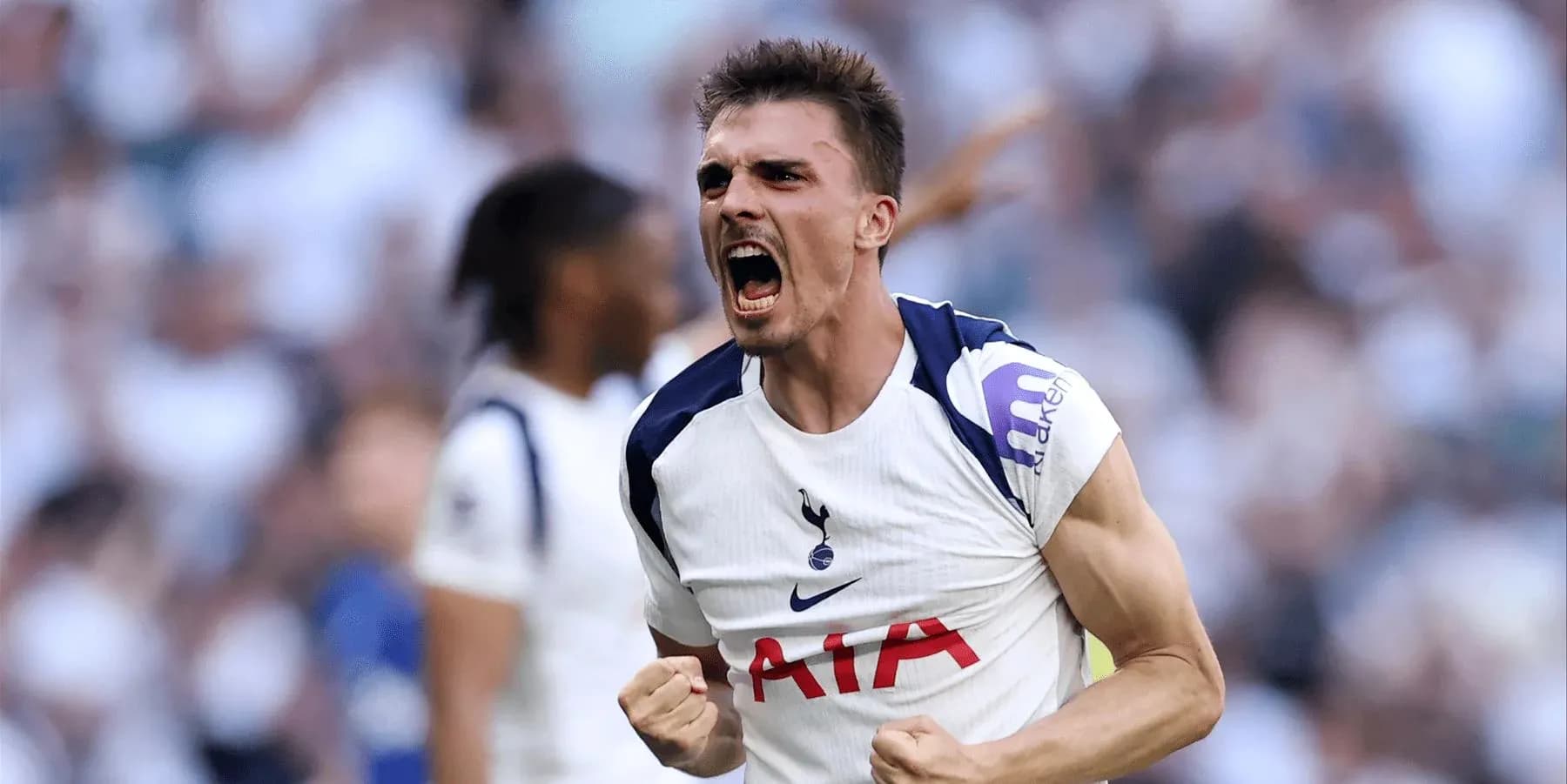
Tottenham’s 1-0 win over Everton at Tottenham Hotspur Stadium was a controlled, systems-first performance from Roberto De Zerbi’s side. In a match where both teams finished with exactly 50% possession and near-identical passing volumes (Tottenham 373 passes, Everton 377), the difference came from structure in midfield and volume of final-third occupation rather than raw dominance of the ball. The hosts generated 20 total shots to Everton’s 9 and leaned on a compact 4-2-3-1 press to lock the game around the visitors’ box, protecting a 43rd-minute strike from João Palhinha that decided this Round 38 Premier League fixture.
Decisive Moment
The decisive moment arrived late in the first half, consistent with Tottenham’s territorial control. Lining up in a 4-2-3-1, De Zerbi used João Palhinha and Rodrigo Bentancur as a double pivot to pin Everton’s own 4-2-3-1 deep. Tottenham’s 15 shots inside the box (out of 20 total) underline how often they managed to collapse the play into the penalty area, with Richarlison as the central reference and the line of Djed Spence, Conor Gallagher and Mathys Tel working between the lines. The goal itself, scored by J. Palhinha at 43', was the logical culmination of sustained pressure: second balls won in central zones, quick recycling from the pivot, and a late arrival into a pocket that Everton’s double pivot of James Garner and Tim Iroegbunam struggled to track.
Defensive Structure
Defensively, Tottenham’s structure was built on an aggressive back four and a high-rest defense. Pedro Porro and Destiny Udogie pushed high to lock Everton’s wingers and full-backs, while Kevin Danso and Micky van de Ven held a relatively advanced line. The risk-reward balance is visible in the numbers: 15 fouls committed, but only 1 shot on goal allowed. When Everton did break, they were usually forced wide or into low-percentage efforts from the edge of the area, reflected in their total of just 9 shots, only 7 of which came inside the box and only one truly testing the goalkeeper.
In goal, A. Kinsky (Tottenham) was largely protected by the block in front of him, officially required to make just 1 save. The low shot-on-target count from Everton (1) indicates that the defensive line succeeded in turning promising transitions into blocked or off-target attempts before they reached the six-yard area. On the other side, Jordan Pickford (Everton) also registered 1 save, but the context was different: Tottenham’s 20 shots and 9 blocked efforts show that much of the danger was smothered by Everton’s back line before it reached him. Both goalkeepers finished with negative goals prevented values (-0.32 for each team), suggesting that the only goal conceded was roughly in line with its underlying probability, and that neither keeper significantly outperformed or underperformed expectation.
Everton's Tactics
Everton’s 4-2-3-1 under Leighton Baines was more conservative and reactive. With Jake O’Brien and James Tarkowski at centre-back and Vitaliy Mykolenko on the left, the visitors tried to keep a compact block and spring transitions through Iliman Ndiaye and Kiernan Dewsbury-Hall behind centre-forward Tom Barry. However, with only 9 total shots and 0.34 xG, Everton struggled to turn their 50% share of possession into real penetration. Their 7 corners did offer a potential route back into the game, but Tottenham’s aerial structure with Danso, van de Ven and Palhinha dealt effectively with set-piece deliveries.
Substitutions
The substitutions underline the tactical intentions on both sides. At 62', Everton made a double change: T. George (IN) came on for M. Rohl (OUT), and H. Armstrong (IN) came on for J. O'Brien (OUT), moves aimed at injecting more energy and progression from midfield and the right side. Later, at 84', Beto (IN) came on for T. Barry (OUT), C. Alcaraz (IN) for K. Dewsbury-Hall (OUT), and S. Coleman (IN) for T. Iroegbunam (OUT), effectively rebalancing the side towards a more attacking posture while adding Coleman’s experience on the flank. Yet the underlying issue remained: Everton’s possession was too horizontal, and Tottenham’s mid-block forced them into predictable channels.
De Zerbi’s changes were about game management and refreshing intensity around the ball. At 73', R. Kolo Muani (IN) came on for Richarlison (OUT), offering fresh pressing legs and depth running, while P. M. Sarr (IN) replaced M. Tel (OUT) to reinforce central stability and protect the lead. Later, at 82', A. Gray (IN) came on for Bentancur (OUT), and J. Maddison (IN) replaced Gallagher (OUT), subtle shifts that maintained control of central zones while adding ball retention and counter-attacking threat. Finally, at 90', R. Dragusin (IN) came on for Udogie (OUT), a clear defensive substitution to close out the final minutes with additional height and box protection.
Discipline
Discipline also shaped the rhythm. Everton collected two yellow cards: at 13', Jake O'Brien (Everton) — Foul, and at 89', James Tarkowski (Everton) — Foul, both consistent with a back line under sustained pressure and forced into interventions to stop Tottenham’s attacks. Tottenham likewise received two cautions, but of a different nature: at 80', Pape Matar Sarr (Tottenham) — Simulation, reflecting an attempt to manage territory and decisions in the final third, and at 87', João Palhinha (Tottenham) — Handball, a small but telling detail of his combative style in protecting the lead.
Match Statistics
Statistically, the match’s story is coherent. Tottenham’s 0.99 xG to Everton’s 0.34 aligns with the 1-0 scoreline and the shot profile: more volume, more presence in the box, but not an avalanche of clear-cut chances. The hosts’ passing (373 passes, 317 accurate, 85%) shows a slightly more secure circulation than Everton’s 377 passes, 314 accurate (83%), particularly important in closing the game out after taking the lead. Both sides posted 7 corners and 2 yellow cards, but Tottenham’s 20 shots versus Everton’s 9 and their 9 blocked efforts speak to territorial dominance rather than pure possession control. In the end, De Zerbi’s 4-2-3-1 proved more effective at turning balanced possession into sustained pressure and one decisive strike, while Baines’ Everton lacked the mechanisms to convert their share of the ball into genuine threat.