.svg&w=384&q=75 "naujapitch logo")
Sunderland vs Manchester United: Tactical Stalemate at the Stadium of Light
The Stadium of Light had the feel of a crossroads fixture. Sunderland, 12th in the Premier League on 48 points with a goal difference of -9 (37 scored, 46 conceded overall), welcomed a Manchester United side chasing the Champions League places, 3rd with 65 points and a goal difference of 15 (63 for, 48 against overall). Heading into this game, both had played 36 matches, both carried distinct identities: Sunderland stubborn and streaky, United expansive but vulnerable. Over 90 minutes, the 0-0 scoreline told one story; the squads and their season-long profiles hinted at another.
For Sunderland, Regis Le Bris leaned into solidity. Robin Roefs started in goal, shielded by a back line of Lutsharel Geertruida, Nordi Mukiele, Omar Alderete and Reinildo Mandava. In front of them, Granit Xhaka and Noah Sadiki formed the double pivot, with Trai Hume, Enzo Le Fée and Chemsdine Talbi supporting lone forward Brian Brobbey. It was a shape consistent with their season-long reliance on 4-2-3-1, the formation they have used 19 times overall, designed to compress space and play in compact, disciplined lines.
The absentees mattered. Daniel Ballard, a key defensive presence with 24 league starts and a record of 24 blocked shots, missed out through suspension after a red card. His blend of aerial strength and front-foot defending has underpinned Sunderland’s better days, and without him Alderete and Mukiele had to assume greater responsibility in duels and in defending set pieces. R. Mundle’s hamstring injury removed a more direct wide option from the bench, limiting Le Bris’s ability to change the tempo in the second half.
Yet Sunderland’s defensive profile this season suggested they were capable of absorbing pressure. At home they concede an average of 1.1 goals per game, compared to 1.5 on their travels, and have kept 7 clean sheets at the Stadium of Light. They have failed to score at home 5 times, an echo of the stalemate here, but that defensive resilience is part of why they have lost only 4 of 18 home matches. Their disciplinary pattern is telling: 23.38% of their yellow cards arrive between 46-60 minutes, a period where intensity can tip into recklessness. Reinildo himself carries a red this season, and Hume has amassed 9 yellows, so game management in that middle third of the match is always a tactical sub-plot.
In midfield, the engine of Sunderland’s season is Xhaka and Le Fée. Xhaka, with 6 assists and 1 goal, has completed 1,684 passes at 83% accuracy, adding 49 tackles and 20 blocks. He is the metronome and the shield, tasked here with screening Bruno Fernandes and cutting off the vertical lanes into Joshua Zirkzee. Le Fée offers a more elastic profile: 4 goals, 5 assists, 48 key passes and 83 tackles overall. His capacity to both press and carry the ball out of tight spaces is central to Sunderland’s attempts to break United’s counter-press.
Manchester United arrived with a different energy. Michael Carrick’s side has split their season between a 3-4-2-1 and a 4-2-3-1, 18 matches each, and here he opted for a back four: Senne Lammens in goal; Noussair Mazraoui, Harry Maguire, Lisandro Martínez and Luke Shaw in defence; a midfield band of Mason Mount, Kobbie Mainoo, Amad Diallo, Bruno Fernandes and Matheus Cunha behind centre-forward Joshua Zirkzee. The absences of B. Šeško and M. de Ligt were significant. Šeško, with 11 league goals and 51 shots (34 on target), is United’s leading scorer; his movement in the box and aerial threat alter the geometry of opposition back lines. De Ligt’s absence deprived Carrick of a dominant organiser at the back, pushing Maguire into the role of senior anchor.
United’s attacking numbers on their travels are imposing: 27 away goals at an average of 1.5 per game, part of a total output of 63 goals overall (1.8 per match). But that ambition comes with risk. Away from home they concede 1.4 goals per game, only marginally better than Sunderland’s overall 1.3 conceded. Their clean sheet count on their travels stands at 3, suggesting that while they can overwhelm opponents, they rarely suffocate them.
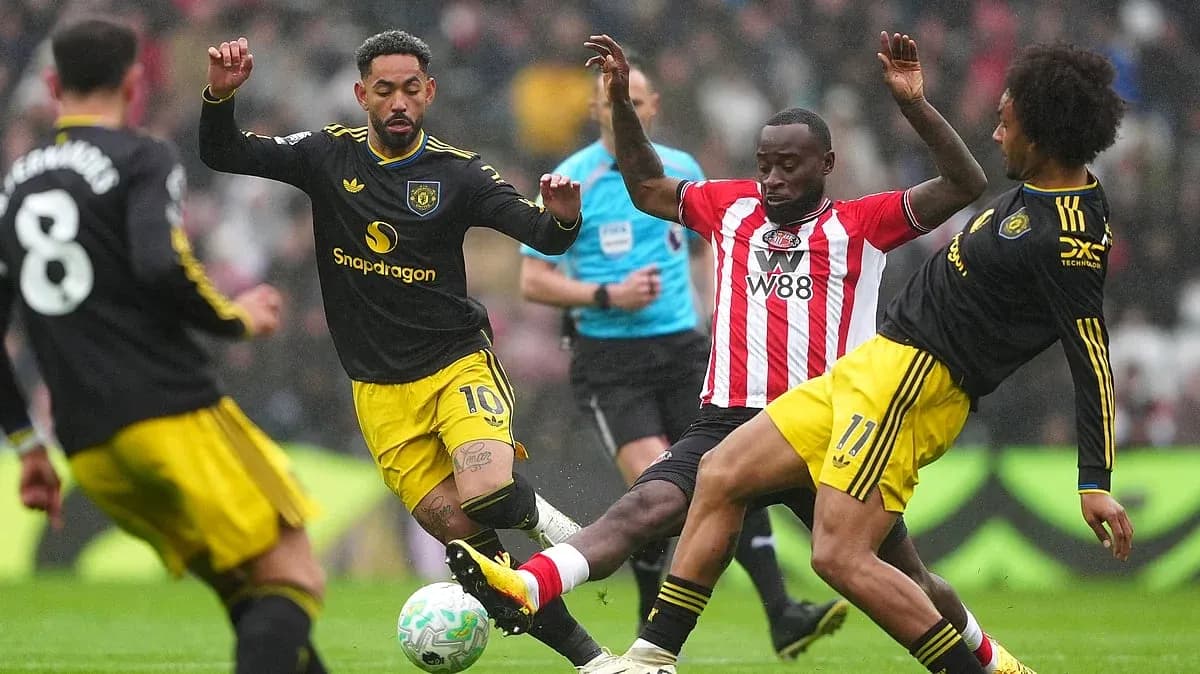
The “Hunter vs Shield” dynamic was clearest in the battle between United’s creators and Sunderland’s defensive structure. Bruno Fernandes, the league’s leading assist provider with 19, arrived having played every one of his 33 matches from the start, producing 125 key passes and 8 goals. His understanding with Cunha, who has 9 goals, 2 assists and 88 dribble attempts (41 successful), is the hinge of United’s attack. Against them, Xhaka and Sadiki had to hold their positions, while Mukiele and Alderete were constantly alive to Zirkzee’s dropping movements and Cunha’s darts into half-spaces.
On the flanks, Hume’s duel with Shaw and Cunha was a physical, tactical grind. Hume’s 64 tackles and 321 duels (171 won) show a defender who relishes confrontation, but his 9 yellow cards underline the fine line he walks. United, whose own yellow-card peak comes between 46-60 minutes (21.31% of their bookings), mirror Sunderland’s tendency to play on the edge in that phase. With Casemiro not in the XI but a looming presence in the squad as a player with 9 yellows and 1 yellow-red this season, Carrick has built a side that is aggressive in the challenge, sometimes to a fault.
In the “Engine Room”, Mainoo and Mount were tasked with linking United’s deeper build-up to the attacking quartet, constantly probing between Sunderland’s midfield lines. Le Fée, for his part, had to balance pressing Mount with offering Brobbey support on transitions. Brobbey’s job in this setup is as much about occupying Maguire and Martínez as it is about finishing; pinning United’s centre-backs back denies them the freedom to step into midfield and compress the pitch.
From a statistical prognosis standpoint, a 0-0 between these profiles is almost an outlier. Heading into this game, Sunderland’s home attack averaged 1.3 goals per match, United’s away attack 1.5. Combined with both sides conceding 1.1 at home (Sunderland) and 1.4 away (United), the expectation would lean towards at least one goal each. Both teams are perfect from the spot this season, each scoring all 4 penalties overall, so a single rash challenge in the box could have tilted the narrative.
Instead, the match settled into a story of structure over chaos. Sunderland’s need for control, sharpened by Ballard’s absence and their late-season form, met a United side whose attacking verve was blunted without Šeško’s penalty-box presence and De Ligt’s progressive passing from the back. Following this result, the numbers still paint United as the more potent force and Sunderland as the more pragmatic, but this afternoon at the Stadium of Light, the squads and their tactical compromises converged into a stalemate that felt less like a missed opportunity and more like a hard-earned point for both.