.svg&w=384&q=75 "naujapitch logo")
Tottenham vs Leeds: A 1-1 Draw Reflecting Season Struggles
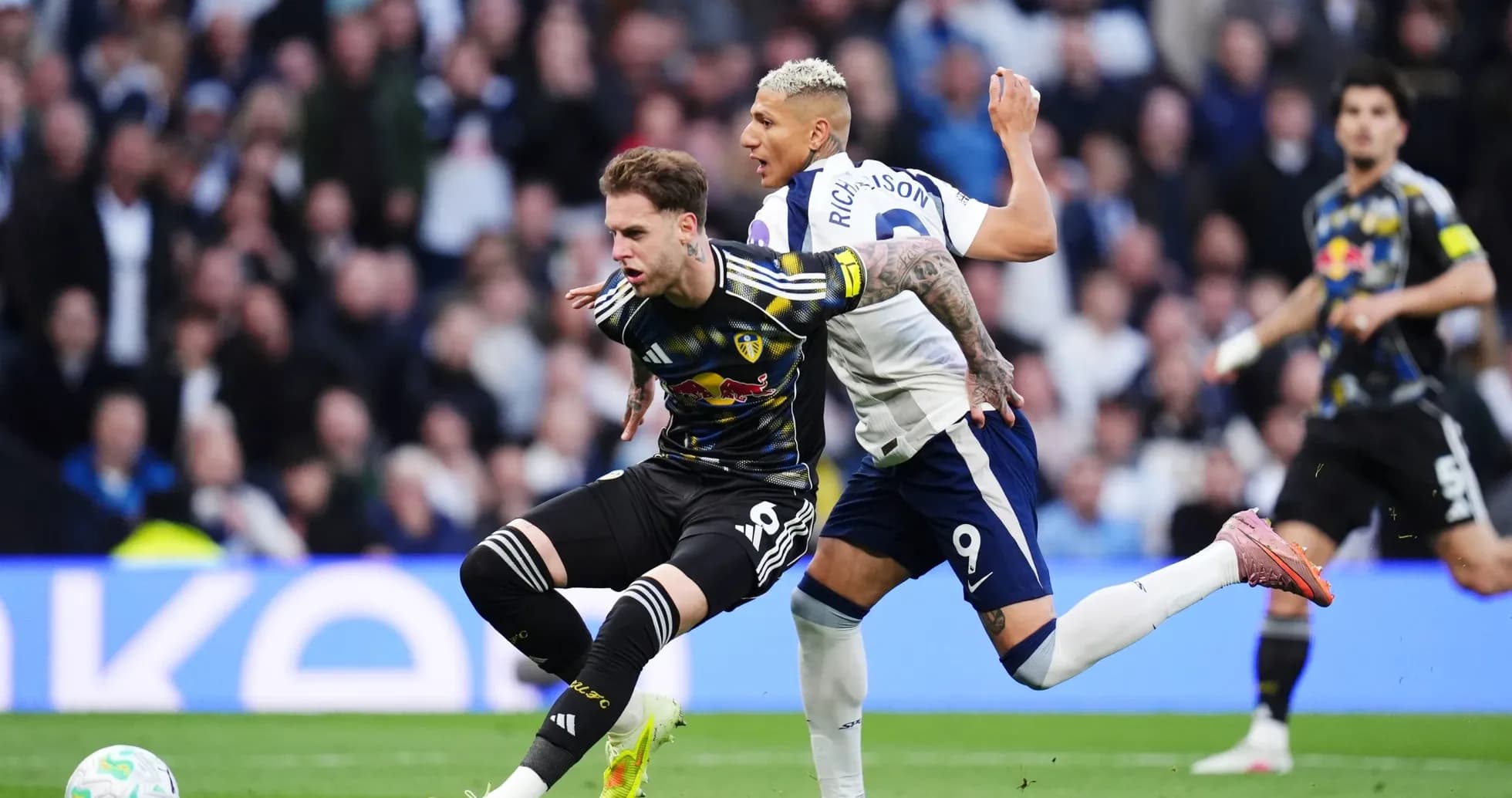
Under the London lights at Tottenham Hotspur Stadium, a 1-1 draw between Tottenham and Leeds closed out 90 tense minutes that felt like a snapshot of both clubs’ seasons: fragile, flawed, but fiercely competitive. Following this result in Round 36 of the Premier League, the table still shows Spurs marooned in 17th with 38 points and a goal difference of -9, while Leeds sit 14th on 44 points with a goal difference of -5 – both sides hovering in that uneasy space between safety and regret.
I. The Big Picture – Two Seasons in a Single Scoreline
Tottenham’s campaign has been a study in imbalance. Overall they have scored 46 goals and conceded 55 across 36 matches, with their home form the glaring fault line: just 2 wins from 18 at the Tottenham Hotspur Stadium, with 21 goals scored and 31 conceded. Heading into this game, their attacking average at home stood at 1.2 goals per match, but they were allowing 1.7, a recipe for anxiety in front of their own fans.
Leeds arrived as the more stable, if inconsistent, outfit. Overall, they had 48 goals for and 53 against from 36 games. At Elland Road they are strong; on their travels, far less so. Away from home they had only 2 wins from 18, with 20 goals scored and 32 conceded, an away defensive average of 1.8 goals against per game. A point in North London, in that context, feels like a continuation of a season in which Leeds have drawn 14 times in total – stubborn, rarely blown away, but not ruthless.
The 1-1 scoreline, after a goalless first half, mirrored those underlying numbers: Tottenham’s inability to control games at home, Leeds’ knack for staying in contests and leaving with something.
II. Tactical Voids – The Missing Pieces
The teamsheets told their own story of compromise. Tottenham were without an entire spine of senior figures: Guglielmo Vicario (groin), Cristian Romero (knee), Ben Davies (ankle), D. Solanke (muscle), M. Kudus (muscle), D. Kulusevski (knee), W. Odobert (knee) and X. Simons (knee) were all listed as Missing Fixture. That is a goalkeeper, a first-choice centre-back, multiple forwards and creative midfielders – a talent drain that forced Roberto De Zerbi to lean hard on squad depth.
In their absence, A. Kinsky started in goal behind a back four of P. Porro, K. Danso, M. van de Ven and D. Udogie in a 4-2-3-1. The double pivot of J. Palhinha and R. Bentancur provided ballast, while the attacking band of R. Kolo Muani, C. Gallagher and M. Tel worked off Richarlison as the lone forward. It was a structure designed to restore control and protect a makeshift axis, especially with Romero – who across the season has combined 58 tackles, 14 blocked shots and 31 interceptions with 10 yellow cards and 1 red – unavailable.
Leeds had their own absentees, though less concentrated in key leadership roles. J. Bogle (hamstring), F. Buonanotte (hamstring), I. Gruev (knee), G. Gudmundsson (muscle) and N. Okafor (calf) all missed out. Daniel Farke responded with a 3-5-2 that has become one of his trusted shapes this season: K. Darlow in goal; a back three of J. Rodon, J. Bijol and P. Struijk; a hardworking midfield line of D. James, A. Stach, E. Ampadu, A. Tanaka and J. Justin; and a front two of D. Calvert-Lewin and B. Aaronson.
Disciplinary trends framed the risk profile. Tottenham’s season-long yellow card distribution peaks between 61-75 minutes, where 25.26% of their bookings arrive, while Leeds’ own peak sits at 61-75 minutes as well with 23.33%. It meant the heart of the second half was always likely to be fractious – and the tactical bravery of both coaches in that window had to be balanced against the danger of a costly dismissal.
III. Key Matchups – Hunter vs Shield, Engine Room vs Enforcer
Hunter vs Shield centred on D. Calvert-Lewin against a Tottenham defence missing Romero. Calvert-Lewin has been Leeds’ spearhead: 13 total league goals and 1 assist, with 64 shots (32 on target) and 444 duels contested, winning 174. He is not just a finisher but a constant aerial and physical reference point, having also won 2 penalties and taken 5 (scoring 4, missing 1). Against a back line anchored by M. van de Ven and K. Danso, his ability to pin centre-backs and bring Aaronson into play was critical.
Van de Ven, who has played 33 times this season with 4 goals, 21 blocked shots and 22 interceptions, is also in the top bracket for red cards with 1 sending-off. His aggression is an asset in stepping out of the line, but it carries risk. Without Romero alongside him, his decision-making against Calvert-Lewin’s movement was always going to shape Tottenham’s defensive stability. The 1-1 outcome suggests he walked that tightrope adequately, but not dominantly.
In midfield, the Engine Room battle was defined by C. Gallagher and R. Bentancur against Leeds’ enforcer E. Ampadu. Ampadu has been immense for Leeds: 33 appearances, 2943 minutes, 1 goal, 1 assist, 1628 passes at 85% accuracy, 78 tackles, 16 blocked shots and 50 interceptions. He also sits high in the yellow-card charts with 9 bookings, underlining the edge he brings to breaking up play.
Gallagher, operating as the advanced central midfielder in the 4-2-3-1, was tasked with finding the spaces Ampadu vacated when stepping out, while Bentancur and Palhinha tried to smother Leeds’ transitions. On the other side, B. Aaronson, Leeds’ creative fulcrum with 5 assists and 32 key passes from 629 total passes at 80% accuracy, floated between the lines, looking to exploit any disorganisation in Spurs’ double pivot. His duel with Palhinha – a natural destroyer – was a subtle but decisive sub-plot.
IV. Statistical Prognosis – What the Numbers Say About the Draw
Following this result, the underlying season data still paints Tottenham as a side more comfortable on their travels (7 away wins, 25 away goals, 24 away conceded) than at home, where their 2 wins and 31 goals conceded underscore a chronic fragility. Their overall scoring rate of 1.3 goals per game is matched by Leeds’ 1.3, while both concede 1.5 on average – two mid-table attacks attached to leaky defences.
Leeds’ away profile remains that of a cautious, draw-heavy side: 2 wins, 9 draws and 7 defeats, with a goalsAgainst away average of 1.8. Their clean sheet count on the road (2) is modest, but they rarely collapse, as reflected in their overall 14 draws.
In xG terms – even without explicit figures – the patterns suggest parity. Tottenham’s limited home threat, undermined by absences in attack, up against a Leeds defence that concedes regularly but not catastrophically away, naturally gravitates toward a one-goal output each. The draw feels less like an accident and more like the statistically “expected” equilibrium between two flawed but competitive squads.
For Tottenham, the story is one of survival and recalibration: a squad stretched by injuries, over-reliant on moments from Richarlison (10 total league goals, 4 assists) and still searching for a home identity. For Leeds, it is about consolidation: Ampadu’s steel, Calvert-Lewin’s penalty-box craft and Aaronson’s creativity forming a spine that, while not spectacular, is robust enough to keep them clear of real danger.
Following this result, the numbers and the narrative align: two teams whose seasons are defined not by dominance, but by the fine margins of games like this – and a 1-1 that feels exactly what the data said it should be.