.svg&w=384&q=75 "naujapitch logo")
Spain Defeats France: A World Cup Exit for Deschamps
ARLINGTON, Texas — The end came not with drama, but with a dull, unforgiving thud.
France, the tournament’s great superpower, walked into Jerry Jones’ vast Texas monument as World Cup favorites and walked out looking ordinary, beaten 2-0 by a Spain side that never flinched, never hurried, and never really looked in doubt once they went ahead. For the first time at this World Cup, Les Bleus trailed. They never looked remotely capable of climbing back.
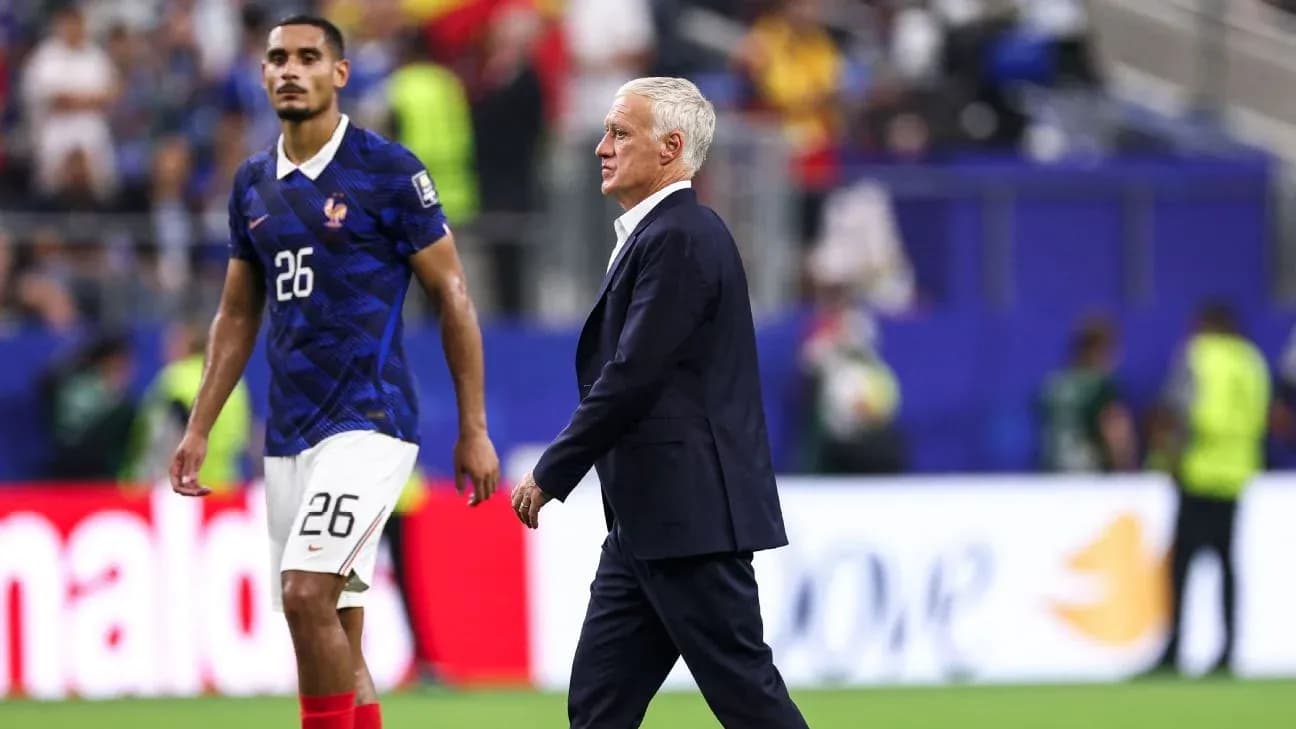
For Didier Deschamps, it was not just the end of a campaign. It was the end of an era.
Fourteen years, 184 games, three major finals, one World Cup as coach, another as captain, and a Nations League for good measure. He came within a Randal Kolo Muani chance of joining the most exclusive of coaching clubs: two-time World Cup-winning managers. Instead, his last act in charge of the most gifted squad of his tenure was a timid semifinal exit, his front four reduced to passengers, his team scraping together a barely believable 0.04 expected goals in the first 64 minutes.
That’s not just defeat. That’s surrender.
Spain dominate, France disappear
You could see this coming from a mile away. Everyone could.
Spain would have the ball. They would circulate it, probe, drag France from side to side, force them to defend for long stretches. That was never in doubt. The only real question was what Deschamps would do about it.
Would he tweak the structure, add a midfielder, close that glaring two-vs-three gap in the middle that Kylian Mbappé himself had highlighted? Would he press higher, disrupt Spain’s rhythm, try to turn their possession into a liability? Or would he do what he has so often done: trust his stars, keep the shape, and assume superior talent would find a way?
He chose the latter. Spain punished him for it.
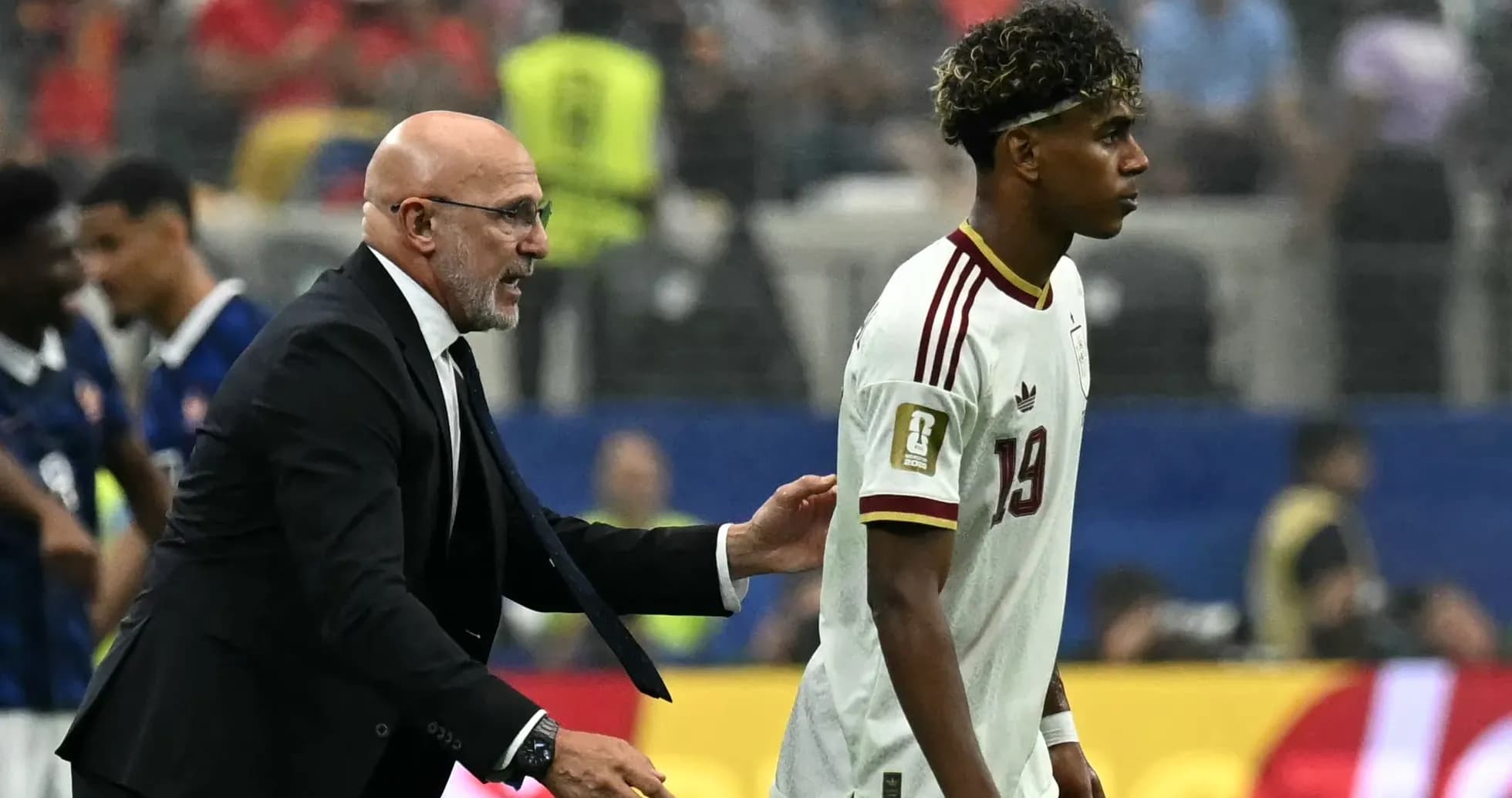
Luis de la Fuente has now faced Deschamps three times in three years in knockout football. Three times he has sent him home. Euro 2024 semifinal. Nations League in 2025, when Spain led 5-1 at one stage and still held on 5-4. And now this World Cup, the most brutal of the lot. Either De la Fuente is Deschamps’ bespectacled, bald, bearded kryptonite, or the Frenchman has simply refused to learn.
Because this was a repeat viewing, only worse. Each time France have met Spain under these two coaches, Les Bleus have regressed.
Spain did what Spain do: they took the ball away and then took the space away. They pressed, squeezed, suffocated. They left France’s front line — the supposed jewel of this squad — starved and static. Without the ball and without space, elite attackers become anonymous. Michael Olise, so often electric, looked as threatening as an office worker stuck in traffic.
And as the minutes ticked by, nothing really changed.
Deschamps’ strengths become fatal flaws
Deschamps has never pretended to be a tactical revolutionary. His philosophy is simple and, for a long time, incredibly effective: keep the dressing room happy, keep the plan clear, and let the talent decide the rest. It worked as a player alongside Zinedine Zidane, Patrick Vieira and Thierry Henry in 1998. It worked as a coach with Mbappé and Antoine Griezmann in 2018 and 2022.
In a low-scoring sport, there is logic to that. Overcomplicate things and you risk tripping over your own ideas. Deschamps never did. He built strong structures, trusted his men and rode their quality.
The problem comes when the opponent strips away the two basic tools of individual brilliance. When they own the ball and close down the space, all that talent turns into a collection of frustrated silhouettes. That’s when you need something else. A new idea. A different shape. A risk.
That has never been Deschamps’ instinct.
His changes here were straight from the manual: Manu Koné, the more progressive passer, for Adrien Rabiot. Désiré Doué for Bradley Barcola. Logical. Predictable. Safe. The footballing equivalent of predictive text.
On a good day, those substitutions keep control and preserve balance. On a night like this, they simply extend the suffering.
His loyalty to certain players told the same story. Rabiot, again, entrusted with a central role. Olise, clearly struggling, kept on the pitch long enough for the damage to feel permanent. These are the same traits that underpinned Deschamps’ success — faith, stability, hierarchy. They also dragged him down in his final act, with arguably the deepest squad France has ever taken to a World Cup.
The very principles that built his legacy helped dismantle it.
Enter Zidane — but which Zidane?
And so the conversation moves, inevitably, to Zinedine Zidane.
France’s greatest modern icon is expected to inherit a team overflowing with attacking talent and scarred by this defeat. On paper, his résumé is immaculate: three Champions League titles, two LaLiga crowns with Real Madrid. A serial winner, a man who commanded a dressing room of superstars and kept them aligned, focused, hungry.
Look a little closer, though, and the picture is less straightforward. Zidane has not coached in five years. His last trophy came in 2020. His only job has been at Real Madrid, a club unlike any other, where resources are vast, turnover is constant and if you don’t like a player, you can ask for another one.
International football offers none of those luxuries. You don’t sign replacements. You don’t drill ideas every day. You see your players in short bursts and then you’re judged on a handful of matches.
Zidane’s Madrid were not built on complex tactical patterns. He preferred clarity and freedom, much like Deschamps. He knew when to step back, when to let his stars take over, when to press the emotional buttons rather than the chalkboard.
So the temptation is obvious: to assume he will be a sleeker, more glamorous version of what France already had.
If that’s all he is, it might not be enough.
Because if this World Cup exit underlined anything, it’s that even with the better players, you cannot always just “let them play.” Sometimes the game demands a concession to balance. Sometimes you have to sacrifice one attacker to control the middle of the pitch. Sometimes you must accept that being slightly less talented but far more coherent can win you the night.
Zidane knows this in his bones. He won a World Cup with Stéphane Guivarc’h as his centre-forward. He thrived in a team where the collective shape allowed the stars to shine, not the other way around. Deschamps, remember, was on that pitch too.
What comes next
The lesson from Arlington is brutal but clear: when the gap in technical quality is small, the collective can crush the individual. Spain were not vastly superior man for man. They were simply better as a team, sharper in their plan, more ruthless in their execution.
Zidane, assuming he steps in, will inherit one of the richest attacking pools in the game and a group of players who have already reached multiple finals. He has had years to study this side from a distance. He will know their strengths, their blind spots, their egos.
If he merely matches Deschamps’ haul — a World Cup, another final, deep runs every cycle — he will be judged a success.
The real question is whether he dares to take this generation somewhere Deschamps, for all his medals and memories, ultimately could not.