.svg&w=384&q=75 "naujapitch logo")
South Africa's World Cup Journey: A New Era Begins
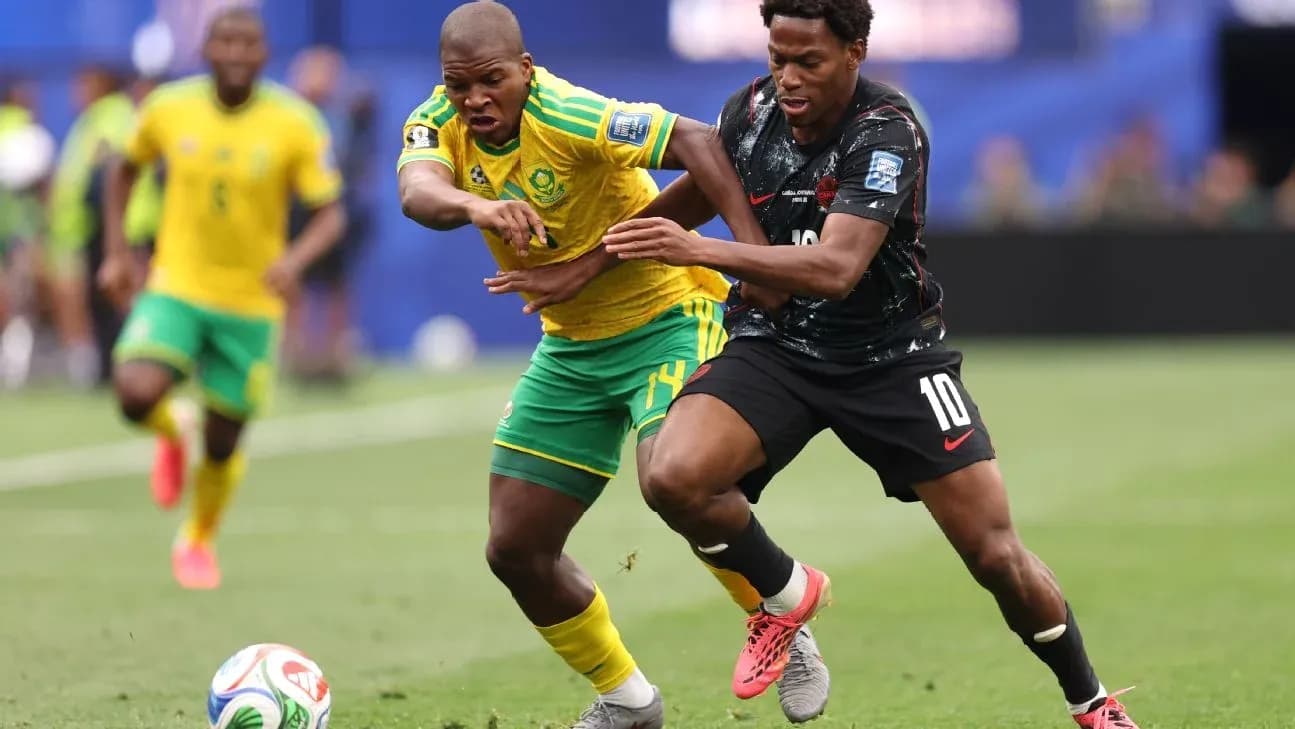
South Africa’s World Cup exit hurt. It had to. A tight, tense 1-0 defeat to Canada in the round of 32 ended a first appearance on the global stage in 16 years and slammed the door on a fairytale that felt within reach.
But this was no hollow return. Bafana Bafana did more than just make up the numbers. They made history, reached their first-ever World Cup knockout match and, in the process, lit up a pathway that suddenly looks far less hazy than it did a year ago.
A defence built to last
If there is one department South Africa can stop worrying about for a while, it is the heart of their defence.
Mbokazi and Okon did not just start at a World Cup; they owned the stage. They played with the authority of men who expect to be there again. Mbokazi, in particular, emerged as one of the standout centre-backs of the tournament, reading danger early, stepping into tackles with conviction and looking entirely at home against world-class forwards.
Behind them, a queue is already forming.
Olwethu Makhanya, Khulumani Ndamane, Tylon Smith, Malibongwe Khoza, Aden McCarthy and others are all waiting for their chance, all capable of stepping in if either Mbokazi or Okon – “TLB” to those who know him best – ever need replacing, whether for a week or a generation.
Whoever sits in Hugo Broos’ chair by the next World Cup cycle, whether it is the Belgian himself or a successor, will inherit a position of strength that past Bafana coaches could only envy. South Africa, for once, looks genuinely stocked in an area where many nations spend years scrambling for answers.
Mofokeng: the card still up South Africa’s sleeve
The frustration around Relebohile Mofokeng’s limited role in 2026 was real. Orlando Pirates fans, and many neutrals, wanted to see more of the 21-year-old attacking midfielder. Broos never quite handed him the keys in the way the public hoped.
But time is on Mofokeng’s side.
By 2030, he will be entering his prime. If he even approaches his ceiling, South Africa will have a creative force capable of tilting games at the highest level. The glimpse came in that 1-0 win over South Korea, where his performance cut through the noise and reminded everyone why his name has been whispered with such excitement.
That display showed something crucial: he can live in that company. He can trade passes and ideas with global stars and not look out of place.
A move to Royale Union Saint-Gilloise in Belgium, widely reported and awaiting confirmation, could be the next step. It is not a glamorous superclub, but it is a smart, upwardly mobile environment in a league that has quietly become a launchpad for talent. For Mofokeng, it could be the bridge from promise to proof.
South Africa might have left this World Cup feeling they did not fully unleash him. The next one may tell a very different story.
Homegrown, world-class
One of the most striking themes of Bafana’s campaign was how many of their leaders have built their careers entirely at home.
- Ronwen Williams
- Teboho Mokoena
- Thalente Mbatha
- Khuliso Mudau
- Aubrey Modiba
These are not products of European academies or players polished in faraway leagues. They are proof that the South African Premiership, when run well and resourced properly, can produce footballers who stand up to the world’s best.
Mokoena, the heartbeat of Mamelodi Sundowns’ midfield, carried that authority onto the World Cup stage. Mbatha, from Orlando Pirates, showed he can handle the tempo and intensity of the game at this level. Mudau and Modiba, Sundowns’ fullback pairing, gave Bafana thrust and resilience down the flanks.
Behind them all, Williams did what he has done for years. He bailed his team out in big moments, commanded his box, and reminded everyone why his reputation has spread beyond South Africa’s borders despite never leaving the domestic league, first with SuperSport United and now with Sundowns.
For young South Africans dreaming of a career, the message is clear: you do not have to leave home to become relevant. A move abroad can help, of course, and many will need it to sharpen their edge. But this World Cup showed that staying in the Premiership is no barrier to building a serious football life.
Maseko’s second chance – and South Africa’s
No story from this campaign cut as deeply into the national psyche as Thapelo Maseko’s.
At 20, he scored his first Bafana goal at the delayed 2023 Africa Cup of Nations, played in early 2024. Hugo Broos liked him. The country saw a winger with pace, courage and a knack for timing his runs.
Then came the stall.
His move from SuperSport United to Mamelodi Sundowns, a step that should have launched him, left him on the fringes. When Miguel Cardoso arrived as Sundowns head coach in December 2024, Maseko slipped even further from the picture, often shunted to the reserves. The excitement around his name dimmed. He spoke on social media about losing his love for the game.
Five months later, in January 2026, he left on loan to AEL Limassol in Cyprus. It looked like a quiet escape route, a way to find minutes and maybe rediscover himself out of the spotlight.
It turned into a lifeline.
By March, he was back in the Bafana squad. By June, he had scored one of the most significant goals in South African football history – the strike against South Korea that pushed Bafana into the World Cup knockout rounds for the first time ever.
That moment was bigger than a finish from close range or a run off the shoulder. It was a reminder that careers do not have to follow a straight line. That a young man who had publicly questioned his relationship with football could, within a year, carry a country’s hopes on his shoulders and deliver.
In Maseko, South Africans saw more than a winger. They saw resilience, vulnerability, and the possibility of starting again.
Money, mistakes and a way out for SAFA
While the team fought on the pitch, the South African Football Association wrestled with its own crisis off it.
SAFA’s finances hovered over this World Cup like a storm cloud. Players had been paid late after the previous African Nations Championship. Operating expenses had outstripped revenue for years. The fear was not just failure on the field, but what another disappointment might mean for a fragile structure creaking behind the scenes.
This campaign has changed that equation.
By simply reaching the group stage, SAFA were guaranteed at least $9 million in performance-based payouts, excluding preparation fees. Progress to the round of 32 added another $2 million, taking the total to $11 million.
That money does not erase past mismanagement. It does not rewrite years of poor decisions or instantly modernise an organisation that has lurched from one financial headache to another. But it does buy time. It gives South African football, from grassroots to the top flight, a stronger safety net in the short term.
More importantly, it changes the conversation with sponsors. A team that qualifies for a World Cup, competes, advances and captures the public imagination is far easier to sell than one watching from home. Commercial partners like visibility, momentum, and hope. Bafana have just delivered all three.
The real test for SAFA starts now.
They can treat this money as a life raft and cling to survival mode, or they can use it as the foundation for something more ambitious – better development structures, stronger support for the domestic game, and a clear plan to ensure that what happened in 2026 is a beginning, not a one-off.
South Africa walked off the pitch against Canada with tears in their eyes and a World Cup dream cut short. But they also walked off with a settled defensive core, a rising star in Mofokeng, a redemption arc in Maseko, proof that homegrown players can compete with the world, and an association given one more chance to get things right.
The question now is not whether this team can dream again.
It is whether the people in charge of the game will be brave enough – and smart enough – to match the courage their players have already shown.