.svg&w=384&q=75 "naujapitch logo")
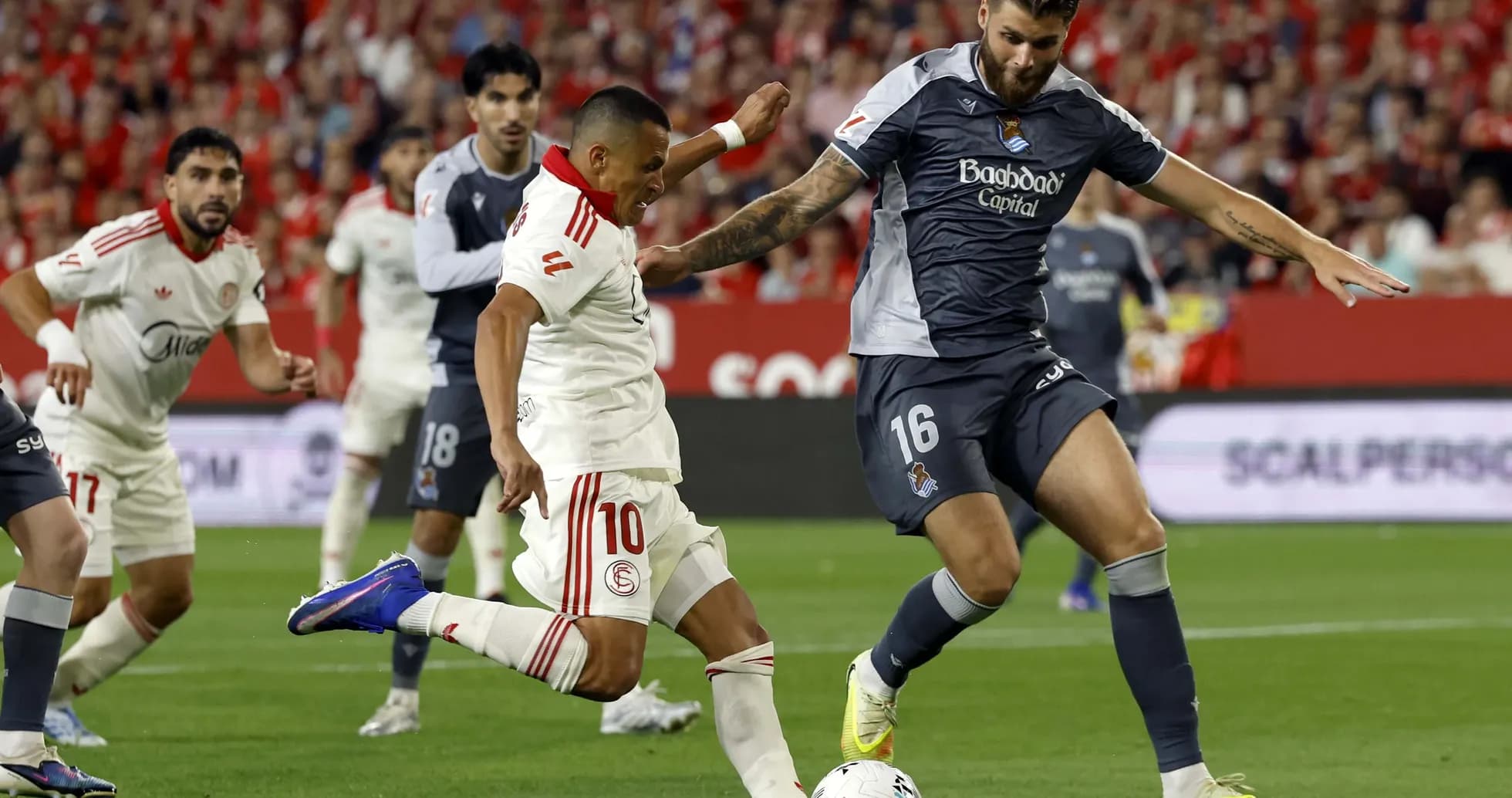
Sevilla Edges Real Sociedad in La Liga Showdown
The Ramón Sánchez Pizjuán under floodlights can be an unforgiving place, and this night in La Liga’s Round 34 was exactly that for Real Sociedad. Sevilla, fighting from 17th place and still looking nervously over their shoulders, edged a 1–0 win that felt bigger than the scoreline. Following this result, the table tells a story of survival versus European ambition: Sevilla on 37 points, clinging on with a goal difference of -14 (41 scored, 55 conceded overall), Real Sociedad stalled in 9th on 43 points, their own goal difference just -1 (52 for, 53 against overall).
I. The Big Picture – A team redrawing its identity
Luis Garcia Plaza rolled out a 4-4-2 that spoke of clarity and pragmatism. Sevilla’s season has been fractured and inconsistent – only 10 wins from 34, with 17 defeats overall – but at home they have been just strong enough: 6 wins, 4 draws, 7 losses, scoring 22 and conceding 23. The margins are thin, but the shape here made sense.
O. Vlachodimos anchored the side from goal, shielded by a back four of José Ángel Carmona, Castrin, Kike Salas and G. Suazo. Ahead of them, a hard-working midfield line of R. Vargas, L. Agoume, N. Gudelj and C. Ejuke supported the front two, Isaac Romero and N. Maupay. It was not an expansive XI; it was a functional one, built to compress space, win duels and live off moments.
Real Sociedad, by contrast, arrived with a more polished statistical profile but a less convincing recent run (form string LDLDW heading in). On their travels they had managed only 3 wins from 17, with 6 draws and 8 defeats, scoring 20 and conceding 28. Pellegrino Matarazzo’s 4-2-3-1 – A. Remiro in goal, a back four of J. Aramburu, J. Martin, D. Caleta-Car and S. Gomez, a double pivot of B. Turrientes and J. Gorrotxategi, then A. Barrenetxea, C. Soler and P. Marin behind Mikel Oyarzabal – promised control and technical quality but carried the same fragility that has undermined them away all season.
II. Tactical Voids – Absences and discipline
Both coaches had to navigate significant absences. Sevilla were without M. Bueno (knee injury), Marcao (wrist injury) and D. Sow (suspension due to yellow cards). That stripped depth from the back line and a key engine from midfield. In response, Garcia Plaza leaned heavily on the physical presence and positional discipline of Agoume and Gudelj to compensate for Sow’s missing dynamism.
Real Sociedad’s list was even longer: G. Guedes (toe injury), J. Karrikaburu (ankle), A. Odriozola (knee) and I. Ruperez (knee) all unavailable. The absence of Guedes in particular removed a vertical, direct threat that might have stretched Sevilla’s back four and given Oyarzabal more room between the lines.
Disciplinary trends shaped the tone. Sevilla are a late-game flashpoint side: 19.79% of their yellow cards come between 76–90 minutes, with another 18.75% between 91–105. Real Sociedad, meanwhile, spike in the 46–60 minute window, with 22.22% of their yellows there, and carry a risk of late reds – 50.00% of their red cards arrive between 76–90, another 25.00% between 91–105. This match followed that emotional profile: Sevilla grew more combative as they protected their lead, Real Sociedad became increasingly stretched and frustrated as time ebbed away.
III. Key Matchups – Hunter vs Shield, Engine Room battles
Hunter vs Shield was always going to revolve around Mikel Oyarzabal. Heading into this game he was one of La Liga’s most efficient forwards: 14 goals and 3 assists in 30 appearances, with 58 shots and 34 on target. He is not just a finisher; his 40 key passes and 6 scored penalties (0 missed) make him the complete focal point.
Sevilla’s “shield” was collective rather than individual. Carmona, one of the league’s most carded players with 11 yellows this season, patrolled the right side with an edge that bordered on reckless but was essential here. His 59 tackles, 7 blocked shots and 34 interceptions in the campaign underline a defender who lives in the duel. Against Oyarzabal drifting into the right half-space and Barrenetxea attacking from that side, Carmona’s aggression and timing were decisive. He stepped out to confront, fouled when he had to, and rarely allowed Oyarzabal to receive on the half-turn close to goal.
On the opposite flank, G. Suazo’s energy and overlapping threat helped pin back P. Marin and S. Gomez, reducing Real Sociedad’s ability to build calmly from the left. The result was that Oyarzabal was often isolated, dropping deeper than he would like, and Real Sociedad’s most dangerous weapon was blunted.
In the Engine Room, Lucien Agoume was Sevilla’s metronome and enforcer rolled into one. Across the season he has combined 1 goal and 2 assists with 1199 passes at 80% accuracy, 59 tackles and 43 interceptions. Here, his job was to disrupt B. Turrientes and J. Gorrotxategi’s rhythm and to block the passing lanes into Soler and Oyarzabal. He did it with a mixture of anticipation and controlled aggression, committing fouls when necessary – consistent with his 10 yellow cards this season – but rarely losing positional discipline.
For Real Sociedad, the creative axis of Barrenetxea and Soler never quite found its usual fluency. Barrenetxea’s season numbers (5 assists, 42 key passes, 106 dribble attempts with 50 successful) speak of a winger who thrives in broken-field situations. Sevilla’s compact 4-4-2 denied him that chaos. With Vargas and Carmona doubling up, Barrenetxea was often forced backwards or inside into traffic, where Gudelj and Agoume were waiting.
IV. Statistical Prognosis – What this game says about both sides
Following this result, Sevilla’s season-long profile remains that of a fragile but stubborn survivor. Overall they score 1.2 goals per game and concede 1.6, but at home the picture is marginally better: 1.3 scored, 1.4 conceded. Their 6 clean sheets overall, split evenly between home and away, show that when their structure holds, they can grind out narrow wins like this one.
Real Sociedad’s numbers are more expansive but also more volatile. Overall they average 1.5 goals for and 1.6 against per game, and on their travels 1.2 for and 1.6 against. They have only 1 away clean sheet all season and have failed to score 3 times away; this match fit that pattern almost perfectly. Their attacking ceiling is high – 52 goals overall, with home form particularly strong – but their away defensive baseline is soft.
If we project forward in Expected Goals terms, Sevilla’s blueprint for the run-in is clear: low-event games, disciplined lines, and leveraging set pieces and individual breaks from players like Isaac Romero and Maupay. Their penalty record – 5 from 5 overall, 100.00% conversion, no misses – also suggests that any marginal xG edge can be ruthlessly converted if they draw contact in the box.
For Real Sociedad, the concern is that their away xG conceded profile is unlikely to improve without a structural tweak. The 4-2-3-1 offers control at home, but away it leaves the double pivot exposed when full-backs push on. Without Guedes’ outlet and with Oyarzabal often dropping deep, they can look sterile despite the talent on the pitch.
Narratively, this 1–0 feels like a microcosm of both seasons. Sevilla, under pressure and imperfect, found just enough solidity and bite to bend the night their way. Real Sociedad, more polished in the data, once again left an away ground with the sense of a plan that looks good on paper but struggles to impose itself when the margins narrow and the stadium roars.