.svg&w=384&q=75 "naujapitch logo")
Atletico Madrid Secures 2-1 Victory Against Osasuna
Osasuna’s 2-1 defeat to Atletico Madrid at Estadio El Sadar was defined by contrasting efficiencies rather than balance of play. In a La Liga fixture where Osasuna dominated territory and volume, Diego Simeone’s side leaned on compact structure, high‑value transitions and ruthless set‑piece execution to secure three points. The hosts’ 58% possession, 23 total shots and higher xG of 2.16 to Atletico’s 1.64 underline how Alessio Lisci’s 4-2-3-1 controlled much of the evening, but Atletico’s 4-4-2, then 4-4-1 after the red card, converted limited attacks into two decisive goals. A late Kike Barja strike narrowed the scoreline without overturning Atletico’s tactical edge in the key moments.
Scoring Summary
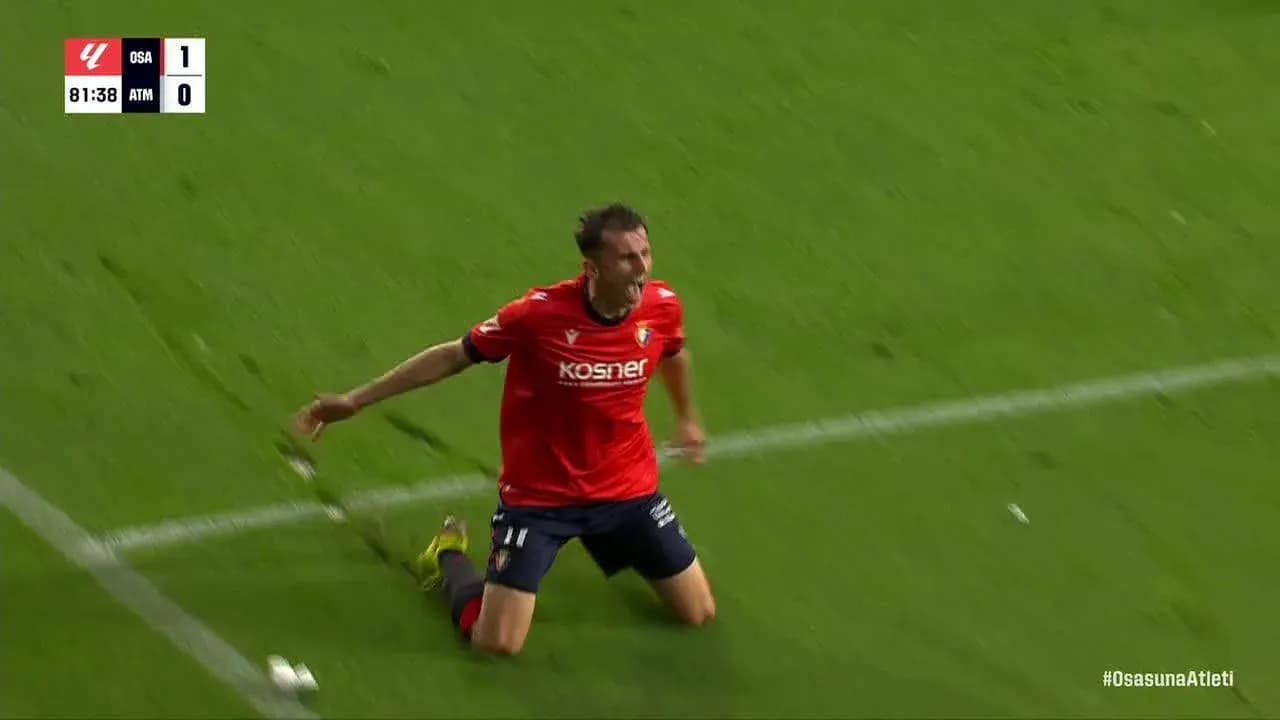
The scoring opened in a tightly choreographed Atletico script. At 13', a VAR intervention confirmed a penalty for Atletico Madrid, with Antoine Griezmann at the heart of the incident; the decision set the tone for the visitors’ threat in early transitions. Two minutes later, at 15', Ademola Lookman converted the penalty for Atletico Madrid (no assist), giving Simeone’s side a 1-0 platform that fit their low‑block, counter‑attacking plan. The second goal arrived at 71', when Alexander Sorloth (Atletico Madrid) finished a Normal Goal after a break, assisted by Marcos Llorente, pushing the score to 2-0 and punishing Osasuna’s high defensive line. Osasuna finally translated pressure into a goal at 90', as Kike Barja (Osasuna) struck a Normal Goal, assisted by Ruben Garcia, capping a late siege that came too late to alter the result. The halftime score was 0-1; Atletico Madrid led 2-0 before Barja’s late reply.
Disciplinary Control
Disciplinary control heavily shaped the rhythm, especially in the second half. The card log, in strict chronological order:
- 14' Javi Galán (Osasuna) — Handball
- 30' Rubén García (Osasuna) — Foul
- 45+9' Ante Budimir (Osasuna) — Argument
- 52' Marcos Llorente (Atletico Madrid) — Argument
- 57' Kike Barja (Osasuna) — Argument
- 57' Koke (Atletico Madrid) — Foul
- 59' Marc Pubill (Atletico Madrid) — Foul
- 79' Marcos Llorente (Atletico Madrid) — Foul (Yellow Card)
- 79' Marcos Llorente (Atletico Madrid) — Foul (Red Card)
- 85' Alejandro Catena (Osasuna) — Argument
- 85' Robin Le Normand (Atletico Madrid) — Argument
- 90+2' Enzo Boyomo (Osasuna) — Foul
Totals: Osasuna 6 yellow cards, Atletico Madrid 5 yellow cards and 1 red card, 12 cards overall. In addition, a VAR check at 45+3' saw a potential Osasuna penalty involving Ante Budimir cancelled (Penalty cancelled), a pivotal non‑event that preserved Atletico’s 1-0 halftime lead.
Osasuna's Tactical Setup
Lisci’s 4-2-3-1 was built to dominate the ball and pin Atletico back. Lucas Torro and Jon Moncayola formed a double pivot that pushed high, allowing Ruben Garcia, Moi Gomez and R. Moro to occupy the half‑spaces behind Ante Budimir. The structure worked territorially: Osasuna produced 477 passes, 415 accurate (87%), with 18 shots inside the box and eight corners, repeatedly stretching Atletico’s back four of Marcos Llorente, Marc Pubill, David Hancko and Matteo Ruggeri.
Yet Osasuna’s attacking problem was one of spacing in the final third. Many of their 23 shots were rushed or from suboptimal angles despite the high xG, as Atletico compressed the central lane and forced wide circulation. The early substitution at 37', with Kike Barja (IN) coming on for R. Moro (OUT), added more directness and vertical dribbling on the flank. Later, at 60', the reshuffle continued: R. Garcia (IN) came on for Ruben Garcia (OUT), and A. Bretones (IN) replaced Javi Galan (OUT), giving Osasuna fresher width and crossing quality. The double change at 72', with A. Oroz (IN) for L. Torro (OUT) and A. Osambela (IN) for M. Gomez (OUT), tilted the structure toward a more aggressive, almost 4-1-4-1 shape, pushing numbers between the lines and setting up the late goal for Barja.
Defensive Vulnerabilities
Defensively, Osasuna’s high line and aggressive rest‑defence left them vulnerable to the very moments Atletico seek. Alejandro Catena and Enzo Boyomo were often isolated in transition. Atletico’s second goal, with Sorloth exploiting the channel and Llorente providing the assist, was the clearest example of Osasuna’s risk‑reward imbalance. Aitor Fernandez, with 2 saves and 0.32 goals prevented, had relatively little direct work, underlining that Atletico’s attacks were few but high quality.
Atletico Madrid's Strategy
Atletico Madrid’s 4-4-2 under Diego Simeone was textbook pragmatism. Koke and R. Mendoza (before R. Le Normand came in and triggered a midfield reshuffle) ensured central compactness, while Thiago Almada and O. Vargas offered outlets between lines. The very early substitution at 18', with R. Le Normand (IN) for R. Mendoza (OUT), hinted at an adjustment toward more defensive stability and aerial presence. At 46', A. Sorloth (IN) replaced T. Almada (OUT), moving Atletico into a more direct, dual‑striker model that paid off with Sorloth’s 71' goal. After Marcos Llorente’s yellow and subsequent red at 79' (both for Foul), Simeone reacted again at 82', with C. Lenglet (IN) for A. Lookman (OUT), sliding to a 4-4-1 with Griezmann and then Sorloth managing phases out of possession and as lone reference in counters.
Juan Musso was central to Atletico’s resilience: 4 saves and 0.32 goals prevented mirrored Fernandez’s numbers but in a far more exposed context, given Osasuna’s 18 shots in the box. Atletico’s back line accepted territorial inferiority, relying on penalty‑box defending and clearances rather than contesting midfield possession (358 passes, 287 accurate, 80%).
Statistical Summary
Statistically, the verdict is of a match where the scoreboard diverged from territorial dominance but not from chance quality. Osasuna’s higher xG of 2.16 reflects sustained pressure, especially after the 60' wave of substitutions and the numerical advantage following Llorente’s dismissal. However, inefficiency in finishing and the cancelled penalty at 45+3' blunted their edge. Atletico’s 1.64 xG from just 5 total shots (4 on goal) shows how clean their opportunities were: a converted penalty and a well‑timed transition. Discipline almost cost Simeone’s side—5 yellow cards and 1 red—but their defensive index remained strong in deep block phases, with Musso matching Fernandez’s 0.32 goals prevented. Over a season lens, this performance aligns with an Atletico side comfortable without the ball and an Osasuna team that can dominate structure yet still fall short in boxes when efficiency deserts them.