.svg&w=384&q=75 "naujapitch logo")
Rayo Vallecano vs Girona: La Liga Stalemate Analysis
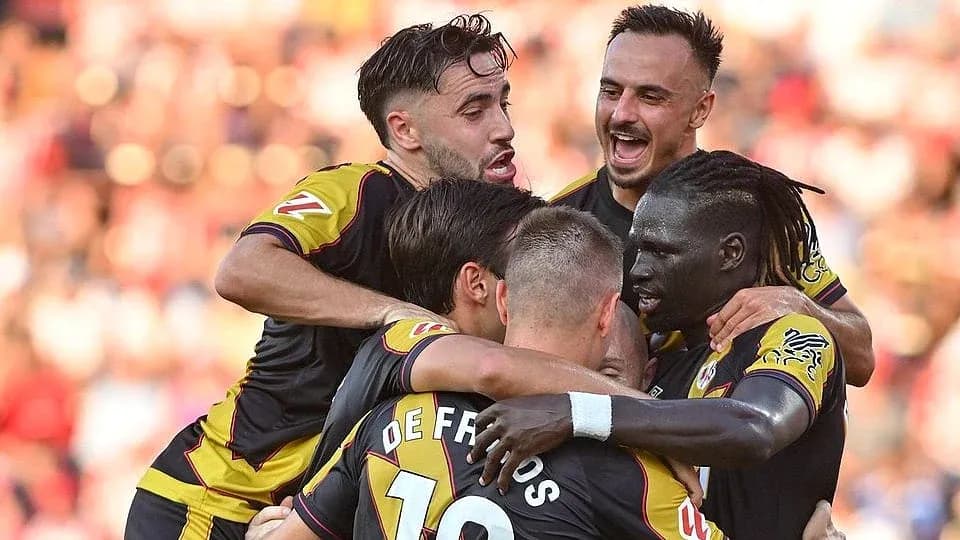
The lights had barely settled over Campo de Futbol de Vallecas when this one closed as a stalemate on the scoreboard but not in narrative: Rayo Vallecano 1–1 Girona, a late-season La Liga scrap between security and desperation.
I. The Big Picture – contrasting trajectories
Following this result, the table tells two different stories. Rayo, 10th in La Liga on 43 points, look like a side that has made peace with mid-table life but still defends with the seriousness of a relegation fight. Overall this campaign they have scored 36 and conceded 42, for a goal difference of -6. The numbers are starkly split by venue: at home they have 22 goals for and 15 against, while on their travels they have 14 for and 27 against. Vallecas is a fortress of control and narrow margins.
Girona, by contrast, are living on the cliff edge. They sit 18th with 39 points, their overall goal difference a worrying -15 from 37 scored and 52 conceded. At home they have 19 for and 25 against; away, 18 for and 27 against. The away profile is clear: they can score, but they leak at 1.5 goals per game both home and away, and that fragility defines their season.
In that context, a 1–1 draw away to a top-half Rayo side is both a point gained and an opportunity missed for Michel’s men.
II. Tactical Voids – absences that shaped the night
The team sheets were already scarred before kick-off. Rayo arrived without four important squad pieces. I. Akhomach (muscle injury) and D. Mendez (knee injury) robbed Inigo Perez of youthful depth in wide and attacking zones, but the most glaring absence was creative heartbeat and set-piece specialist I. Palazon, suspended after a red card. Add the injury of Luiz Felipe and you understand why P. Ciss had to anchor deeper and why the back four leaned on familiarity rather than rotation.
Girona’s list was even longer and more destabilising. B. Gil (suspension via yellow cards) and Portu (knee injury) stripped width, direct running and secondary goal threat from the flanks. Juan Carlos was out with a knee injury, V. Vanat with an unspecified injury, and D. van de Beek with an Achilles tendon problem. Even more strangely, the absence of M. ter Stegen – registered under Girona in this data snapshot and sidelined with a hamstring issue – symbolised how Michel had to trust P. Gazzaniga as his undisputed No. 1. The bench felt thinner, the margin for in-game tactical shifts smaller.
Disciplinary trends framed the tone. Heading into this game, Rayo’s yellow-card profile was spread but intense from 46-75’, with 18 yellows between 46-60’ (18.37%) and 19 between 61-75’ (19.39%). Girona, meanwhile, are late-game chaos incarnate: 39.19% of their yellows arrive between 76-90’, with another 17.57% from 91-105’. You could almost script the tension curve – Rayo tightening the screw after the break, Girona walking the disciplinary tightrope in the closing stages.
III. Key Matchups – Hunter vs Shield, and the battle for control
The headline duel began before a ball was kicked: Jorge de Frutos against Girona’s porous defence. De Frutos came into this one as Rayo’s standout attacking reference in La Liga 2025: 10 goals and 1 assist in 33 appearances, with 47 shots (26 on target) and 27 key passes. His profile is that of a wide forward who thrives on volume and persistence – 53 dribbles attempted, 26 successful, and 36 fouls drawn. He is the “hunter” in this narrative.
The “shield” was not a single man but a unit defined by inconsistency. Overall, Girona concede 1.5 goals per game, and on their travels they have shipped 27 in 18 matches. Structurally, Michel again leaned on a 4-2-3-1, with Vitor Reis at the heart of the back line. The Brazilian teenager is one of Girona’s few defensive bright spots: 33 appearances, 2868 minutes, 46 tackles, and an outstanding 38 blocked shots. When Rayo’s 4-3-3 swung into wide overloads, it was often Vitor Reis stepping out, blocking lanes and literally getting in the way.
On the flanks, A. Ratiu’s presence was central to Rayo’s plan. His season numbers are those of a modern attacking full-back: 32 appearances, 41 key passes, 66 tackles, 6 blocked shots and 38 interceptions. Without I. Palazon drifting inside from the right, Ratiu had to provide both progression and width. His overlaps with J. de Frutos on the opposite side of the front three created asymmetry: one flank offering direct threat, the other stretching Girona’s block.
In midfield, the “engine room” duel was about control more than chaos. For Girona, A. Witsel and F. Beltran sat as the double pivot, tasked with screening the back four and feeding the advanced line of V. Tsygankov, T. Lemar and J. Roca behind A. Ounahi. Witsel’s role was to slow Rayo’s transitions, while Beltran had to shuttle and press P. Diaz and O. Valentin, the Rayo interior duo in front of Ciss.
Ciss himself, one of La Liga’s most combative midfielders this season, brought bite: 49 tackles, 32 interceptions and an eye-catching 14 blocked shots. His two red cards and eight yellows underline the edge he plays with. Against a technical Girona three, his job was to disrupt rhythm, win second balls and give U. Lopez a platform to connect with the front line.
IV. Statistical Prognosis – what the numbers say about this draw
Strip away the emotion and the 1–1 looks almost pre-ordained by the data. Heading into this game, Rayo at home averaged 1.2 goals for and 0.8 against. Girona away averaged 1.0 scored and 1.5 conceded. Overlay those profiles and the expected goals story feels like a narrow Rayo edge – something like a 1.2–0.9 type of underlying xG tilt to the hosts, especially with their 7 home clean sheets and Girona’s meagre 1 away clean sheet all season.
Instead, Girona found enough incision to breach one of La Liga’s tighter home defences, while Rayo’s attack – still blunt without a true second scorer behind de Frutos – could only match them once. The draw preserves Rayo’s solid mid-table identity: hard to beat at Vallecas, structured, reliant on their wide talisman. For Girona, it is another night where their 4-2-3-1 showed flashes of quality but could not translate territorial or technical phases into a decisive advantage.
Following this result, the tactical verdict is clear. Rayo remain a side whose defensive solidity at home keeps them safe even when their attack misfires. Girona, meanwhile, continue to live in the grey area between competitive and fragile – a team whose xG potential is undermined by a defence that bends just enough, just too often, to keep them tethered to the relegation fight.