.svg&w=384&q=75 "naujapitch logo")
Sassuolo vs Lecce: Serie A Survival Drama
The late spring light was fading over MAPEI Stadium – Città del Tricolore when this Serie A survival drama reached its conclusion. Following this result, a 3–2 away win for Lecce over Sassuolo in Round 37, the table told its own story: Sassuolo sitting 11th on 49 points with a goal difference of -3 (46 scored, 49 conceded), Lecce clinging to 17th on 35 points and a far bleaker -23 (27 for, 50 against).
It felt like a match where the season’s identities were distilled into 90 minutes. Sassuolo, a side whose campaign has been built on attacking verve but defensive fragility, again found both faces on display. Heading into this game they averaged 1.3 goals for at home and 1.4 against, and the 2–3 scoreline landed almost exactly on that knife-edge profile. Lecce, meanwhile, arrived as one of the league’s most goal-shy outfits – just 0.7 goals per game overall, 0.8 on their travels – but with a defensive structure that, while porous, could stiffen in key phases.
Fabio Grosso stayed loyal to Sassuolo’s season-long blueprint, rolling out the familiar 4‑3‑3 that has been his default in 35 league matches. S. Turati sat behind a back four of W. Coulibaly, Pedro Felipe, T. Muharemovic and U. Garcia, a unit that has rarely been allowed to settle this season, not least because of a brutal injury list. The absence of D. Boloca (muscle injury), F. Cande and E. Pieragnolo (both knee injuries), plus the long-term unavailability of F. Romagna, A. Vranckx and S. Walukiewicz, stripped Sassuolo of depth and rotation in the defensive and midfield corridors.
In front of them, the engine room of K. Thorstvedt, N. Matic and I. Kone tried to knit together the transitions, while the front three of D. Berardi, M. Nzola and A. Laurienté carried the creative burden. It was a line-up that screamed “we’ll score, but can we hold?” – a fair question for a side with only 8 clean sheets overall and 11 matches failed to score, yet also 46 league goals and a home “biggest win” of 3‑0.
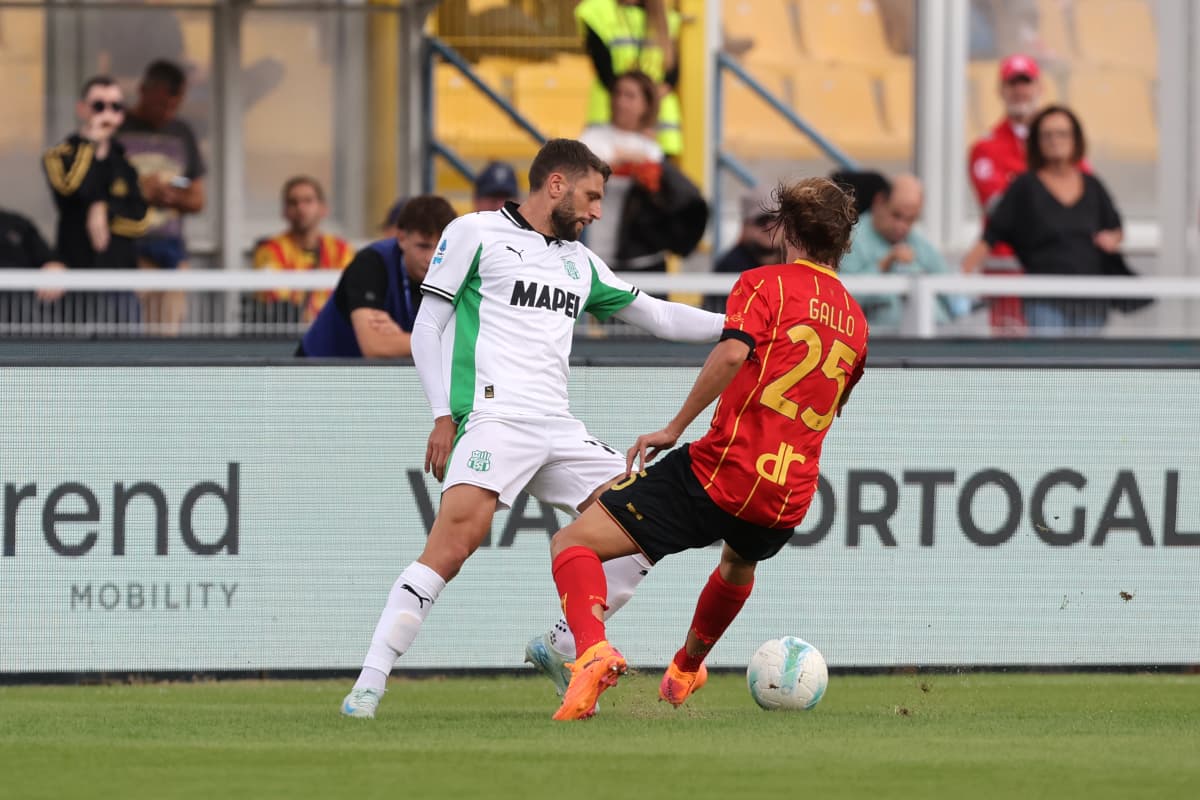
Across the technical area, Eusebio Di Francesco opted for Lecce’s most-used armour: the 4‑2‑3‑1 that has started 21 times this campaign. W. Falcone anchored a back four of D. Veiga, J. Siebert, Tiago Gabriel and A. Gallo. In front, the double pivot of Y. Ramadani and O. Ngom was tasked with screening central spaces and disrupting Sassuolo’s rhythm. The attacking band of S. Pierotti, L. Coulibaly and L. Banda supported lone striker W. Cheddira, a structure designed to spring forward quickly rather than dominate the ball.
Lecce’s own absences were lighter but still significant. M. Berisha (thigh injury) and R. Sottil (back injury) were unavailable, slightly narrowing Di Francesco’s options for in-game adjustments in the final third. With only 27 goals in total this season and 19 matches without scoring, every missing attacking profile matters.
The disciplinary undercurrent was always likely to be a factor. Sassuolo have lived on the edge all season: 24 yellow cards in the 76–90’ window alone – a late-game surge of 29.63% of their cautions – and red cards arriving in the 16–30’, 46–60’ and 76–90’ ranges. Matic, who started in the heart of midfield, embodies that edge: 7 yellows and 1 red this season, yet also 1 goal, 1 assist, 1699 completed passes at 86% accuracy and 43 tackles. He is both metronome and potential flashpoint.
Lecce mirror that volatility in their own way. Their yellow-card peak also comes late, with 29.85% of bookings between 76–90’, and their two reds this season are split between 46–60’ and 91–105’. Ramadani, the archetypal enforcer, leads Serie A’s card charts for his team with 9 yellows; he has also delivered 90 tackles, 11 successful blocks and 46 interceptions, a relentless shield in front of the back four. D. Veiga, with 9 yellows, 95 tackles and 14 blocked shots, adds further bite on the flank.
The “Hunter vs Shield” narrative belonged to Sassuolo’s forwards against Lecce’s defence. Andrea Pinamonti, though starting here on the bench, came into the fixture as Sassuolo’s leading scorer with 9 goals and 3 assists in 35 appearances. His underlying numbers – 57 shots, 30 on target – underline a striker who gets into dangerous zones consistently, even if his penalty record is blemished: 1 missed spot-kick this season, a reminder that this is not a flawless finisher. Alongside him in the season’s story stands Berardi, with 8 goals and 4 assists, plus 32 key passes and 20 shots on target. Between them, they are the cutting edge of a side whose overall attacking average of 1.2 goals per game masks how dangerous they can be when the rhythm clicks.
But Lecce’s shield, while heavily dented by 50 goals conceded overall (26 away), is not without structure. Clean sheets in 9 matches, including 5 on their travels, suggest that when the double pivot of Ramadani and Ngom is compact and the centre-backs’ line is disciplined, they can choke supply into the box. Kialonda Gaspar, even from the bench here, has been emblematic of that resilience: 21 successful blocks across the season and an 84% passing accuracy from the back.
In the “Engine Room” duel, Thorstvedt and Matic against Ramadani and Ngom was always going to be decisive. Thorstvedt’s profile – 4 goals, 4 assists, 32 key passes and 13 blocked shots – blends creativity with graft. He is the player who steps between the lines, linking Laurienté and Berardi to the midfield. Laurienté himself, Serie A’s second-ranked assist provider with 9, plus 7 goals and 54 key passes, is Sassuolo’s chaos generator, constantly driving at defenders (79 dribbles attempted, 29 successful) and winning fouls in dangerous zones.
Ramadani, by contrast, plays in grayscale rather than neon. His 1412 passes at 80% accuracy and 343 duels (190 won) speak of a player who constantly contests the central channel, breaks up play, and keeps Lecce’s transitions clean. When he and Ngom close the distances between lines, they can starve Berardi of the half-spaces he thrives in, forcing Sassuolo wide and into lower-percentage crosses.
From a statistical prognosis perspective, the patterns were clear heading into this fixture. Sassuolo’s home profile – 9 wins, 2 draws, 8 defeats, with 25 scored and 26 conceded – pointed to volatility rather than control. Lecce’s away record – 5 wins, 3 draws, 11 defeats, 15 scored and 26 conceded – suggested a side that can steal games on their travels but rarely dominates. With both teams conceding more than a goal per game (Sassuolo 1.3 overall, Lecce 1.4), any xG model would have leaned towards a match with chances at both ends, tilted slightly by Sassuolo’s superior attacking talent but tempered by Lecce’s desperation and compact shape.
The 3–2 final scoreline, then, fits the underlying numbers: Sassuolo again produced enough to hurt an opponent but were undone by the same defensive looseness that has kept their goal difference in the red. Lecce, for once, punched above their modest attacking averages, capitalising on transitions and set-piece moments to edge a contest that will feel like a small miracle in a season of struggle.
Following this result, the narrative is twofold. For Sassuolo, it is a reminder that an attack built around Laurienté, Berardi and Pinamonti can compete with almost anyone in Serie A, but without a sturdier platform behind them, their ceiling is capped at mid-table turbulence. For Lecce, survival remains a scrap defined not by fluency but by resilience – by Ramadani’s tackles, Veiga’s blocks, Banda’s direct running, and the collective willingness to suffer without the ball.
On a night when numbers and narratives converged, the table tightened, the margins shrank, and both squads left the pitch knowing that their season-long identities had been laid bare under the Reggio Emilia floodlights.