.svg&w=384&q=75 "naujapitch logo")
Real Sociedad vs Real Betis: A Tactical Chess Match Ends in 2-2 Draw
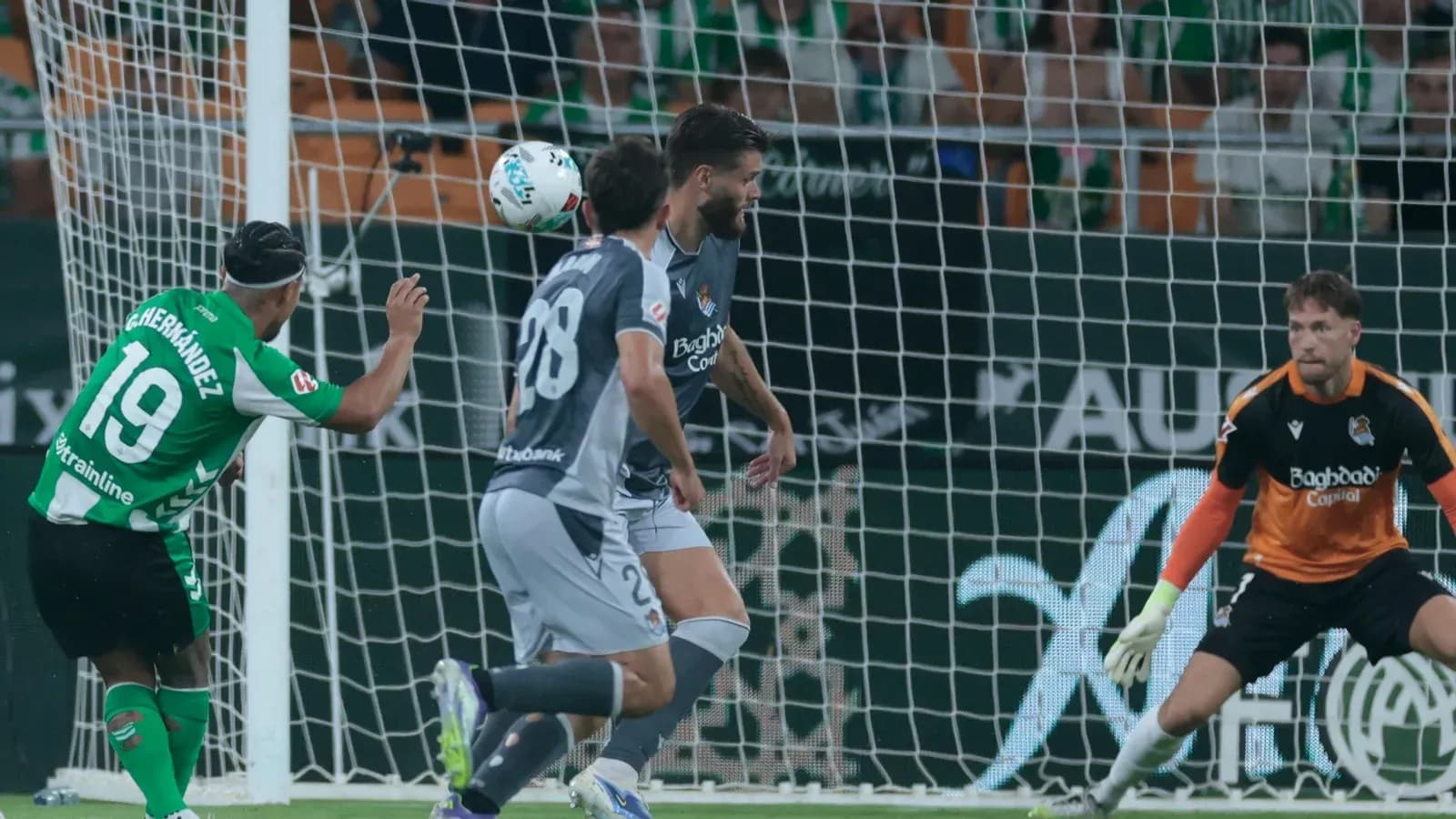
Under the Basque evening sky at Reale Arena, Real Sociedad and Real Betis shared a 2-2 draw that felt less like a dead rubber in “Regular Season - 35” and more like a tactical chess match between two European aspirants. Following this result, the table still tells a story of contrasting routes to the top: Betis sitting 5th on 54 points with a robust overall goal difference of 11 (54 scored, 43 conceded), Sociedad 8th on 44 points with a far more fragile overall goal difference of -1 (54 scored, 55 conceded). One is a side defined by balance and control, the other by volatility and streaks.
I. The Big Picture – Systems, Context, and Seasonal DNA
Real Sociedad’s season has been one long oscillation. Overall they average 1.5 goals scored and 1.6 conceded per game, and the numbers split cleanly between a more expansive Reale Arena version and a more cautious travelling side. At home they have scored 34 and conceded 27 in 18 matches, averaging 1.9 for and 1.5 against. That attacking punch is married to a worrying lack of control without the ball.
Betis, by contrast, arrive with the profile of a Champions League chaser built on stability. Overall they also average 1.5 goals scored, but concede just 1.2 per game. On their travels they sit at 1.3 scored and 1.4 conceded, not spectacular but consistently hard to beat: 5 away wins, 9 draws, only 4 defeats. Manuel Pellegrini’s 4-2-3-1 has been his default weapon, used 25 times this league campaign, and it was again the shape in San Sebastian.
On the night, Pellegrino Matarazzo mirrored his own season-long trend, leaning back into a 4-4-2 he has used 12 times. A. Remiro anchored a back four of S. Gomez, D. Caleta-Car, J. Martin and A. Elustondo, with a midfield band of T. Kubo, J. Gorrotxategi, C. Soler and A. Barrenetxea behind the front pair of M. Oyarzabal and O. Oskarsson. It was an XI that screamed verticality and wing-driven aggression rather than slow possession.
Betis responded with their familiar 4-2-3-1: A. Valles in goal; a back line of R. Rodriguez, V. Gomez, D. Llorente and A. Ruibal; the double pivot of M. Roca and S. Altimira; and a fluid trio of Antony, Pablo Fornals and A. Ezzalzouli supporting Cucho Hernandez.
II. Tactical Voids – Absences and Discipline
The teams entered this fixture carrying significant absences that shaped the tactical landscape. Real Sociedad were without J. Aramburu (suspended for yellow cards), G. Guedes (toe injury), J. Karrikaburu (ankle), A. Odriozola (knee), I. Ruperez (knee) and I. Zubeldia (muscle injury). The loss of Aramburu is more than a name on a list: in La Liga he has made 32 appearances, winning 193 of 340 duels and blocking 9 shots. His 10 yellow cards underline an aggressive, front-foot defender whose absence forced Matarazzo into a different right-side defensive profile with A. Elustondo.
On Betis’ side, M. Bartra (heel) and A. Ortiz (hamstring) were missing, trimming Pellegrini’s defensive rotation. Without Bartra’s experience, the responsibility on V. Gomez and D. Llorente to manage aerial and positional stress increased, particularly against Oyarzabal’s clever movement between the lines.
From a disciplinary standpoint, both squads carried their season-long tendencies into this contest. Heading into this game, Sociedad’s yellow-card distribution showed a steady rise after half-time, with a clear spike between 46-60 minutes (21.62%) and a late-game surge between 76-90 minutes (17.57%). Betis, for their part, are notorious for late bookings: 24.64% of their yellows come between 76-90 minutes, and another 17.39% in 91-105. This is a side that often finishes games on a disciplinary tightrope, even if their red cards have been concentrated in extra time rather than regulation.
III. Key Matchups – Hunter vs Shield, Engine Room Battles
The headline duel was always going to be Mikel Oyarzabal against the Betis defensive block. With 15 league goals and 3 assists in 31 appearances, Oyarzabal is Real Sociedad’s attacking compass. He arrived having taken 61 shots, 36 on target, and scoring 7 penalties from 7 attempts. His threat is as much about timing and intelligence as raw pace, and in this 4-4-2 he operated as a hybrid nine-and-a-half, drifting into pockets between Roca and the centre-backs.
Against him stood a Betis unit that, overall, had conceded just 43 goals in 35 matches. On their travels they had allowed 26 in 18 games, an average of 1.4, a figure that speaks to a side comfortable absorbing pressure. V. Gomez and D. Llorente were tasked with tracking Oyarzabal’s diagonal runs while R. Rodriguez and A. Ruibal had to manage both the width and the underlapping surges of Kubo and Barrenetxea.
In the “Engine Room,” C. Soler and J. Gorrotxategi were pitted against M. Roca and S. Altimira. Fornals’ presence as a high eight/ten added another layer. Fornals’ season numbers – 7 goals, 5 assists, 82 key passes and 86% pass accuracy – underline his role as Betis’ metronome between lines. His ability to receive under pressure and switch play made him the pivot around which Antony and Ezzalzouli could isolate full-backs.
Out wide, the duel between Antony and S. Gomez on one flank, and A. Ezzalzouli against A. Elustondo on the other, was central to the narrative. Ezzalzouli’s campaign – 9 goals, 8 assists, 80 dribble attempts with 38 successes, and 345 duels with 179 won – paints him as a relentless one-v-one machine. Antony, with 8 goals, 6 assists and 50 key passes, is more of a hybrid creator-finisher, but his 5 yellow cards and 1 red show the emotional edge he brings to these contests.
Up front, Cucho Hernandez represented Betis’ “Hunter” in the box. With 10 goals and 3 assists from 30 appearances, he thrives on quick deliveries and second-phase chaos. His duel with D. Caleta-Car and J. Martin was about who could win the first contact and who could react quicker to the second ball.
IV. Statistical Prognosis – What This Draw Says About Both Sides
Without explicit xG numbers from the data, the statistical prognosis must lean on season-long profiles. Heading into this game, both sides averaged 1.5 goals scored overall, but Betis’ defensive record (1.2 conceded per match) significantly outperformed Sociedad’s 1.6. Betis also boasted 10 clean sheets overall to Sociedad’s 3, underlining a structural solidity that usually decides tight encounters.
Yet this 2-2 in San Sebastian fits Real Sociedad’s home DNA: high-event, emotionally volatile, and dependent on Oyarzabal’s finishing and the wing threat of Kubo and Barrenetxea. Their perfect penalty record overall (8 scored from 8, 100.00%) adds another layer of threat in the box, even if spot-kicks did not decide this particular fixture.
For Betis, the draw reinforces their identity as a side that rarely collapses. On their travels they had lost only 4 of 18 before this match, and the ability to emerge from a hostile Reale Arena with a point, despite the home side’s 1.9-goal home average, is consistent with a Champions League-chasing profile.
From a tactical lens, the night underlined three truths. First, Real Sociedad’s 4-4-2 gives them punch but not full control; their overall goal difference of -1 remains the clearest summary of their season. Second, Betis’ 4-2-3-1, driven by the creative triangle of Ezzalzouli, Antony and Fornals, is one of La Liga’s most balanced attacking structures. Third, in a league where margins are thin, the side with the stronger defensive baseline – Betis – remains better placed to turn these wild, open contests into the points that decide European places.