.svg&w=384&q=75 "naujapitch logo")
Premier League Success: Glory and Hidden Struggles
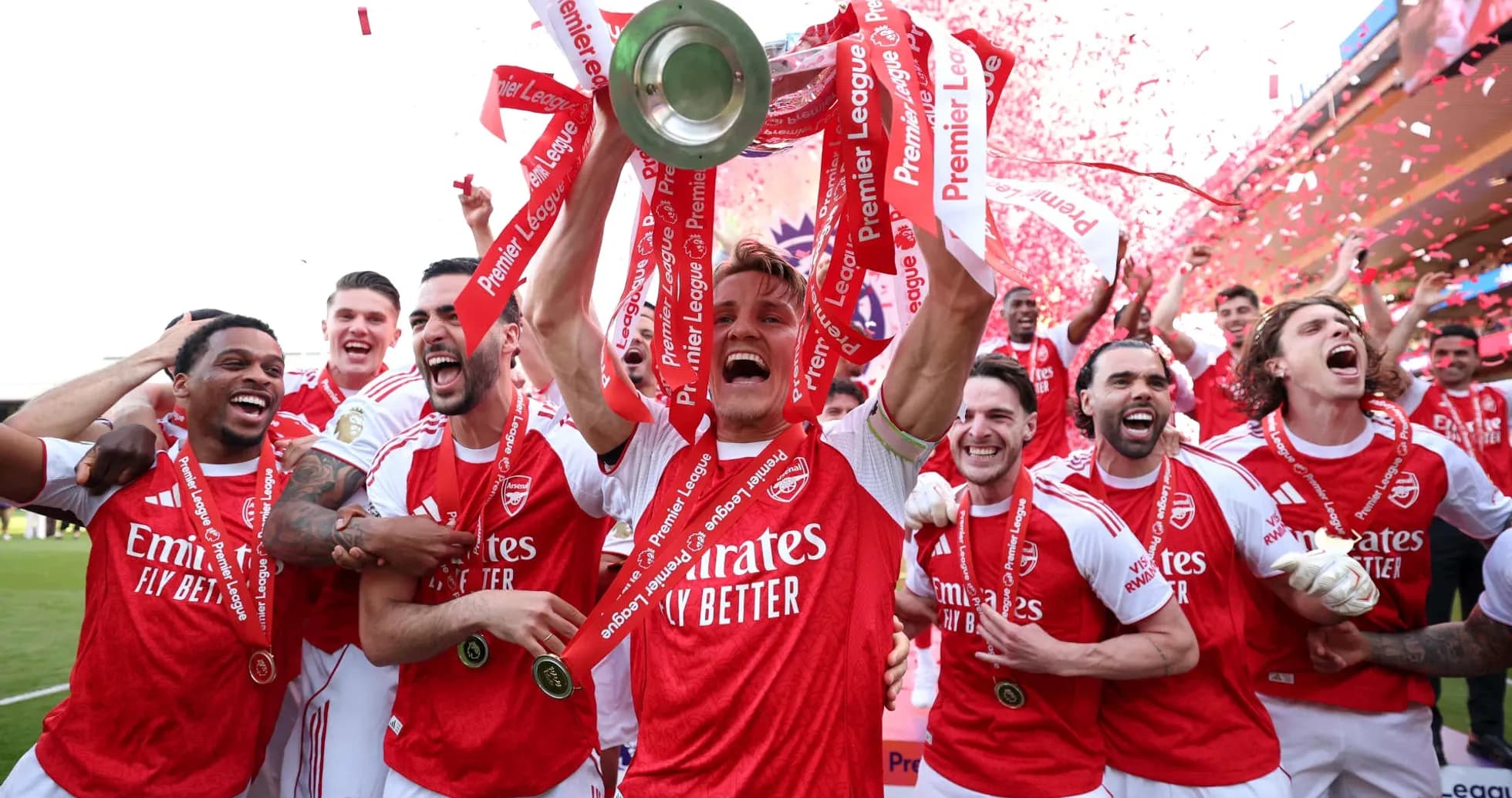
Martin Ødegaard raised the Premier League trophy into the Selhurst Park night and, for a moment, English football looked untouchable. Arsenal, champions again after 22 long years, back on their perch with a 14th league title. A different name on the trophy for the third straight season, after Liverpool in 2024-25 and Manchester City in 2023-24. Variety at the top, drama to the end, a stadium crackling in south London. On the surface, the game has never looked healthier.
Scratch it, though, and the gloss comes off quickly.
A League That Others Envy
The numbers tell one story. England’s top flight is the most competitive at the summit among Europe’s major leagues. Spain, the nearest financial rival, is still largely a private duel between Barcelona and Real Madrid, who have claimed 20 of the last 22 titles between them. In Germany, Bayern Munich have turned the Bundesliga into a long-running procession, winning 13 of the last 14 seasons. France has been much the same, with Paris Saint-Germain taking eight of the last nine.
Serie A stands alone as the exception. Italy has shared its recent honours between Juventus, Inter Milan, AC Milan and Napoli, four different champions in the last seven years. That mix mirrors the Premier League more than any other, yet it is England that sets the financial pace.
English clubs sit at the heart of European competition. Only a penalty shootout defeat for Arsenal against PSG in the Champions League final denied the Premier League a clean sweep of UEFA trophies, after Aston Villa and Crystal Palace claimed the Europa League and Europa Conference League. Chelsea still hold FIFA’s Club World Cup. The message from the pitch is blunt: English clubs dominate.
Off the pitch, the muscle is even clearer. The Premier League’s domestic and overseas broadcast deals dwarf every other competition. Deloitte’s latest ranking of the 30 richest clubs by revenue is half-filled by English sides, a list that stretches beyond the traditional giants to include AFC Bournemouth, Brentford and Brighton & Hove Albion. That is the breadth of the money now in the division.
Yet for all that cash, for all that success, the warning lights are flashing.
Talent Drifting Away
The first concern is sporting, not financial. English football, for decades the magnet, is now seeing some of its best talent head in the opposite direction.
Harry Kane, the England captain, has already gone. Last week, Anthony Gordon left Newcastle United for Barcelona. With that move, six members of England’s squad for the forthcoming World Cup now play their club football abroad.
Once, that would have been a badge of honour. Martin Samuel of The Times captured the mood shift. England used to celebrate when Real Madrid or AC Milan came calling for a homegrown star. Now, almost a quarter of the national squad is based overseas. That feels less like prestige and more like a slow bleed.
The problem is not just who leaves, but who comes in. As Samuel pointed out, the anxiety grows because the same level of quality is not flowing back the other way. The Premier League still attracts stars, but the balance of elite English talent is tilting. For a league that sells itself as the pinnacle, that is not a trend to ignore.
Rich, But Not Healthy
The second concern cuts to the core of the business model. Despite record revenues, only four Premier League clubs — Newcastle, Aston Villa, Bournemouth and Liverpool — turned a profit in the most recent season with published figures. Four, in a league swimming in broadcast money.
Below the top flight, the picture is even starker. Historic clubs such as Derby County and Sheffield Wednesday have gone into administration in recent years, sliding into crisis despite their stature and support. They are not alone. The financial strain runs deep through the pyramid.
Many clubs now lean on creative accounting just to stay within financial fair play rules. Sale-and-leaseback deals on stadiums and training grounds, short-term fixes dressed up as strategy, are increasingly common. The regulations are supposed to protect the sport: to stop a handful of ultra-wealthy owners, including sovereign wealth funds, from inflating transfer fees and wages to a level that drags everyone else into danger.
Instead, they have helped create a landscape where some clubs survive by squeezing value out of their very foundations.
And those wealthy owners the system was designed to restrain? They may not be quite so keen to join the party anymore.
The Fear Factor for Investors
This season delivered a jolt to the boardroom as sharp as any late goal. Tottenham Hotspur, one of the six Premier League clubs that flirted with the ill-fated European Super League in 2021, only just avoided relegation. A club of that size, with that stadium, that revenue potential, staring over the edge.
West Ham United, the Premier League’s eighth-longest serving club and 20th in Deloitte’s Money League, went over it. Relegated. Gone from the top flight despite their financial standing and commercial strength.
For American investors in particular, used to closed leagues and guaranteed places, that kind of jeopardy is a shock to the system. In the NFL or NBA, there is no equivalent to the trapdoor that swallowed West Ham. No scenario where a single bad season can wipe out the financial assumptions on which a takeover was built.
Right now, Liverpool, Manchester United, Crystal Palace, Chelsea and Newcastle are all, in one way or another, on the market or open to new investment. Samuel noted that any prospective buyer will look at what happened to West Ham, at how close Tottenham came, and feel a chill.
Executives at the Premier League will have felt it too. The product they sell is built on peril and unpredictability. Those same qualities can terrify the people writing the cheques.
A Game at a Crossroads
So English football stands in a strange place. On the pitch, it is vibrant, volatile, thrilling. Arsenal lifting the trophy at Selhurst Park, three different champions in three years, English clubs contesting and winning European finals. The envy of the continent.
Beneath that spectacle, the foundations creak: a talent drain at the top end of the national pool, a league where most clubs lose money, a pyramid scarred by administrations, and an ownership model that suddenly looks less enticing to the global billionaires it has come to rely on.
The Premier League has never sold itself better. The question now is whether it can still afford the cost of its own success.