.svg&w=384&q=75 "naujapitch logo")
England's World Cup Win: Celebrations and Consequences
In the grey half-light of a Thursday rush hour outside Durham, the party from the night before met the cold air of reality.
Police cars sat on the roadside, blue lights dormant but presence unmistakable, as officers waved down drivers at random and asked them to blow into a breathalyser. No screeching tyres, no dramatic arrests. Just a quiet, pointed reminder that England’s 4-2 World Cup win over Croatia in Dallas did not end when the final whistle blew.
Durham Constabulary launched the operation on the back of a stark pattern: around 20% more collisions on England match days. With this World Cup being staged in North America and kick-off times pushed late into the UK evening, the concern is no longer just the drive home from the pub. It is the commute the morning after, when the hangover has arrived but the alcohol has not yet fully left the bloodstream.
None of the motorists stopped while the Press Association watched failed the test. One, though, discovered they were uncomfortably close to the limit.
Sergeant Sarah Manser, overseeing the checks, did not bother dressing the message up.
“We come out this morning to give that message that alcohol still might be in your system the next morning,” she said. “We’ve had a couple this morning already who haven’t blown over the limit, but they have had alcohol in the system. Please just don’t and drink-and-drive, it’s just as simple as that.”
On the roadside, drivers like Louis Renwick, who blew clear with no alcohol in his system, backed the clampdown. “There’s too many deaths on the roads through drink-driving,” he said. The football, the beers, the songs – all of that is supposed to stay in the stands and the bars, not spill onto the A-roads.
A World Cup night that didn’t know when to stop
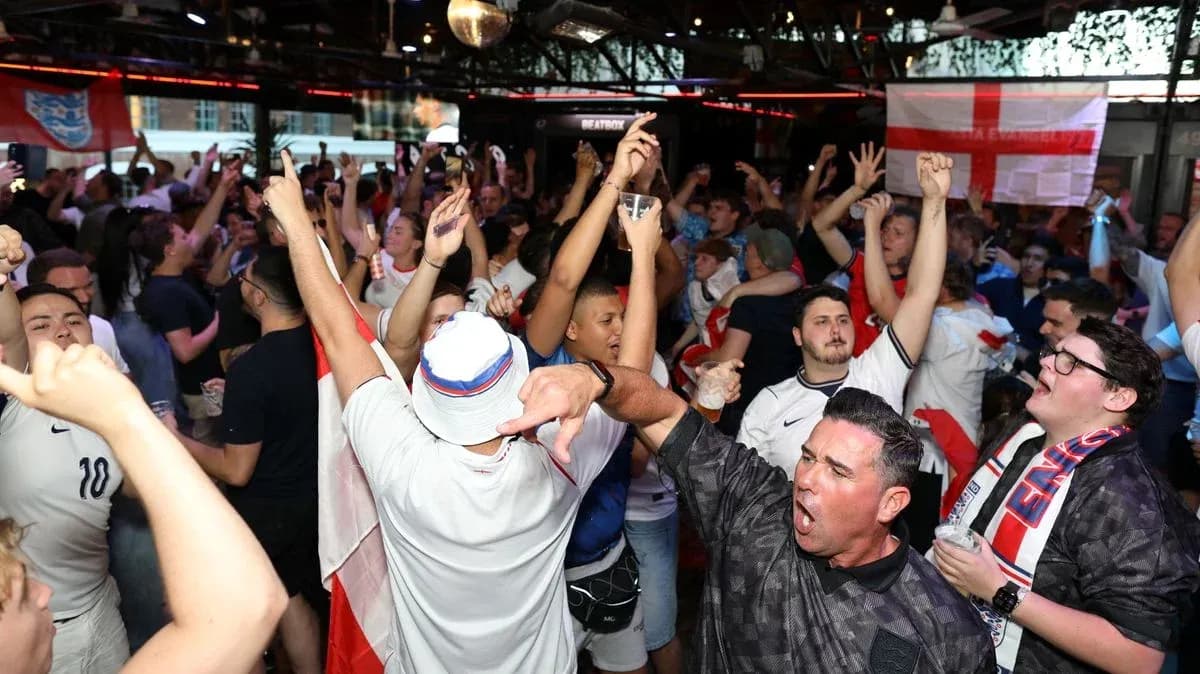
In Dallas, the evening told a very different story. At the Londoner Pub, the World Cup felt less like a football match and more like a festival that had broken its own barriers.
The numbers were eye-watering. Hundreds of England fans packed into the bar. More than 5,000 beers sunk. A total of 2,352 bottles sold. Over £30,000 taken in a single night.
The pub had advertised a later closing time than most venues. Word spread. Fans arrived in waves. Before long, the place was heaving.
Then the authorities stepped in.
Police moved in at the start of the match, footage showing officers forcing fans out even as they belted out the national anthem. The venue had hit maximum capacity, and only two security guards were on duty. What began as a watch party drifted into something closer to a safety operation.
By Wednesday, the Londoner was shut down on the order of the fire marshal.
“We are closed for the rest of the day, on order of the fire marshal,” the pub said in a statement. “Thank you to those of us who saw the mayhem that descended upon us and understand we did our very best to manage the situation.
“The sales are overinflated in reports and do not account for the destruction of our property and landscaping.
“We are incredibly grateful for the business and have done our absolute best to manage it.
“Reminder to our guests: We are in a complex of other businesses, but there are also residences in Mockingbird Station.”
The party had been profitable. It had also been costly.
Inside the “Palace in Dallas”
Inside the stadium, the chaos felt different. It was loud, wild, and yet strangely familiar – like an FA Cup third-round tie dropped into a Super Bowl show.
England’s 4-2 win over Croatia played out in waves. At times it resembled a frantic domestic cup tie. At others, a choreographed global event. Then, as Marcus Rashford’s 85th-minute goal finally killed off Croatian resistance, it turned into a karaoke session.
“Hey Jude” rolled around the stands. “Wonderwall” followed. “Sweet Caroline” was inevitable. And when the fourth goal hit the net, the old refrain erupted: “Football’s Coming Home.”
The atmosphere pulled in more than just travelling England fans. American supporter Jessica Long, a former London Marathon runner, spoke with the kind of wide-eyed excitement that FIFA craves from host cities.
“This is brilliant what an amazing day,” she said. “The World Cup is fantastic – look at everyone coming together.”
For the bookmakers, the performance did more than stir the soul. It shifted the numbers. England’s odds to win the World Cup were clipped from 8/1 to 13/2.
“After a shaky end to the first half, England were excellent in the second 45, and that was a real statement win from Thomas Tuchel’s men,” said Betway spokesperson Lewis Knowles. “They undoubtedly answered a lot of critics last night… there seems to be a real belief that football might actually come home this summer.”
Tuchel’s touch and Kane’s drive
On the pitch, the transformation between halves carried the manager’s fingerprints.
England went in at the break level at 2-2, twice pegged back by Croatia. Tuchel’s response was ruthless and decisive. Tweaks, substitutions, fresh legs – and a completely different contest after the restart.
Kyle Walker, writing in The Sun, drew a clear line between Tuchel and former England manager Gareth Southgate.
“When I look back at the tournaments I played under Gareth Southgate, there is a difference compared to how Thomas Tuchel operates,” Walker wrote. He pointed to the timing and impact of Tuchel’s changes, contrasting them with Southgate’s loyalty to his core XI.
“Sometimes when you’re on the field, you’re thinking ‘go on, make a change, do something’ and Thomas got that right,” Walker added. “If you’ve got Saka, Rogers and Rashford coming on when they did with about 20 minutes left, it would scare any team in the world.”
The pressure finally told. Jude Bellingham struck two minutes into the second half, Rashford wrapped it up late on, and England never looked in danger once they surged ahead.
Harry Kane, who scored twice in the first half to equal Gary Lineker’s 10-goal record as England’s top scorer at World Cups, later revealed the message that reset the mood at half-time.
“He told us to take the shackles off, calm down and let’s go,” the England captain said of Tuchel. “He said what’s the worst that can happen? Show the world who we can be.
“We came out in the second half full gas and they couldn’t live with it, and that’s the level we have to set in every game.”
For Kane, the stakes are personal as well as collective. He is chasing history, trying to become the first man to win the Golden Boot at two World Cups after his 2018 triumph. Watching Kylian Mbappe and Erling Haaland both score braces in their opening games lit a familiar fire.
“Obviously I saw the guys scoring their goals,” Kane said. “As a striker myself, I just want to get on the scoresheet as quickly as possible. In the back of my mind that competition helps me to push my levels.”
Tuchel, who has worked with elite forwards across Europe, did not hold back in his assessment.
“If you see the commitment of our captain, of our number nine, in the extra time to block a crucial shot after a set piece with all his body and his commitment to buy into a defensive action like this, then you know everything about his performance today,” he said. “Complete performance, absolute leader and he is all in – he’s all in physically, he’s all in mentally, and he’s all in.”
Bellingham, the chip, and the conversion
No player divided opinion more going into this tournament than Jude Bellingham. No player did more in Dallas to seize the narrative back.
At 22, the Real Madrid midfielder is already in his fourth major international tournament. His talent has never been in question. His temperament, at times, has been.
Tuchel himself had previously criticised Bellingham’s behaviour, with the England manager saying his own mother found the midfielder’s conduct “repulsive” after a difficult international window last summer. There were doubts about whether Bellingham could fully buy into Tuchel’s idea of “brotherhood”. Injuries kept him out of the September and October camps. His place in the squad – and in the XI – became a topic of debate.
Bellingham answered with a performance that was both defiant and disciplined.
“For me personally, it was nice to put some of the noise aside and just show my country and my team-mates how committed I am to help us try to win football matches,” he told BBC Sport. “It has been a tough season for me but I am feeling fresh and sharp and stronger. I have got a little bit of a chip on my shoulder. That helps me a lot to find that focus early in the game and to find that intensity.”
He did not duck the criticism.
“I know that it’s part of being a footballer and I don’t hold a grudge against anyone who says bad things about me because sometimes I do deserve it,” he said. “Today, it was nice to try to show people and remind people what I’m about.”
Tuchel, who admitted before the game that Bellingham was not guaranteed a starting spot with Morgan Rogers pushing hard, saw exactly what he wanted.
“A very good player, he deserved to start, and that’s what he needs to do to fight for his place,” the Germany coach said.
From the pundits’ gantry, one of his fiercest previous critics changed his tune. Dietmar Hamann, who had bristled at some of Bellingham’s behaviour during his Borussia Dortmund days, acknowledged the shift.
“I saw him for Dortmund for a couple of seasons, and some of the things he did I didn’t like at all,” the former Germany midfielder admitted. But he pointed to Bellingham’s instant impact at Real Madrid, his Champions League win in his first season in Spain, and his display against Croatia as proof of a player who now channels his presence into the team.
“Tonight he looked like a team player,” Hamann said. “When he does play for the team, when he does work for his team-mates, we know he’s an excellent player.”
A tournament that never sleeps
While England basked in their opening win, the World Cup story rolled on elsewhere with its own strange twists.
In Mexico, the military brought down a drone flying near South Korea’s training camp ahead of their Group A meeting with the hosts. Officials used specialised equipment to detect what they described as an “unregistered drone”. No one could say for sure whether it was spying on the team’s preparations.
South Korea coach Hong Myung-bo called it “unfortunate”.
“During our training, there was a drone in the sky that we came to know about the fact,” he said. “But fortunately, it was right before we practised our tactics, so it did not impact us. But while we were preparing for the match, that was the most important timing, so what happened was unfortunate.”
On the pitch, the schedule for day eight underlined how little margin for error remains for others. The Czech Republic face South Africa in a must-not-lose encounter after both were beaten in their opening games. Switzerland meet Bosnia-Herzegovina, then Canada take on Qatar in a Group B where all four sides sit on one point. Mexico and South Korea close the day in a clash that could all but seal a place in the knockouts.
Even Cristiano Ronaldo could not escape scrutiny. His sixth World Cup began with a frustrating draw against the Democratic Republic of Congo, Yoane Wissa cancelling out Portugal’s early advantage. Ronaldo, limited to two half-chances from pull-backs, cut a peripheral figure.
On BBC Radio 5 Live, Chris Sutton accused Portugal boss Roberto Martinez of being “scared” to substitute the 39-year-old.
“He is not the manager,” Sutton said. “He might score the winner, but the game has passed him by. He is a brilliant player. He was once the playmaker, but now he is the poacher. He is not only the poacher, but he runs the estate.”
It was one of the sharpest lines of the tournament so far – and a reminder that reputations, no matter how gilded, are under constant review at this level.
From bar stool to breathalyser
Back in England, though, the story loops from Dallas to Durham in a way that matters beyond tactics and Golden Boot races.
Hundreds of fans in Texas turned a pub into a cauldron and helped generate a five-figure bar take. Thousands more at home stayed up late, drank late, and rode the emotional surge of a comeback win. A day later, on the edge of Durham city centre, officers stopped cars and checked whether that surge had spilled onto the roads.
The message was blunt because it had to be. The World Cup will always encourage excess – of emotion, of noise, of alcohol. The job now, for police forces and fans alike, is to make sure the only thing that spins out of control over the next month is the ball, not the cars heading to work the morning after.