.svg&w=384&q=75 "naujapitch logo")
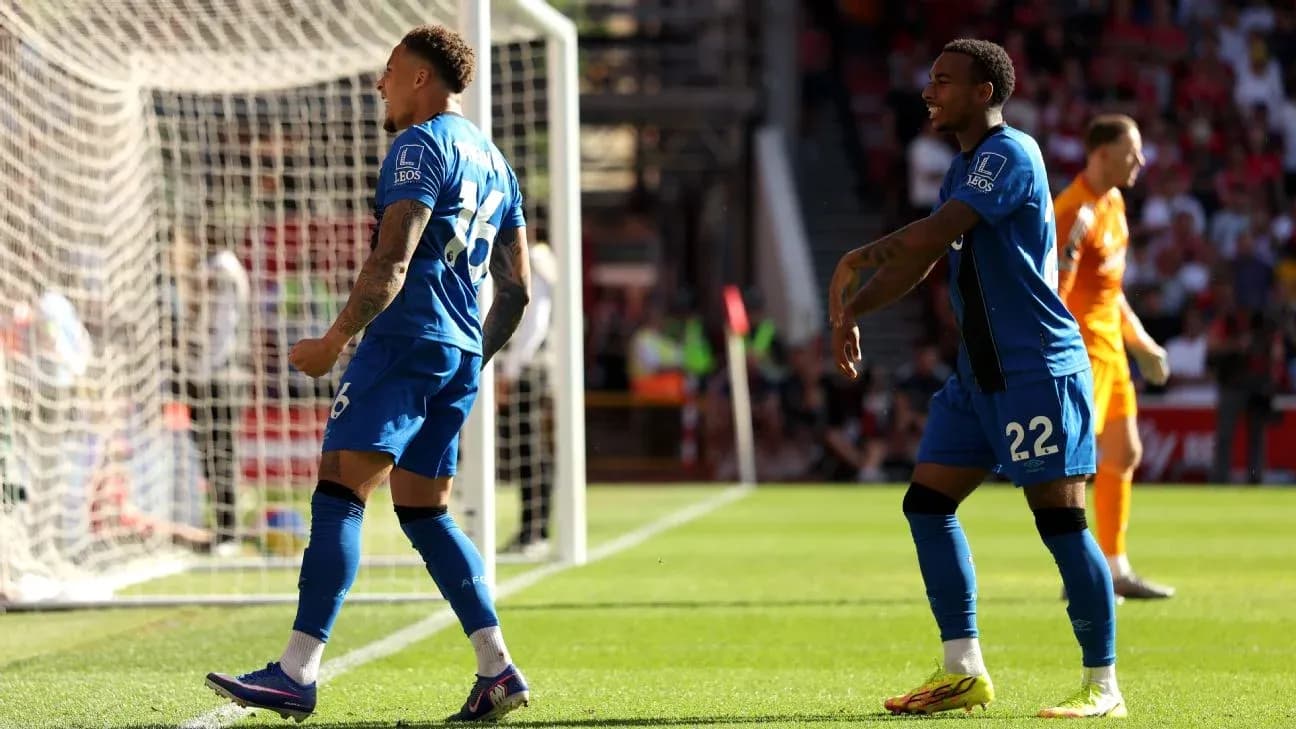
Nottingham Forest vs Bournemouth: Tactical Stalemate in 1-1 Draw
The 1-1 draw at City Ground was a meeting of contrasting game plans that ultimately converged on parity. Nottingham Forest, in a 4-4-2 under Vitor Pereira, leaned into verticality, direct runs from wide midfielders and a high shot volume. Bournemouth, set up by Andoni Iraola in a 4-2-3-1, prioritised control through the double pivot and a higher share of the ball. The statistics underline that split: Forest generated 15 total shots and 1.87 xG from just 45% possession, while Bournemouth’s 55% share yielded 17 shots but only 1.0 xG, reflecting more sterile circulation. Both sides created enough to threaten, but neither managed to tilt the tactical balance decisively.
First Half
Forest’s 4-4-2 was built around clear reference points. Chris Wood and Igor Jesus formed a classic strike pair, with Wood the primary target for direct balls and Igor Jesus tasked with running channels and attacking second balls. The wide midfielders, O. Hutchinson on the right and M. Gibbs-White from the left, were encouraged to come inside aggressively, turning the shape into a situational 4-2-2-2 in possession. That was visible in the opening goal: Gibbs-White’s advanced, central positioning allowed him to arrive as a quasi-second striker and finish after Hutchinson’s supply from the flank.
The double pivot of I. Sangare and E. Anderson provided the structural glue. Sangare anchored in front of the back four, screening Bournemouth’s No. 10 zone and protecting against counters, while Anderson stepped higher to connect with Gibbs-White and Hutchinson between the lines. With 396 total passes and 307 accurate at 78%, Forest were not dominant on the ball but efficient, using possession to launch quick, purposeful attacks rather than long spells of circulation.
Defensive Approach
Out of possession, Forest’s 4-4-2 block was compact rather than ultra-high. The front two screened passes into Bournemouth’s midfield, trying to force play wide, where full-backs N. Williams and Cunha could engage. The back line of Williams, Cunha, N. Milenkovic and Morato was relatively narrow, inviting crosses that they backed themselves to clear. The five blocked shots underline how often Forest managed to get bodies in the way around the box, even as Bournemouth probed.
Bournemouth's Strategy
Bournemouth’s 4-2-3-1, by contrast, was built to dominate territory. T. Adams and A. Toth in the double pivot gave a solid base, with Adams often dropping to form a three in the first phase and Toth stepping into midfield to link with the advanced line of M. Tavernier, E. J. Kroupi and Rayan behind Evanilson. Their 483 total passes, 405 accurate at 84%, and 55% possession show a side comfortable recycling the ball, switching play and trying to stretch Forest horizontally.
However, Bournemouth’s chance creation profile tells a more nuanced story. Despite 17 total shots and 11 efforts from outside the box, their xG of 1.0 indicates a lot of low-quality shooting, often from range or under pressure. Forest’s compact central block forced Bournemouth to circulate around the edges, with A. Smith and A. Truffert providing width but rarely finding clear cut-backs into the heart of the area. When Bournemouth did equalise through Tavernier, it came from that interplay on the flank, Truffert supplying from wide and Tavernier arriving from the line of three to exploit the half-space.
Defensive Performance
Defensively, Bournemouth’s back four of Smith, James Hill, M. Senesi and Truffert held a relatively high line, compressing the middle third and helping them keep Forest’s passing numbers down. Yet the trade-off was vulnerability to direct balls into the channels for Igor Jesus and the advanced movements of Gibbs-White. Forest’s 10 shots inside the box compared to Bournemouth’s 6 highlight how the hosts were more effective at turning possession into genuine penalty-area threat, even with less of the ball.
Game Management
In terms of game management, both coaches used substitutions to adjust the tactical picture. Iraola’s changes in the 73rd minute — J. Kluivert (IN) for E. J. Kroupi (OUT), E. Unal (IN) for Evanilson (OUT) and A. Adli (IN) for Rayan (OUT) — refreshed the front line and added more direct running and penalty-box presence, aiming to turn possession into clearer chances late on. L. Cook (IN) for A. Smith (OUT) at 90' further tilted Bournemouth towards central control, with Cook offering extra composure in build-up as they pushed for a winner.
Pereira’s adjustments were more about preserving structure while adding energy. T. Awoniyi (IN) for C. Wood (OUT) at 62' swapped a back-to-goal target for a more vertical runner, threatening Bournemouth’s high line. L. Netz (IN) for Cunha (OUT) on 63' and R. Yates (IN) for E. Anderson (OUT) plus N. Dominguez (IN) for I. Sangare (OUT) at 65' rebalanced the side, injecting fresh legs in both full-back and midfield zones without altering the basic 4-4-2. J. McAtee (IN) for O. Hutchinson (OUT) at 78' added a more interior, creative profile on the flank, helping Forest retain some threat in transition as the tempo dropped.
Discipline and Duels
Discipline and duels played their part in shaping the rhythm. Bournemouth’s James Hill picked up a yellow card at 33' — James Hill (Bournemouth) — Foul — reflecting Forest’s success in drawing contact when turning quickly. Later, Taiwo Awoniyi (Nottingham Forest) was booked at 67' — Foul — as the game became more stretched and Forest’s forwards pressed and contested aggressively. The foul counts (11 for Forest, 7 for Bournemouth) mirror that narrative: Forest’s more reactive, transition-focused approach naturally invited more defensive interventions, while Bournemouth’s ball-dominant plan kept them from overcommitting in the tackle.
Goalkeeping Performance
Between the posts, both goalkeepers were tested but not overwhelmed. M. Sels (Nottingham Forest) made 3 saves, underpinning a defensive effort that limited Bournemouth largely to lower-value efforts despite their shot volume. At the other end, D. Petrovic (Bournemouth) also registered 3 saves, crucially preventing Forest from turning their superior xG into a second goal that would likely have decided the match. The goals prevented figures (both at -0.5) suggest that each goalkeeper conceded slightly more than the model would expect from the shots faced, but within a narrow band that points more to finishing variance than glaring errors.
Statistical Verdict
The statistical verdict reinforces the tactical reading. Forest’s 1.87 xG from 15 shots, 10 of them inside the box, confirms that their more direct, vertical 4-4-2 produced clearer chances despite ceding the ball. Bournemouth’s 1.0 xG from 17 shots and 55% possession illustrates a side that controlled territory but struggled to consistently access premium zones, often settling for shots from distance (11 outside the box) or under pressure, as evidenced by Forest’s 5 blocked shots.
Set Pieces
Set pieces and restarts were another subtle battleground. Forest’s 6 corner kicks to Bournemouth’s 3 point to more sustained pressure phases for the hosts, particularly around their spells of attacking momentum. Yet Bournemouth’s structure in open play, anchored by the Adams–Toth axis and their capacity to recycle possession, prevented those moments from turning into overwhelming waves.
In the end, the 1-1 scoreline at City Ground reflects a tactical stalemate between Forest’s efficient, chance-focused 4-4-2 and Bournemouth’s controlled but sometimes blunt 4-2-3-1. Forest can point to the xG edge and superior box presence as evidence they might have edged it; Bournemouth will highlight their control of possession, passing accuracy and territorial dominance. From a tactical standpoint, each side imposed its identity, but neither found the final layer of precision needed to turn structure into victory.