.svg&w=384&q=75 "naujapitch logo")
Negreira Case: A New Chapter in the Madrid-Barcelona Rivalry
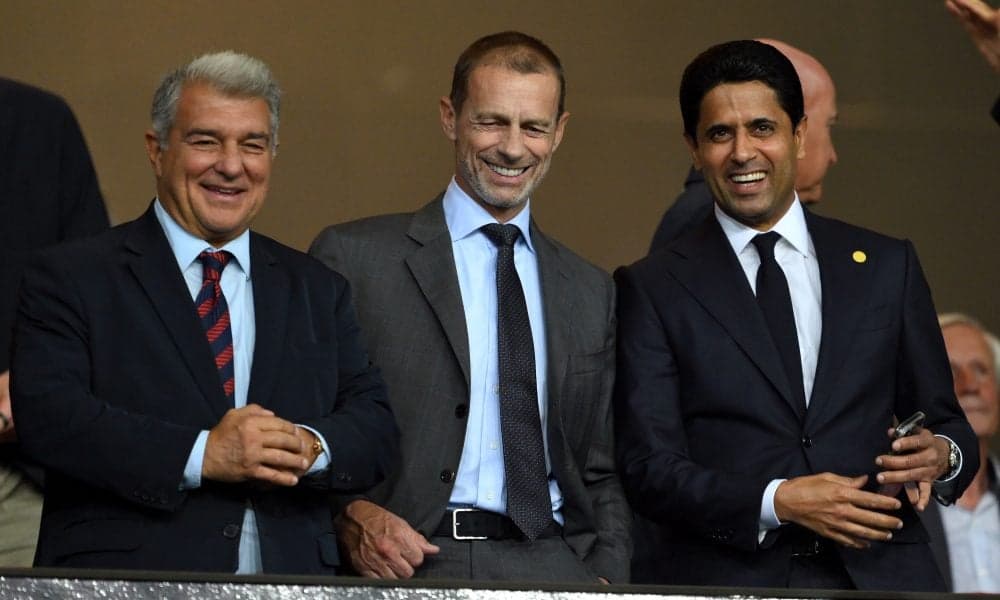
The Negreira case has roared back into the centre of Spanish football, reigniting the cold war between Real Madrid and Barcelona and dragging UEFA into the crossfire.
Barely a day after Florentino Pérez publicly branded it the “biggest scandal in history” and pointed the finger squarely at Barcelona, the legal reality has begun to cut through the noise. Madrid are pushing hard, demanding that UEFA step in and punish their great rival. They believe Europe’s governing body offers a route where Spanish institutions have stalled.
On paper, it sounds simple: invoke UEFA’s disciplinary machinery, lean on Article 4, and go after Barcelona for damaging the integrity of the game. In practice, it runs straight into a wall.
The clock that saved Barcelona
That wall is time.
The payments at the heart of the Negreira case stretch from 2001 to 2018. The scandal only exploded into public view in 2023, when Cadena SER revealed the relationship between Barcelona and José María Enríquez Negreira, the former vice-president of the referees’ committee.
By then, the clock had already done its work.
Article 9 of the RFEF Disciplinary Code is blunt: very serious offences expire after three years, counted from the day after the infringement took place. The last alleged payments date back to 2018. The story did not surface until five years later. That means the period in which any sporting body could open a disciplinary case had already run out before anyone even filed a document.
The consequence is stark. In Spain, both the CSD and the RFEF have had their hands tied, not by lack of will or interest, but by the statute of limitations. The case may be alive in the courts and in the media, but in sporting terms, the window slammed shut long ago.
UEFA’s hands are tied the same way
Real Madrid’s hope lies in UEFA. They point to Article 4 of UEFA’s disciplinary regulations, which allows the body to act against clubs whose behaviour brings the game into disrepute, even if they have not been punished domestically.
The problem for Madrid is that UEFA operates under its own version of the same time limits.
The European body cannot simply ignore its own statute of limitations to make an example of Barcelona. Its disciplinary framework mirrors the Spanish one on this point: once the deadline passes, the case is untouchable from a sporting sanctions perspective. No matter how explosive the allegations, no matter how loud the political pressure, the rules shut the door.
UEFA is not bound by Spanish court rulings, and it does not need a domestic sanction to open its own file. But it cannot leap over the expiry of the disciplinary period. That is the red line.
So while the Negreira case continues to fuel accusations, press conferences, and a deepening institutional feud between Madrid and Barcelona, the key question for UEFA has already been answered by the calendar, not by a committee.
The battle for moral ground will rage on. The battle for sporting sanctions, under current rules, is already lost.