.svg&w=384&q=75 "naujapitch logo")
Napoli Dominates Pisa in Tactical Clash
Arena Garibaldi felt like two different seasons colliding. On one side, Pisa, already condemned to relegation, rooted to 20th with 18 points and a goal difference of -44, trying to salvage pride from a brutal Serie A baptism. On the other, Napoli, marching in as the league’s second-placed powerhouse on 73 points and a +21 goal difference, still sharpening their edge heading into the final bend of the campaign.
The 3-0 scoreline to Napoli, built on a 2-0 half-time advantage and calmly managed to full time, reflected not just a gap in quality but a clash of tactical identities. Pisa’s 3-5-2 under Oscar Hiljemark has been the season’s default – the formation they have used in 20 league matches – but here it felt more like a survival mechanism than a blueprint for resistance. Antonio Conte, meanwhile, went with a 3-4-3, a variation of the back-three structure that has defined Napoli’s season (their most-used shape remains the 3-4-2-1, played 21 times), and it gave his side both control and vertical threat.
Pisa’s season-long numbers framed the task. Heading into this game, they had scored just 9 goals at home at an average of 0.5 per match, while conceding 26 at 1.4 per game. Overall, 25 goals for and 69 against across 37 matches spoke of a side that has rarely been able to turn defensive toil into attacking release. Their five clean sheets in total have been drowned out by 21 matches in which they failed to score.
Napoli arrived with a very different statistical DNA. On their travels they had scored 25 goals at an average of 1.3 and conceded 18 at 0.9 per away game, underpinned by 8 away clean sheets. Overall, they had 57 goals for and 36 against, a balanced, well-drilled contender whose defensive control is as important as their offensive firepower.
Hiljemark’s lineup was a mix of necessity and conviction. Injuries and suspensions stripped Pisa of depth and variation: R. Bozhinov and F. Loyola were both out with red-card bans, while F. Coppola, D. Denoon and M. Tramoni were missing through muscle and ankle issues. Lorran was listed as inactive. That left Pisa leaning heavily on the experience of A. Caracciolo at the back and the work rate of M. Aebischer in midfield.
Caracciolo’s season tells the story of a defender under siege. With 71 tackles, 24 successful blocks and 51 interceptions, he has been the last line of resistance in too many waves, and his 10 yellow cards underline how often he has had to step across the line to halt danger. Aebischer, with 1 goal, 1 assist and 33 key passes from midfield, has been Pisa’s main conduit between defence and attack, but here he was again tasked with plugging gaps as much as creating.
In front of them, M. Hojholt and E. Akinsanmiro flanked Aebischer in the central band, with S. Angori and M. Leris as wide midfielders. On paper, that five-man line could compress Napoli’s central lanes, but Pisa’s season-long tendency to retreat deep – and their habit of collapsing late, with 25.97% of their yellow cards coming between 76-90 minutes – hinted at a side that would eventually buckle under sustained pressure.
Conte’s Napoli, by contrast, looked like a machine built for control and sudden violence. The back three of S. Beukema, A. Rrahmani and A. Buongiorno offered height, aggression and calm distribution, shielding A. Meret, who has benefited from a team that has kept 14 clean sheets overall. Ahead of them, the double pivot of S. Lobotka and S. McTominay was the game’s quiet axis of power.
McTominay has been one of Serie A’s standout midfield scorers this season, with 10 goals and 3 assists from 32 appearances. His 71 shots, 34 on target, speak to a midfielder who arrives late into the box and tests goalkeepers relentlessly. Defensively, his 28 tackles and 13 successful blocks add an enforcer’s edge to his scoring instincts. Lobotka’s metronomic presence beside him allowed Napoli to dictate the rhythm, drawing Pisa’s midfield line out and then slicing into the spaces that opened behind.
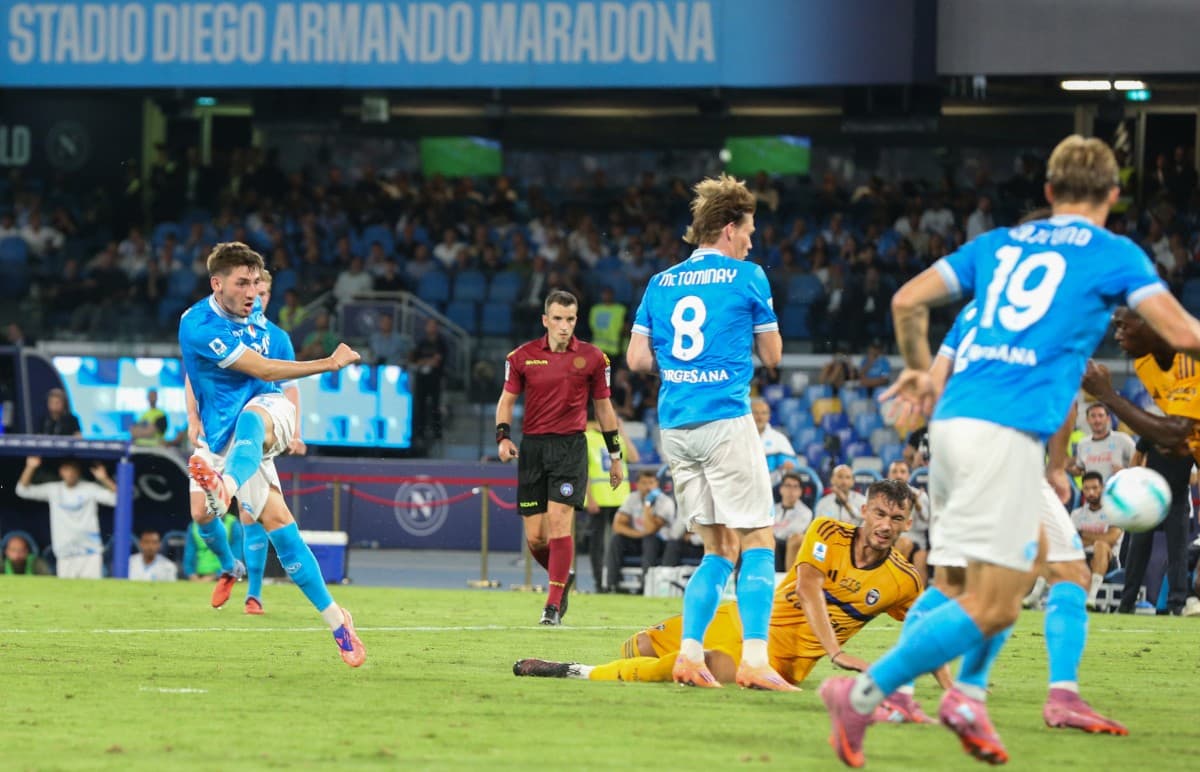
Out wide, G. Di Lorenzo and L. Spinazzola provided the width that Pisa’s narrow 3-5-2 struggled to contain. Every time Angori or Leris stepped out to confront them, lanes opened for Napoli’s front three: E. Elmas drifting between the lines, Alisson Santos attacking the channels, and R. Højlund as the central spear.
Højlund’s season numbers framed him as the “Hunter” in this contest. With 11 league goals and 5 assists, plus 44 shots (23 on target) and 31 key passes, he has evolved into both finisher and creator. His 303 duels and 51 fouls drawn underline the physical battle he constantly invites. Against a Pisa defence that has conceded 1.9 goals per game overall and 2.4 on their travels – but still a worrying 1.4 even at home – Højlund was always likely to find space, especially when Caracciolo and S. Canestrelli were dragged into wide or front-foot duels.
The disciplinary subtext added another layer. Pisa’s season-long card profile shows a late-game spike, with 18.18% of their yellows between 31-45 minutes and another 18.18% between 61-75, before that 25.97% surge in the final quarter of an hour. Napoli, meanwhile, tend to pick up their yellows between 61-75 minutes (30.61%), the phase where Conte’s sides often raise the intensity of their press. That intersection – Pisa tiring and desperate, Napoli ramping up – was always likely to tilt the match further in the visitors’ favour as time went on.
Napoli’s own red-card pattern is curious: both of their reds this season have arrived between 76-90 minutes. That risk of late volatility is the only real blemish on an otherwise disciplined unit, but with the game already well in hand here, it never truly threatened to swing the narrative.
The absences on the Napoli side – David Neres (ankle), R. Lukaku (hip) and M. Politano (suspended for yellow cards) – might have clipped some of their attacking variety, particularly Politano’s creative output of 5 assists and 36 key passes. Yet Conte’s bench still carried high-level solutions: K. De Bruyne as a potential late-game conductor, F. Anguissa and B. Gilmour as alternative midfield profiles, and Juan Jesus as a versatile defensive option whose 37 tackles and 10 successful blocks this season underline his reliability, even if his 9 yellow cards and one yellow-red warn of his combative edge.
Following this result, the statistical prognosis for both squads hardens into something close to final judgment. Pisa’s season-long averages – 0.7 goals scored and 1.9 conceded per match overall – have been lived out again in microcosm: limited attacking threat, overburdened defenders, and a structure that can resist for spells but rarely for the full 90. Their 12 draws and 23 defeats from 37 games tell of a team that often hangs on but almost never seizes control.
Napoli, conversely, have once more validated their blend of solidity and incision. With 1.5 goals scored and just 1.0 conceded on average overall, plus 22 wins from 37, they resemble a side whose xG and defensive metrics would almost certainly paint them as one of the division’s most stable powers. The clean sheet in Pisa fits neatly into a pattern of away control, and the three goals align with a front unit that, even without some of its stars, continues to find solutions.
In narrative terms, this match felt less like a contest and more like a confirmation. Pisa’s 3-5-2, stretched and battered all season, ran headlong into a Napoli 3-4-3 that knew exactly where to probe and when to accelerate. The Hunter – Højlund – roamed against a back line that has spent the year firefighting; the Shield – Napoli’s back three plus Lobotka and McTominay – snuffed out a home attack that has struggled to reach even 1.0 xG in many outings.
The tactical ledger closes with a simple truth: Napoli’s structure, personnel and season-long numbers all pointed towards a controlled, multi-goal victory with a strong chance of a clean sheet. At Arena Garibaldi, the pitch merely brought those probabilities to life.