.svg&w=384&q=75 "naujapitch logo")
Manchester City vs Aston Villa Tactical Analysis: Control vs Incision
Manchester City’s 4-2-2-2 against Aston Villa’s 4-2-3-1 produced a tactical story of control versus incision at Etihad Stadium, with Unai Emery’s side winning the key battles in both boxes to overturn a 1-0 deficit into a 1-2 away victory.
City’s structure in possession was textbook Guardiola: J. Trafford (Manchester City) behind a back four of R. Lewis, J. Stones, R. Dias and N. Ake, with Nico and B. Silva as the double pivot and a narrow band of A. Semenyo and Savinho supporting a front pair of P. Foden and T. Reijnders. The 4-2-2-2 morphed into a 3-2-5 in many phases, with Lewis stepping inside and Ake tucking in to create a back three, while Semenyo and Savinho occupied the half-spaces.
The plan initially worked. City’s 52% possession and 458 total passes, with 405 accurate (88%), show a side largely dictating tempo. Their 16 total shots, including 10 from inside the box, underline that they regularly reached dangerous zones. The opening goal on 23 minutes from A. Semenyo, for Manchester City, was the logical outcome of this territorial dominance: City successfully overloaded Villa’s double pivot of L. Bogarde and Douglas Luiz, pulling the visitors’ 4-2-3-1 narrow and creating space between full-back and centre-back.
Yet, for all their volume, City’s final-third efficiency was modest. Only 3 shots on goal from 16 attempts, plus 6 blocked shots, indicate slow ball circulation at the edge of the area, allowing Aston Villa’s back four to recover shape and get bodies in the way. The xG figure of 1.25 aligns with a team that created steady but not overwhelming chances, and M. Bizot (Aston Villa) needed to make only 2 saves. Villa’s defensive line, with A. Garcia and I. Maatsen wide and V. Lindelof–T. Mings central, held a relatively compact block, trusting that City’s narrow front four could be crowded out centrally.
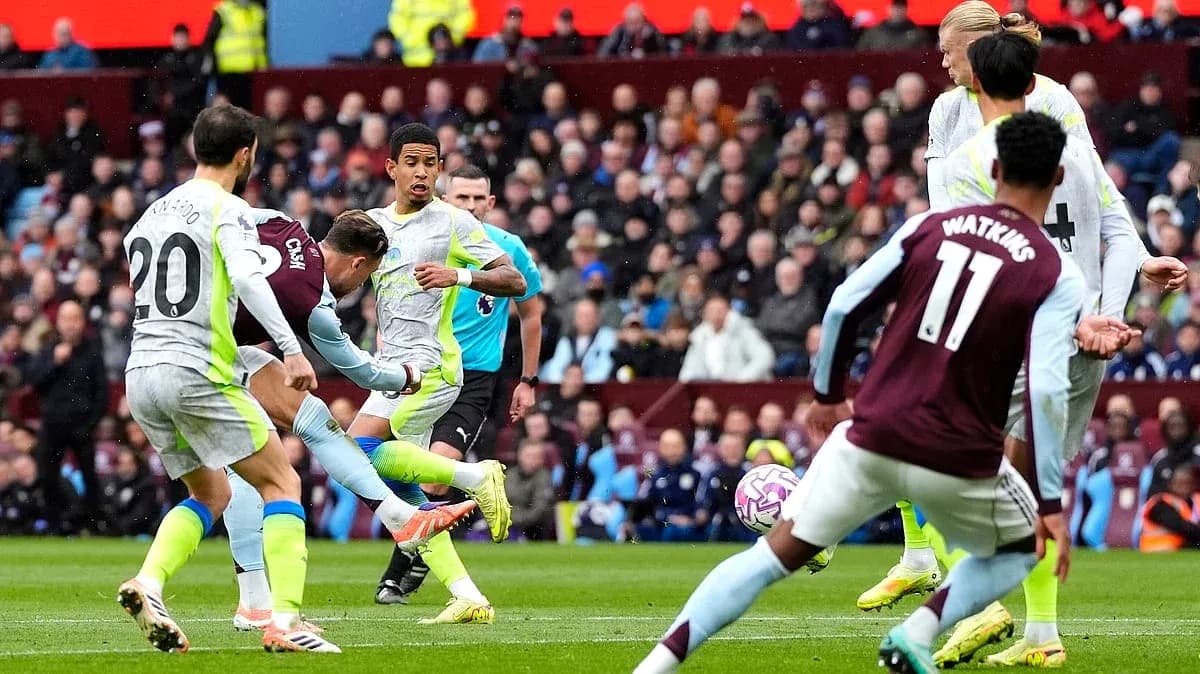
The game pivoted around Emery’s use of transitions and his adjustment at half-time. At the break, Aston Villa were 1-0 down but had already shown they could threaten in space. The substitution at 46', with M. Cash (IN) coming on for A. Garcia (OUT), sharpened Villa’s right flank both defensively and on the counter. Within a minute, at 47', O. Watkins struck the equaliser for Aston Villa, exploiting the space behind City’s advanced full-backs. That goal crystallised Villa’s strategy: absorb, then attack quickly into the channels.
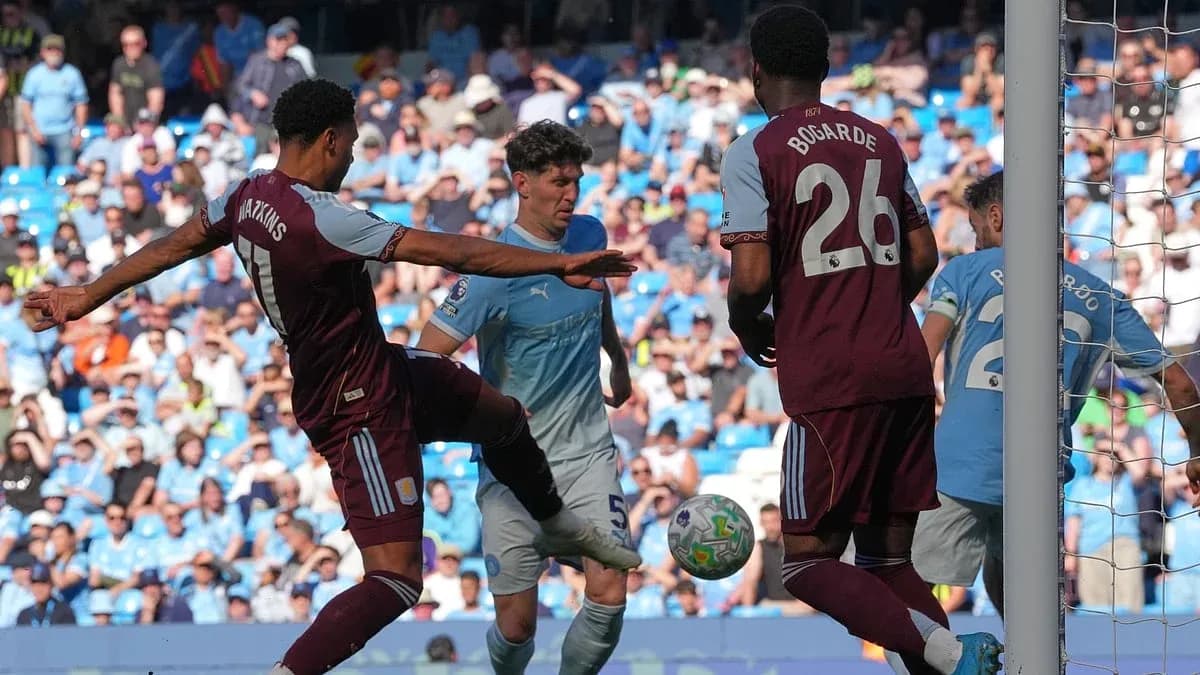
Villa’s 12 total shots, 9 from inside the box, with 5 on goal, reveal a far more vertical and selective approach. Their xG of 1.58, higher than City’s despite less possession (48%), underlines that their chances were clearer. O. Watkins’ second goal at 61', assisted by R. Barkley, was emblematic: Villa broke through the first line of City’s press, Barkley received between the lines and released Watkins into a high-value area. VAR’s “Goal confirmed” check at 63' reinforced how tight those margins were, but the pattern was consistent—Villa repeatedly found ways to isolate Watkins against City’s centre-backs in dynamic situations.
Out of possession, Aston Villa’s 4-2-3-1 compacted into a mid-block, with E. Buendia and L. Bailey tucking in to help L. Bogarde and Douglas Luiz screen central zones. Their foul count—just 4, and no yellow cards—shows they controlled space more through positioning than disruption. The double pivot stayed narrow, forcing City to either recycle through the back or play into crowded central pockets where interceptions and blocks were likely. As the game wore on, Emery’s triple change on 73'—Y. Tielemans (IN) for Douglas Luiz (OUT), P. Torres (IN) for V. Lindelof (OUT), and A. Onana (IN) for L. Bogarde (OUT)—refreshed the spine and preserved intensity in the press and counters.
Guardiola’s response was to chase more direct threat and fresh legs. On 58', R. Cherki (IN) came on for A. Semenyo (OUT), and on 59', M. Kovacic (IN) replaced B. Silva (OUT), subtly changing the profile of City’s midfield from control to ball-carrying and late runs. Later, J. Doku (IN) for T. Reijnders (OUT) and R. Ait-Nouri (IN) for N. Ake (OUT) at 77', plus J. Gvardiol (IN) for J. Stones (OUT) at 78', tilted City further towards aggressive wing play and high full-backs. The disallowed potential goal for Phil Foden at 90+2', ruled out by VAR, showed how close City came to rescuing a point, but also how much they were relying on late, high-risk surges rather than controlled, repeatable patterns.
Defensively, Manchester City’s structure was less convincing. J. Trafford (Manchester City) faced 5 shots on goal and made 3 saves. The 2 goals conceded align with the numbers: Villa generated fewer but higher-quality looks, often with Watkins attacking the space between full-back and centre-back after City had committed numbers forward. City’s lone booking—Rico Lewis (Manchester City) at 82' for “Foul”—reflected some desperation as they tried to break Villa’s rhythm in transition.
Statistically, the verdict is of a match where surface control did not translate into scoreboard control. City had more shots (16 vs 12), more corners (9 vs 4), and marginally more of the ball (52% vs 48%), and completed more passes—458, with 405 accurate (88%)—but Aston Villa’s 436 passes, 394 accurate (90%), show they were nearly as secure technically while being far more incisive. Villa’s blocked shots (2 vs City’s 6) and their superior xG (1.58 to 1.25) underline that they turned their possessions into cleaner chances.
In the end, the tactical balance favoured Emery: his 4-2-3-1 absorbed City’s positional play, protected central spaces, and launched O. Watkins into the exact zones City were weakest. Guardiola’s late structural tweaks increased volume but not efficiency, and with M. Bizot (Aston Villa) only required to make 2 saves, Villa’s defensive game plan and transition threat were enough to secure a disciplined, tactically coherent 1-2 away win.