.svg&w=384&q=75 "naujapitch logo")
Liverpool vs Brentford: Tactical Analysis of the 1-1 Draw
Liverpool’s 1-1 draw with Brentford at Anfield was defined by territorial dominance from Arne Slot’s side against a compact, resilient 4-2-3-1 block from Keith Andrews, with the numbers underlining how sharply the game split between control and efficiency. Liverpool produced 24 shots to Brentford’s 11, held 60% of the ball and generated 2.9 xG against the visitors’ 1.22, yet needed a second-half surge to avoid turning superiority into defeat.
Structurally, both teams mirrored each other on paper with 4-2-3-1 systems, but their interpretations diverged. Liverpool’s back four of C. Jones, I. Konate, V. van Dijk and A. Robertson played high and wide, enabling the full-backs to occupy advanced lanes and pin Brentford’s wide midfielders. The double pivot of R. Gravenberch and A. Mac Allister provided circulation and counter-pressing platforms, allowing the attacking trio of R. Ngumoha, D. Szoboszlai and M. Salah to operate between lines behind C. Gakpo.
The shot map profile is telling: 17 of Liverpool’s 24 attempts came from inside the box, with 8 on target and 8 blocked. This reflects sustained pressure and repeated access into Brentford’s penalty area, but also Brentford’s commitment to last-ditch defending. The visitors’ centre-backs S. van den Berg and Nathan Collins, shielded by V. Janelt and Jordan Henderson, consistently dropped into the area to narrow shooting angles, explaining the high blocked-shot count.
Out of possession, Brentford’s 4-2-3-1 flattened into a 4-4-1-1, with K. Schade and D. Ouattara tracking Liverpool’s full-backs and M. Jensen working to screen passes into Szoboszlai and Salah. The visitors conceded territory but focused on vertical threat: 9 of their 11 shots came from inside the box, indicating that when they did break, they reached genuinely dangerous zones rather than settling for hopeful efforts from range.
Scoring Pattern
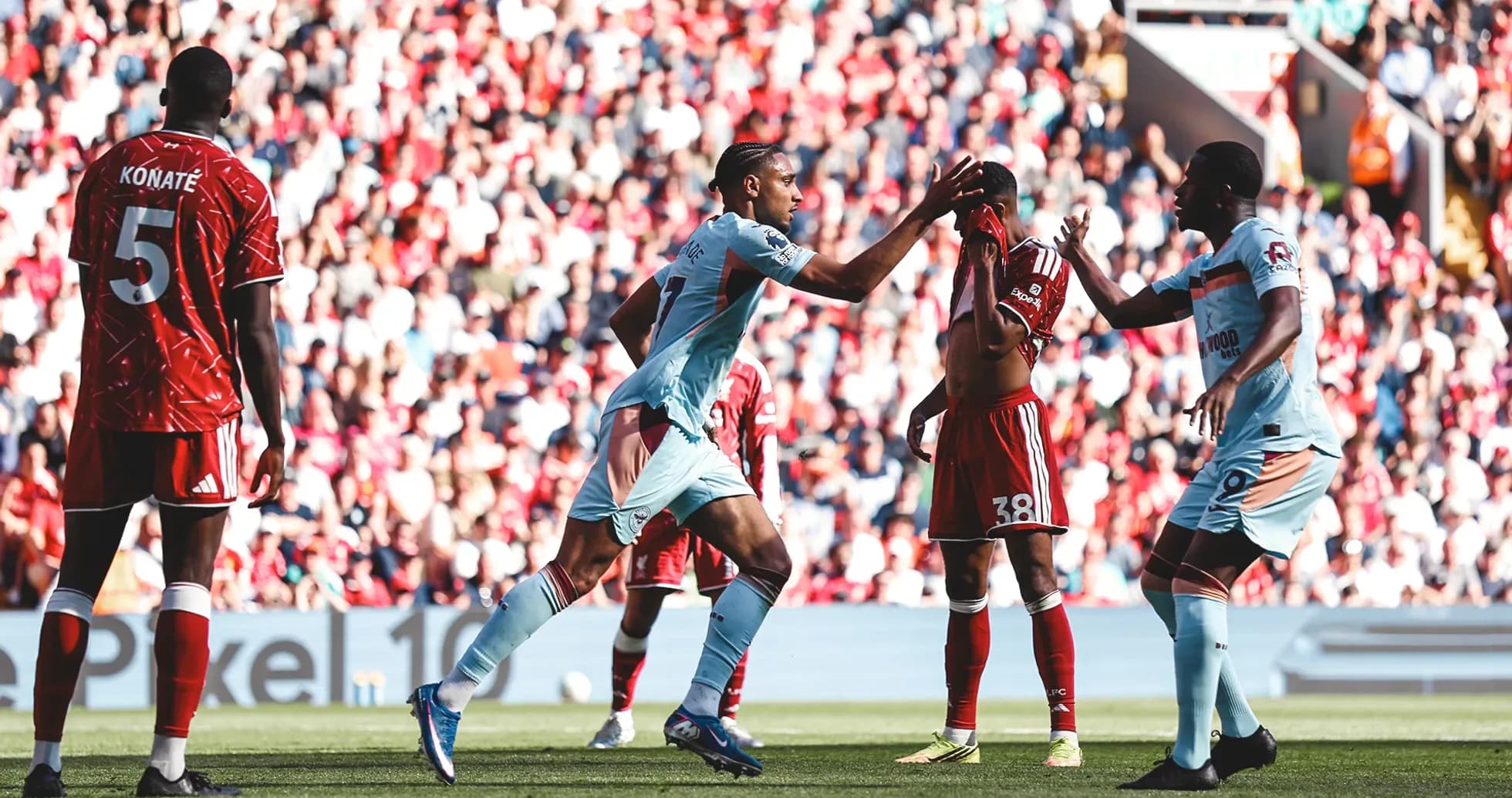
The scoring pattern reflects the tactical battle. Liverpool’s breakthrough at 58' came from C. Jones, assisted by M. Salah, and was a logical outcome of mounting pressure and overloads down the flanks. Brentford’s equaliser at 64', finished by K. Schade, highlighted their transition plan: absorb, then attack quickly into the space left by Liverpool’s aggressive full-backs and high line. With both goals arriving in a six-minute window, the game briefly opened up before Brentford re-consolidated their block.
In goal, Alisson (Liverpool) was largely a spectator in terms of volume, credited with 1 save, but the team’s goals prevented figure of 1.4 points to the importance of the few interventions and the defensive unit’s ability to limit shot quality. On the other side, C. Kelleher (Brentford) was central to the result. He made 7 saves, and Brentford’s goals prevented metric of 1.4 underscores how often he and his defence defied the underlying xG. The disparity between Liverpool’s 8 shots on goal and Brentford’s 2 further emphasises how much more sustained attacking work Kelleher faced.
The passing data reinforces Liverpool’s territorial control. They completed 503 passes, with 434 accurate at 86%: a strong possession structure that allowed them to keep Brentford pinned back for long stretches. Brentford, by contrast, completed 331 passes, 262 accurate at 79%. Their lower volume and accuracy are consistent with a more direct, risk-tolerant approach in transition, accepting turnovers in exchange for quicker progression when space appeared.
Set pieces and wide pressure were another key front. Liverpool forced 14 corner kicks to Brentford’s 2, repeatedly hemming the visitors in and recycling attacks. This high number of corners, combined with the volume of blocked shots, paints a picture of sustained siege around Brentford’s box, with the away side defending deep and narrow, often with all ten outfield players inside their own third.
Discipline and game management also shaped the rhythm. Brentford collected three yellow cards, Liverpool two, with the reasons highlighting the emotional and physical demands of defending for long periods. Before kick-off, at -5', Jordan Henderson (Brentford) was booked for “Argument”, signalling early tension. Later, Ibrahima Konaté (Liverpool) received a yellow at 79' for “Foul” as Liverpool pushed to regain control after the equaliser. In stoppage time, Alexis Mac Allister (Liverpool) was cautioned at 90+2' for “Foul”, while Brentford’s late-game resistance featured bookings for Nathan Collins at 90+5' and Vitaly Janelt at 90+4', both for “Argument” amid a frantic finish. The matching foul count (9-9) shows that while Liverpool had more of the ball, Brentford were not shy about contesting duels and disrupting rhythm when needed.
Substitutions
Substitutions were clearly tactical rather than merely rotational. For Brentford, A. Hickey (IN) came on for J. Henderson (OUT) at 60', adding defensive legs and natural full-back qualities to cope with Liverpool’s wing pressure. M. Damsgaard (IN) replaced M. Jensen (OUT) at 83', giving fresher energy between the lines for counters. Later, R. Nelson (IN) for K. Lewis-Potter (OUT) at 89' offered pace to threaten Liverpool’s high line late on.
Slot’s changes were aimed at refreshing the press and adding creativity. F. Wirtz (IN) came on for R. Ngumoha (OUT) at 73', injecting playmaking between lines. J. Frimpong (IN) for M. Salah (OUT) at 74' suggested a desire for more direct running from the right. At 83', M. Kerkez (IN) for A. Robertson (OUT) and T. Nyoni (IN) for R. Gravenberch (OUT) added dynamism on the left and new energy in midfield. Finally, J. Gomez (IN) for I. Konate (OUT) at 89' stabilised the back line for the closing phases as Liverpool chased a winner without sacrificing defensive cover against counters.
Statistically, Liverpool’s 2.9 xG against Brentford’s 1.22, combined with the shot and corner dominance, indicates that over a larger sample of similar games they would expect to win more often than not. However, Brentford’s compact 4-4-1-1, disciplined penalty-box defending, and the performance of C. Kelleher (Brentford) bridged that gap. The identical goals prevented values (1.4 for each side) suggest that both defensive units outperformed the quality of chances faced, but Liverpool will view this as two points dropped given the control they exerted. Brentford, conversely, can frame the draw as a tactically executed away result: limited possession, efficient box entries, and a goalkeeper-anchored rearguard that bent under pressure but did not break.