.svg&w=384&q=75 "naujapitch logo")
Inter Held to Draw by Resilient Hellas Verona
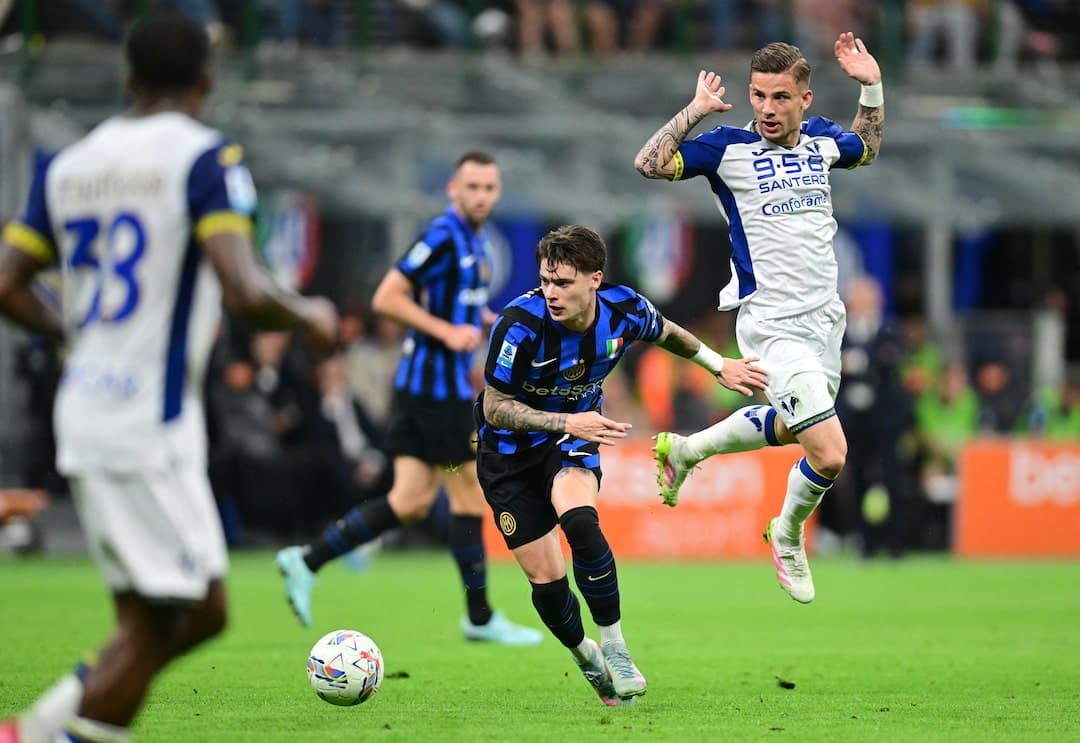
Stadio Giuseppe Meazza, late in the Serie A season, and a script that refused to follow the table. Inter, heading into this game as league leaders on 86 points with a formidable +54 goal difference (86 goals for, 32 against overall), were expected to brush aside a Hellas Verona side marooned in 19th with 21 points and a -34 goal difference (25 for, 59 against overall). Instead, the 1-1 draw over 90 minutes became a study in tactical resistance and squandered superiority.
Inter lined up in their now-institutional 3-5-2, Cristian Chivu staying loyal to the shape that has been deployed in all 37 league matches. Y. Sommer anchored the back three of M. Darmian, S. de Vrij and F. Acerbi, a unit that has underpinned an outstanding defensive record: at home Inter have conceded only 16 goals in 19 matches, an average of 0.8 per game. Ahead of them, the wing-backs Carlos Augusto and Luis Henrique flanked a central trio of H. Mkhitaryan, P. Sucic and A. Diouf, with A. Bonny supporting L. Martinez up front.
Across from them, Paolo Sammarco made a conscious decision to bow to the context. Verona, whose season has been defined by fragility – 59 goals conceded overall at an average of 1.6 per game, including 33 on their travels at 1.7 per away match – dropped into a 5-3-2. M. Frese, N. Valentini, A. Edmundsson, V. Nelsson and R. Belghali formed a five-man line in front of L. Montipo, while R. Gagliardini, S. Lovric and A. Bernede tried to compress the central lanes. Up front, T. Suslov and K. Bowie were more out-balls than outright strikers.
The absences only deepened Verona’s underdog posture. D. Mosquera, G. Orban, D. Oyegoke and S. Serdar were all listed as missing, stripping Sammarco of both depth and variation. Orban’s absence in particular removed a direct, chaotic presence in transition from a team already short of goals, with only 25 in total this campaign and an identical 0.7 average goals scored per game both at home and away.
Inter, by contrast, were able to start their talisman. Lautaro Martínez – the league’s top scorer in this data set with 17 goals and 6 assists – led the line. His season numbers sketch the “hunter” profile clearly: 69 shots, 39 on target, 246 duels contested and 112 won, a forward who initiates as much as he finishes. Behind him, the creative weight of this Inter side was mostly on the bench at kick-off: F. Dimarco, with 16 assists and 94 key passes, and N. Barella, with 8 assists and 72 key passes, waited as potential game-changers rather than starters. H. Çalhanoğlu, another conductor with 9 goals, 4 assists and a league-leading passing accuracy of 90%, also began among the substitutes.
That selection choice shaped the narrative. Without Dimarco’s left-footed supply line and Barella’s vertical surges from midfield, Inter’s 3-5-2 felt more functional than flamboyant. The structure was familiar, the automatisms clear, but the final ball lacked its usual venom. Inter’s season-long attacking profile is devastating – 86 goals overall at an average of 2.6 at home and 2.0 on their travels – yet Verona’s deep 5-3-2 managed to slow the tempo and deny the half-spaces.
This is where the disciplinary and psychological layers came into play. Verona arrived with a reputation for walking the disciplinary tightrope. Their season data shows a side living on the edge: yellow cards heavily clustered between 31-60 minutes (20.93% from 31-45 and 23.26% from 46-60) and red cards spiking late, with 50.00% of their reds coming in the 76-90 minute range. Gagliardini, with 10 yellows and 73 tackles plus 54 interceptions, is the archetypal enforcer; J. Akpa Akpro and M. Frese add 9 and 8 yellows respectively, a trio conditioned to foul and disrupt.
Inter’s card profile is almost the mirror opposite. They pick up 30.65% of their yellows in the 76-90 minute band, but crucially have no red cards recorded in any time range. It is a team that can live with late pressure without tipping into self-destruction. That discipline, combined with 18 clean sheets overall and only 2 matches at home where they have failed to score, usually means late-game control rather than chaos.
In this match, however, Verona’s defensive shell held just enough. The “hunter vs shield” duel – Lautaro and the most prolific attack in Italy against a defence that has already conceded 59 times – should, on paper, have been decisive. Inter’s home average of 2.6 goals per game up against Verona’s away concession rate of 1.7 suggested a multi-goal afternoon. Yet Montipo, protected by a narrow back five and screened by Gagliardini’s 285 duels (169 won) and 13 blocked shots, turned the contest into something closer to a siege than a shootout.
In the engine room, the contrast was just as stark. Inter’s best playmakers – Çalhanoğlu with 41 key passes and Dimarco with 94 – are metronomes capable of pinning opponents back with sheer circulation and set-piece threat. Verona’s midfield, by comparison, is built more for survival than creation: Gagliardini’s 1166 passes and 81% accuracy are solid but conservative, Lovric and Bernede tasked more with closing gaps than opening them.
Following this result, the statistical prognosis is almost paradoxical. Inter’s season-long xG profile, implied by their 86 goals from 37 matches and a relentless shot volume from players like Lautaro and Thuram, remains that of a title-winning juggernaut. Their defensive solidity – only 32 goals conceded overall, less than 1 per game – underlines a structure that very rarely breaks. Verona, with just 3 wins in 37 and 19 matches without scoring, still project as a side whose margin for error is essentially zero.
And yet this 1-1 at San Siro is a reminder that football is played inside game states, not spreadsheets. A Verona side stripped of key attackers, forced into a 5-3-2 they have used only sparingly this season, managed to bend but not break. Inter, even with their overwhelming statistical weight, discovered that without their full creative battery from the start, the most dominant campaign can still be punctuated by stubborn resistance.