.svg&w=384&q=75 "naujapitch logo")
Golden Boot Race: Messi, Mbappe, and the 2026 World Cup Showdown
“Sometimes in football, you have to score goals.”
Thierry Henry tossed that line out in 2008. In 2026, with only four games left at this World Cup, it feels less like a cliché and more like the cold, sharp truth that will decide medals, legacies and one very precious piece of individual silverware: the Golden Boot.
The trophy has a strange habit of dodging the eventual world champions. No winner of the men’s Golden Boot has lifted the World Cup itself since Ronaldo thundered in eight goals for Brazil in 2002. Just Fontaine’s mythical 13-goal haul for France in 1958 still stands untouched, a number that looks almost cartoonish in the modern game.
Yet this is no ordinary tournament. Sixteen extra teams, 40 more matches than Qatar 2022, and a flood of goals have turned the scoring charts into a nightly drama. The World Cup is nearing its climax. The race for top scorer is already there.
How the Golden Boot is decided
There is no mystery about how the award is settled, only ruthlessness.
If players finish level on goals, the first tiebreak is assists — a rule in place since 1992. It famously settled the 2010 race when Thomas Muller edged David Villa, Diego Forlan and Wesley Sneijder. All scored five. Muller added three assists; the others managed just one each.
Since 2006, if goals and assists are still tied, the award goes to the player who needed the fewest minutes on the pitch to score them. Efficiency over volume.
With that in mind, the numbers this year tell their own story.
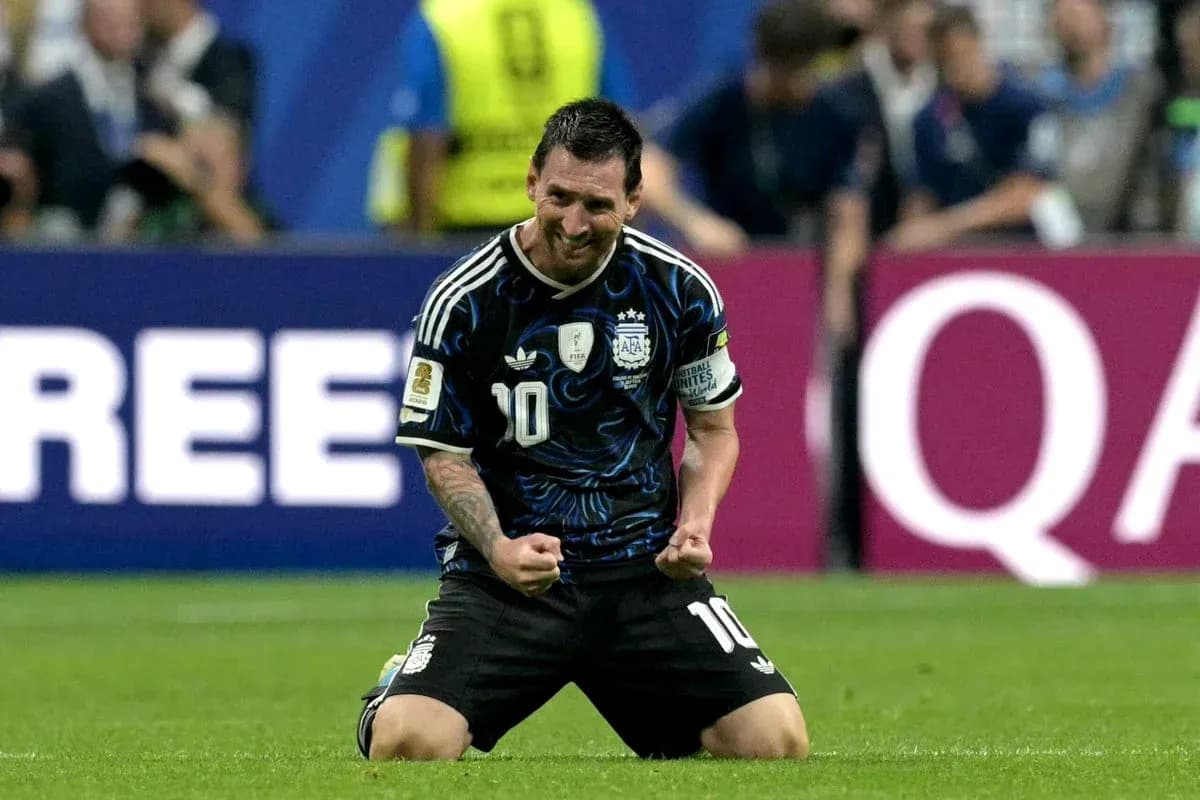
1. Lionel Messi (Argentina) – 8 goals
(4 assists – 712 minutes)
At 39, Lionel Messi is not just stretching the record books; he is rewriting them.
He thought he had opened his 2026 account early against Algeria, only for VAR to rule him offside. No matter. Later in the first half, he took the ball 20 yards out and whipped it in with that familiar, effortless violence.
After the break, he pounced again. Luca Zidane spilled a low shot from Alexis Mac Allister, and the Argentina captain did what he has done for two decades — arrived first, finished calmly.
The hat-trick goal was pure Messi theatre: a curling strike from the edge of the box, shaped like a pass to a ghost runner behind the goal, Zidane rooted and helpless.
His fourth came against Austria after he had already missed a penalty. Facundo Medina slid a pass into him, and Messi swept in first time. That finish pushed him clear as the men’s World Cup all-time leading scorer. He then added a fifth in the same game, stabbing home from close range after his initial effort had been blocked.
He did not even start Argentina’s final group match against Jordan. It did not matter. With 10 minutes left, he stepped up and bent a free kick into the net, another addition to a catalogue that needs its own library.
In the knockouts, he struck again in the round of 32 against Cape Verde, then delivered his eighth in the most dramatic fashion — a late equaliser against Egypt, another rescue act in a career full of them.
Eight goals. Four assists. More minutes than Mbappe, but a complete body of work that stretches across the tournament.
2. Kylian Mbappe (France) – 8 goals
(3 assists – 666 minutes)
Kylian Mbappe arrived in North America as the reigning Golden Boot holder and the new face of Real Madrid. He has played like a man determined to keep the crown.
He started with a brace in a 3-1 win over Senegal, all acceleration and venom. Against Iraq, he opened the scoring with a strike from range, then returned after a long weather delay in Philadelphia to double France’s lead.
The group stage was only the warm-up. When the knockouts began, Mbappe stayed ruthless. Two precise finishes against Sweden in the round of 32. A penalty converted against Paraguay. Another goal against Morocco in the quarter-final, the kind of relentless scoring that breaks opponents’ belief.
Then came Spain. For the first time in this tournament, Mbappe and France hit a wall. A 2-0 defeat in the semi-final left them out of the title race and bound for the third-place play-off on Saturday.
Mbappe stands level with Messi on eight goals, but trails on assists and minutes. One more game, one last chance to tilt the numbers back in his favour.
3. Erling Haaland (Norway) – 7 goals*
(0 assists – 537 minutes)
Erling Haaland waited his whole career to step onto a World Cup stage. He wasted no time once he got there.
Two goals on debut in a 4-1 win over Iraq set the tone. The first was quintessential Haaland — a sliding finish from six yards, meeting David Moller Wolfe’s low cross with brutal simplicity. The second came from sheer force of will as he charged down the goalkeeper and bundled the ball into the net.
Against Senegal, he swept in a composed finish for his third of the tournament, then added a fourth with a clever volley. The goals were not just frequent; they were decisive.
His fifth might have been the most important of all: a late winner from close range against Ivory Coast in the round of 32, snatching a 2-1 victory.
Then came Brazil, and Haaland tore into them. Two more goals, his sixth and seventh, as Norway stunned the five-time champions in the last 16. The second that night caught everyone off guard, a surprise strike from a man who usually announces his intentions with a roar.
Norway are out now. Haaland is stuck on seven. No assists, fewer minutes than both Messi and Mbappe. His Golden Boot hopes rest on others failing to move.
4. Jude Bellingham (England) – 6 goals
(1 assist – 574 minutes)
Jude Bellingham has turned from midfield prodigy into England’s driving force.
He scored in both of England’s opening group wins, first in a 4-2 victory over Croatia, then in a more controlled 2-0 against Panama. His timing from deep, his composure in front of goal — both have become central to England’s attacking identity.
The knockouts pushed him up another level. Two goals against Mexico in the last 32. Two more in the quarter-final against Norway, dragging England forward when the margins tightened.
He sits on six goals with a single assist, but crucially with fewer minutes played than his captain Harry Kane. If the tiebreakers come into play, that efficiency could matter.
5. Harry Kane (England) – 6 goals
(1 assist – 627 minutes)
Harry Kane knows this territory. He won the Golden Boot in 2018 with six goals. He is back on that number again.
The Bayern Munich striker opened his campaign with a brace in the 4-2 win over Croatia. Against Ghana, he struggled along with the rest of England in a goalless draw, marked and frustrated.
He responded by scoring England’s second goal in the final group match against Panama, restoring some rhythm.
In the round of 32, Kane turned match-winner again. Two second-half goals against DR Congo carried England through, a reminder of his enduring knack for decisive moments. He then added a penalty against Mexico in the last 32, pushing his tally to six.
Like Bellingham, he has one assist. Unlike Bellingham, he has spent more time on the pitch. If both finish level, the numbers favour the younger man.
=6. Ousmane Dembele (France) – 5 goals
(2 assists – 492 minutes)
Ousmane Dembele arrived at this World Cup with an odd statistic: 19 major tournament appearances, no goals.
That changed in a rush.
He scored France’s third in the 3-0 win over Iraq, finally breaking his drought. Then he exploded against Norway, hitting a first-half hat-trick, a blur of movement and finishing that underlined why PSG built so much of their attack around him.
His fifth came in the quarter-final against Morocco, another sharp finish to round off a personal resurgence.
Dembele’s five goals and two assists have transformed his international reputation. Like Mbappe, he has only the third-place play-off left to add to his total.
=6. Mikel Oyarzabal (Spain) – 5 goals
(1 assist – 519 minutes*)
Mikel Oyarzabal’s World Cup began with frustration. Spain drew their opener with Cape Verde, a flat start for a team with title ambitions.
He helped flip the mood in the second match. Spain beat Saudi Arabia 4-0, and the Real Sociedad forward scored twice, both finishes clean and confident.
He repeated the double act in the round of 32, striking twice in a 3-0 win over Austria that underlined Spain’s growing control of the tournament.
His most important contribution, though, came from the penalty spot in the semi-final against France. Oyarzabal stepped up and opened the scoring, a calm finish under huge pressure.
Five goals, one assist, and at least one more game to play. His name is now firmly etched into this World Cup’s story.
=8. Vinicius Junior (Brazil) – 4 goals*
(1 assist – 505 minutes)
Vinicius Junior’s World Cup began with a rescue mission.
Morocco led Brazil in their opener, and the pressure began to build. Vinicius answered with an emphatic, whipped finish to level the match, the kind of strike that snaps a giant awake.
Against Haiti, with Brazil already cruising thanks to two goals from Matheus Cunha, he added his second of the tournament, a flourish in a dominant performance.
His third came against Scotland, capitalising on a mistake from Scott McKenna and sliding the ball past Angus Gunn to open the scoring. His fourth was a far simpler affair: a back-post header from a teasing Bruno Guimaraes cross.
Brazil are out. Vinicius is done at four. The numbers will not move now, but the impression he left will.
=8. Ismaila Sarr (Senegal) – 4 goals*
(1 assist – 419 minutes)
Ismaila Sarr lit up Senegal’s Group I campaign.
Against Norway, the Crystal Palace winger scored twice in a 3-2 defeat. The first was improvised brilliance — an unorthodox clipped finish while falling to the floor. The second, more orthodox, was no less sharp.
He added a third goal in Senegal’s final group game against Iraq, then struck again against Belgium in the round of 32.
Four goals, one assist, and a reminder of his threat on the biggest stage. Senegal’s exit froze his tally, but not his reputation.
=8. Julian Quinones (Mexico) – 4 goals*
(1 assist – 440 minutes)
Julian Quinones scored the first goal of this World Cup. That alone is a neat piece of trivia. His full body of work is far more substantial.
He opened the tournament by netting in Mexico’s 2-0 win over South Africa, then struck again in a 3-0 victory over Czech Republic. In the last 32 against Ecuador, he once more broke the deadlock, a recurring theme in Mexico’s campaign.
He even found the net against England in the knockout rounds, underlining why he dominated the Saudi Pro League last season with 33 goals in 31 games.
Four goals and an assist from the wing. Mexico are out, but Quinones has announced himself to a wider audience.
The chasing pack
Behind them, 11 players sit on three goals, all hoping for a late surge or a chaotic semi-final to thrust them into the conversation. For some, the chance has already gone, their teams eliminated and their numbers fixed in place.
The weight of history
The Golden Boot has existed officially as the ‘Golden Shoe’ since 1982, though the top scorer has been honoured, formally or not, since the 1930s. The roll of names tells the story of the World Cup itself.
In 2022, Mbappe scored a hat-trick in the final, joining Geoff Hurst as only the second man to do so. Unlike Hurst in 1966, he did not leave with the trophy. His eight goals tied Ronaldo’s 2002 mark for the most at a single World Cup in the modern era.
Four years before that, Kane’s six goals powered England to a semi-final, where they fell to Croatia. The pattern has held: the Golden Boot winner often walks away with individual glory and collective regret.
Now, with 2026 heading for its final act, Messi and Mbappe are level again, Haaland lurks one behind, and Bellingham, Kane, Dembele and Oyarzabal wait for any slip.
Four games remain. The World Cup will crown a champion. The Golden Boot will crown a finisher. Which matters more to the men chasing both?