.svg&w=384&q=75 "naujapitch logo")
Sweden's Tactical Domination: 5-1 Victory Over Tunisia
Sweden’s 5-1 win over Tunisia at Estadio BBVA was built on a clear structural contrast: Graham Potter’s aggressive 3-1-4-2 against Sabri Lamouchi’s conservative 5-3-2. Despite Tunisia edging possession 51% to 49%, Sweden controlled the game through verticality, coordinated movements from the front two, and an assertive high press that repeatedly exposed Tunisia’s back five.
In Sweden’s 3-1-4-2, the three centre-backs — Gustaf Lagerbielke, Isak Hien and Victor Lindelöf — formed a broad first line, allowing wing-midfielders Alexander Bernhardsson and Gabriel Gudmundsson to push very high and pin back Tunisia’s wing-backs Ali Abdi and Amine Ben Hmida. Jesper Karlström operated as the single pivot in front of the defence, giving Sweden both a rest-defence anchor and a simple outlet to recycle possession. Ahead of him, Benjamin Nygren and Yasin Ayari acted as dual number eights, constantly jumping into the half-spaces to link with the front two, Viktor Gyökeres and Alexander Isak.
The shot profile underlines how well this structure worked: Sweden generated 13 total shots, with 9 inside the box and 7 on target, plus 3 blocked. Their xG of 1.36 suggests they scored far above expectation, but the volume and location of chances show sustained territorial dominance. Tunisia, by contrast, were restricted to just 6 shots (2 on target), with only 2 inside the box; most of their threat came from distance, reflected in 4 shots from outside.
First Half
Early on, Sweden’s central overloads dismantled Tunisia’s 5-3-2 block. With Tunisia’s midfield three (Rani Khedira, Ellyes Skhiri, Hannibal Mejbri) tasked with covering both Sweden’s double eights and the pivot, Ayari and Nygren repeatedly found pockets between the lines. The opening goal at 7' from Yasin Ayari encapsulated this: Sweden broke through the inside channels, and with Tunisia’s back line pinned by Gyökeres and Isak, Ayari could arrive from midfield to finish.
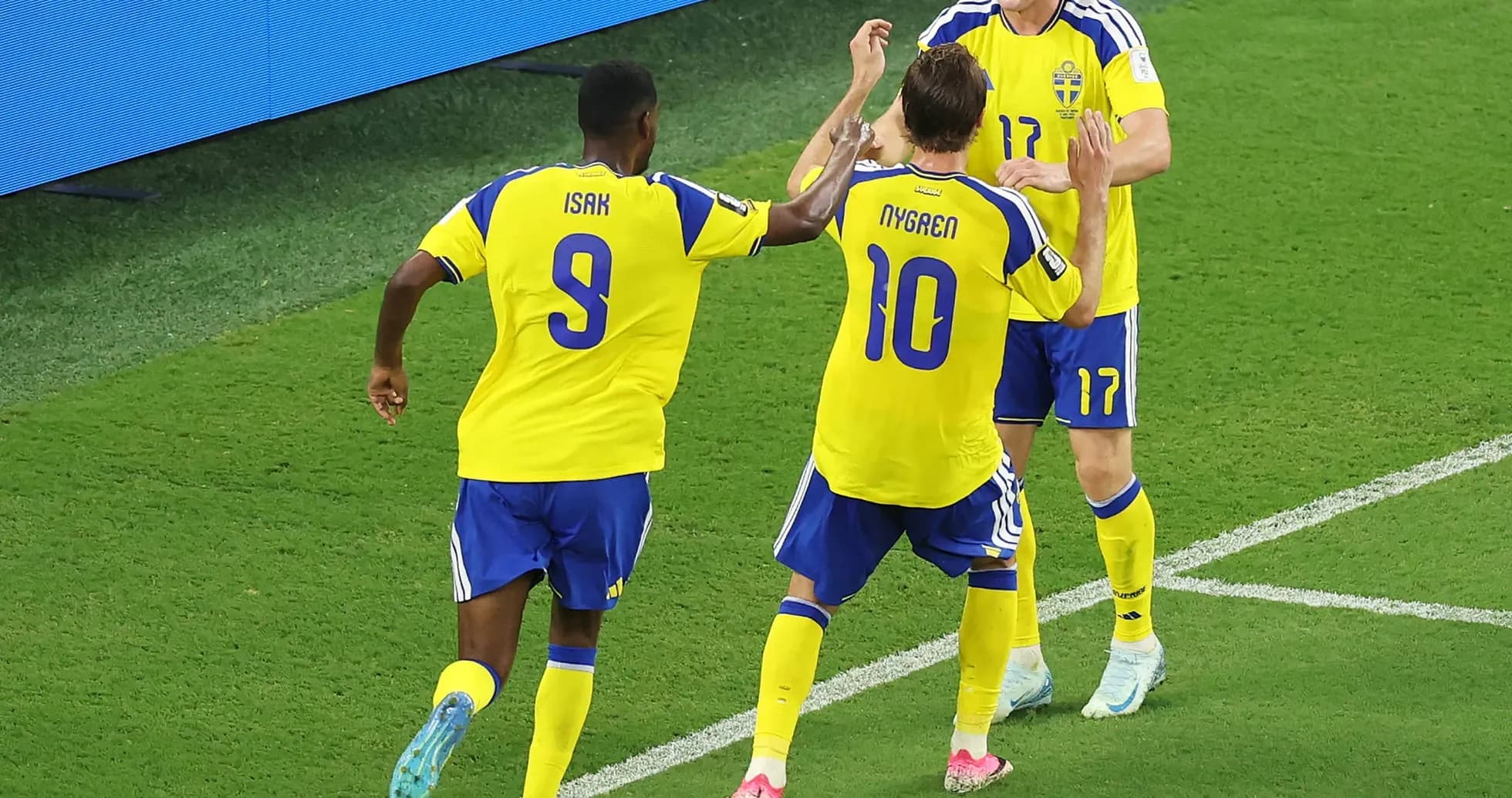
The second goal at 30' — Alexander Isak finishing from a Viktor Gyökeres assist — highlighted the complementary roles of the front two. Gyökeres often dropped off the line or drifted wide, dragging centre-backs out of shape, while Isak attacked the vacated central space. That pattern not only produced the 2-0 but also foreshadowed the third goal at 59', when Gyökeres himself scored from an Isak assist. Sweden repeatedly turned direct vertical passes into dangerous combinations because Tunisia’s back five struggled to decide whether to follow dropping forwards or hold the line.
Tunisia’s lone goal at 43', scored by Omar Rekik from a Hannibal Mejbri assist, came from one of the few moments they managed to connect through midfield and exploit Sweden’s three-at-the-back structure. When Tunisia did break the first press, they could briefly create 3v3 or 3v2 situations against Sweden’s defensive line. However, those moments were rare; overall, Sweden’s front and midfield lines pressed in a compact 3-1-4-2 block, forcing Tunisia into longer passes or sideways circulation.
Disciplinary Data
The disciplinary and duel data add another layer to the tactical story. Sweden committed 10 fouls to Tunisia’s 8, a reflection of their more proactive defending and willingness to break up counters early. The only card of the match went to Rani Khedira (Tunisia) at 54' — “Tripping” — illustrating Tunisia’s increasing desperation as Sweden continued to play through their midfield pressure.
Possession and Passing
In possession, Tunisia’s 51% share and 364 total passes (288 accurate, 79%) suggest they were not overrun in pure control terms. But much of that possession was sterile, circulating across the back five and into the midfield trio without penetration. Sweden, with 353 passes (280 accurate, 79%), matched Tunisia’s passing quality while being far more purposeful: they turned similar pass volumes into more box entries and final-third actions, as evidenced by the superior shot numbers and 4 corner kicks to Tunisia’s 2.
Goalkeeping Perspective
From a goalkeeping and defensive perspective, the numbers are stark. Kristoffer Nordfeldt (Sweden) faced only 2 shots on target and made 1 save, a sign of how well Sweden’s structure limited Tunisia’s access to dangerous zones. Abdelmouhib Chamakh (Tunisia) also registered 1 save, but the 5 goals conceded combined with a goals prevented figure of -2.99 for Tunisia indicate that Sweden’s finishing ruthlessly punished both defensive lapses and goalkeeping vulnerabilities. Sweden’s own goals prevented metric of -2.99, paired with just 1 save, reflects that the one goal conceded slightly outstripped the model’s expectations, but it was largely irrelevant given their attacking output.
In-Game Management
Potter’s in-game management reinforced Sweden’s dominance. At 65', Gabriel Gudmundsson (OUT) was replaced by Elliot Stroud (IN), and Benjamin Nygren (OUT) by Lucas Bergvall (IN), refreshing the wide and central midfield roles without altering the 3-1-4-2 structure. Tunisia responded at 72' with a triple change — Elias Saad (OUT) for Sebastian Tounekti (IN), Yan Valery (OUT) for Mohamed Belhadj Mahmoud (IN), and Ellyes Skhiri (OUT) for Elias Achouri (IN) — effectively trying to inject more energy and attacking impetus. Yet the structural issues remained: their 5-3-2 struggled to create overloads against Sweden’s three centre-backs and pivot.
The closing phase showcased Sweden’s squad depth and tactical continuity. At 84', Jesper Karlström (OUT) made way for Mattias Svanberg (IN), and Svanberg immediately added a fourth goal at 84' from another Alexander Isak assist — a fresh runner exploiting tired Tunisian legs in midfield. Tunisia then changed Rani Khedira (OUT) for Ismael Gharbi (IN) at 83' and Anis Ben Slimane (OUT) for Firas Chaouat (IN) at 84', morphing towards a more attacking posture, but without defensive stability. At 90', Alexander Isak (OUT) was replaced by Anthony Elanga (IN), and at 90+1' Alexander Bernhardsson (OUT) by Daniel Svensson (IN), preserving Sweden’s intensity on the flanks and up front. In added time, Yasin Ayari’s second goal at 90+6', assisted by Lucas Bergvall, underlined how Sweden’s midfield rotations and late-arriving runners continued to overwhelm a stretched Tunisian block.
Statistically, the 5-1 scoreline overshoots Sweden’s xG of 1.36, pointing to exceptional finishing efficiency and some Tunisian defensive collapse, while Tunisia’s 0.28 xG aligns with their limited threat. Yet the underlying tactical dynamics justify a wide margin: Sweden’s structure generated more high-quality positions, more box touches, and a constant capacity to attack the channels between centre-backs and wing-backs. Tunisia’s 5-3-2, intended to provide defensive solidity and counter-attacking threat, instead became a passive shell that neither protected the box sufficiently nor offered enough outlets to relieve pressure.
Overall, this was a textbook example of a modern, proactive 3-1-4-2 dismantling a deeper 5-3-2: superior spacing, better use of half-spaces, and coordinated forward movements turned near-equal possession and passing numbers into a lopsided, tactically coherent 5-1 Sweden victory.