.svg&w=384&q=75 "naujapitch logo")
Australia’s World Cup Triumph: Tactical Analysis of 2-0 Victory Over Türkiye
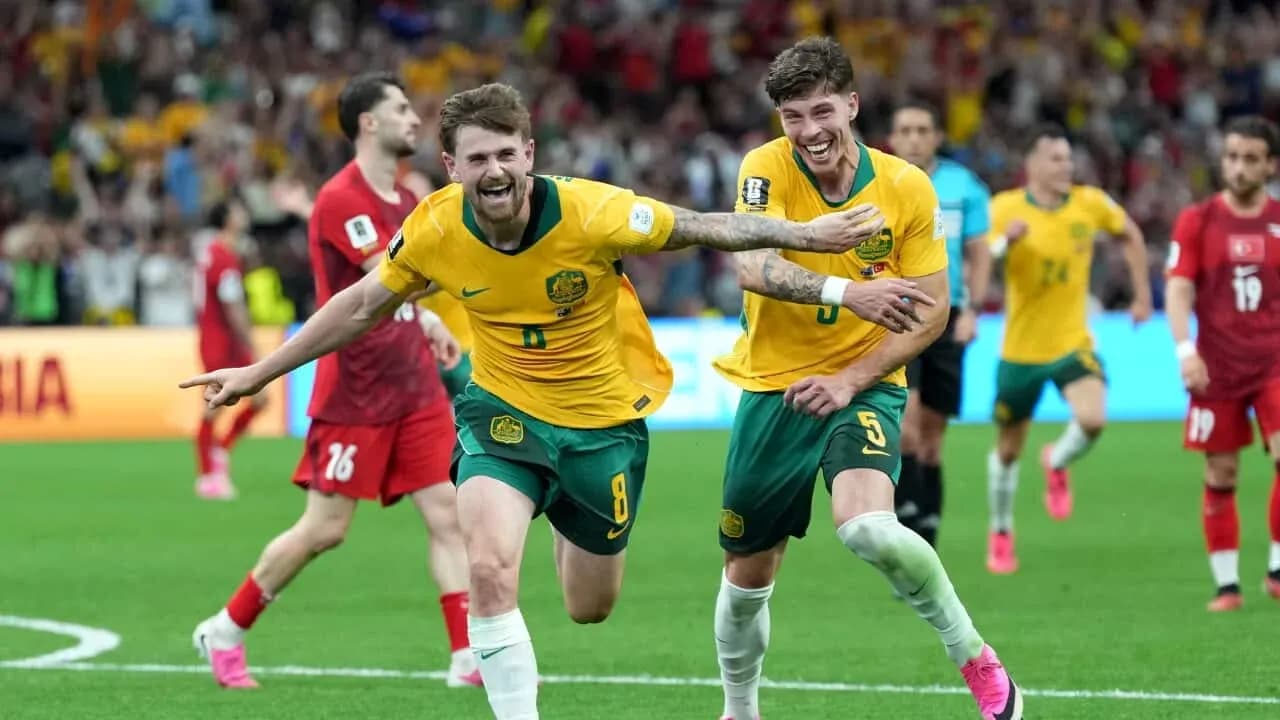
Under the closed roof of BC Place in Vancouver, Australia’s World Cup story has opened with the kind of clarity coaches dream of and opponents fear. A 2–0 victory over Türkiye in Group D, finished inside 90 minutes under the watch of referee Jesús Valenzuela, has not only banked three points but also revealed a tactical blueprint that feels repeatable rather than accidental.
Following this result, Australia sit 2nd in Group D with 3 points, a goal difference of +2 (2 goals scored, 0 conceded) from 1 match. Türkiye, beaten by the same 2–0 scoreline, are 3rd with 0 points and a goal difference of -2 (0 scored, 2 conceded). Both sides have played 1 match in total; Australia’s work has come “at home” in this fixture classification, while Türkiye’s defeat has come “on their travels.”
I. The Big Picture – Structure and Identity
Australia lined up in a 5-4-1 that was anything but conservative. Patrick Beach anchored the back five, with Jacob Italiano and Jordan Bos as the wide defenders, and Alessandro Circati, Harry Souttar and Cameron Burgess forming a towering central trio. Ahead of them, Connor Metcalfe, Aiden O’Neill, Paul Okon-Engstler and Nestory Irankunda supported lone forward Mohamed Touré.
This structure delivered immediate statistical clarity. Heading into their next game, Australia’s season numbers show 1 match played in total, 1 win and 0 draws or losses. At home they have played 1, won 1, drawn 0 and lost 0. They have scored 2 goals in total, all at home, with an overall average of 2.0 goals per match in total and 2.0 at home. Defensively, they have yet to concede: 0 goals against in total, 0.0 on average overall and 0.0 at home. One clean sheet in total underlines that this is not just a defensive shape on paper but a functioning block.
Türkiye, by contrast, arrived in a 4-2-3-1 that promised control and creativity. Uğurcan Çakır stood behind a back four of Zeki Çelik, Merih Demiral, Abdülkerim Bardakcı and Ferdi Kadıoğlu. İsmail Yüksek and Hakan Çalhanoğlu were the double pivot, with Arda Güler, Orkun Kökçü and Barış Alper Yılmaz supporting central forward Kerem Aktürkoğlu.
Yet their statistical profile after this opener is stark. Following this result, Türkiye have played 1 match in total, with 0 wins, 0 draws and 1 loss. On their travels they have played 1, lost 1 and failed to take a point. They have not scored: 0 goals for in total, 0.0 average overall and 0.0 away. Defensively they have conceded 2 goals in total, all away, for an average of 2.0 goals against overall and 2.0 away. They have 0 clean sheets and have failed to score in 1 total match, that single failure coming away.
II. Tactical Voids and Discipline
There are no listed absentees for either side, so this was close to full-strength against full-strength. The tactical voids came not from missing names but from in-game imbalances.
For Australia, the back five gave them numerical superiority against Türkiye’s lone striker and the three attacking midfielders. Circati and Souttar could step out aggressively knowing Burgess sat in cover, while Italiano and Bos could push high without exposing Beach. The absence of any recorded yellow or red card timing spikes for Australia this season suggests a defensive unit that defends more by structure than by emergency.
Türkiye’s void was between their double pivot and their back line. When Çalhanoğlu stepped forward to connect with Güler and Kökçü, Yüksek was often isolated in transition. Australia’s 5-4-1 became a 3-4-3 on the break, with Irankunda and Okon-Engstler driving into those spaces.
Disciplinary data underlines Türkiye’s late frustration. Their yellow-card distribution shows a single booking in the 76–90 minute window, accounting for 100.00% of their cautions so far. That card belongs to Yunus Akgün, who came off the bench and now leads both their yellow and red card charts in the season dataset, even though he has not actually been sent off in this match. It paints a picture of a side chasing the game late, forced into reactive defending and tactical fouls.
III. Key Matchups – Hunter vs Shield, Engine Room
The “Hunter vs Shield” narrative is embodied by Nestory Irankunda against a Türkiye defence that has already conceded 2 goals on their travels. Irankunda is Australia’s standout attacking reference in the data: 1 appearance, 61 minutes, 1 goal in total from 2 shots, both on target, and a rating of 7.5. His dribbling output – 1 attempt, 1 success – hints at a player who chooses his moments wisely rather than dribbling for its own sake.
Against him, Türkiye’s back four is under immediate pressure. Demiral and Bardakcı have already presided over a 2-0 away defeat, and the team’s biggest away loss in total is exactly that 2-0 scoreline. If Australia continue to channel early ball into Irankunda’s channel, Türkiye’s shield will be repeatedly tested in the half-spaces between full-back and centre-back.
In the “Engine Room”, Paul Okon-Engstler versus Hakan Çalhanoğlu is the defining duel. Okon-Engstler’s season line is quietly outstanding: 1 appearance, 84 minutes, 1 assist, 32 passes with 81% accuracy, 2 key passes, plus 3 tackles, 2 successful blocks and 3 interceptions. He is not just Australia’s leading creator; he is also their most active midfield defender.
Çalhanoğlu, by contrast, is tasked with dictating Türkiye’s tempo but is operating inside a side that, in total, has 0 goals for and has failed to score in its only match. The structural question is whether he can receive often enough between Australia’s lines. With O’Neill and Metcalfe screening and Okon-Engstler jumping to press, Australia’s midfield triangle is built to suffocate a deep playmaker.
IV. Statistical Prognosis – Where This Is Heading
From a pure numbers perspective, Australia’s early World Cup profile is that of a low-volume but high-efficiency side. They have played 1 match in total, scored 2 goals with an overall average of 2.0, and have yet to concede. Their biggest home win in total is 2-0, which is also their only result. Clean sheets stand at 1 in total, and they have not yet failed to score. With 0 penalties awarded and 0 missed in total, there is no reliance on spot-kicks to inflate their attacking output.
Türkiye’s statistical prognosis is more fragile. In total, they have 0 goals for, 2 against, and an average of 2.0 goals conceded on their travels. They have not yet kept a clean sheet and have failed to score in their only match. Their biggest away defeat in total is that same 2-0, and their disciplinary profile shows a late-game surge of 100.00% of their yellow cards in the 76–90 minute band, suggesting they are more likely to be chasing than controlling games as they wear on.
If we map likely xG trends onto these patterns, Australia’s compact 5-4-1 and clean-sheet record point to a side that will concede few high-quality chances, relying on structured counters and set-piece situations to generate their own xG. Türkiye, with a 4-2-3-1 that has yet to translate possession into goals, may produce volume without efficiency unless their front four find sharper final-third connections.
Following this result, the tactical balance of the group tilts towards Australia: a team whose numbers, shape and standout performers – Irankunda in attack, Okon-Engstler in the engine room, and a back five that has not been breached – all align around a clear identity. Türkiye, for all their talent, will need to recalibrate quickly, tightening the spaces in front of their defence and giving Çalhanoğlu and Güler more stable platforms, or the story of their campaign risks being written by the same statistics that have already defined their opening night in Vancouver.