.svg&w=384&q=75 "naujapitch logo")
England's Tactical Mastery in 2-1 Comeback Against Congo DR
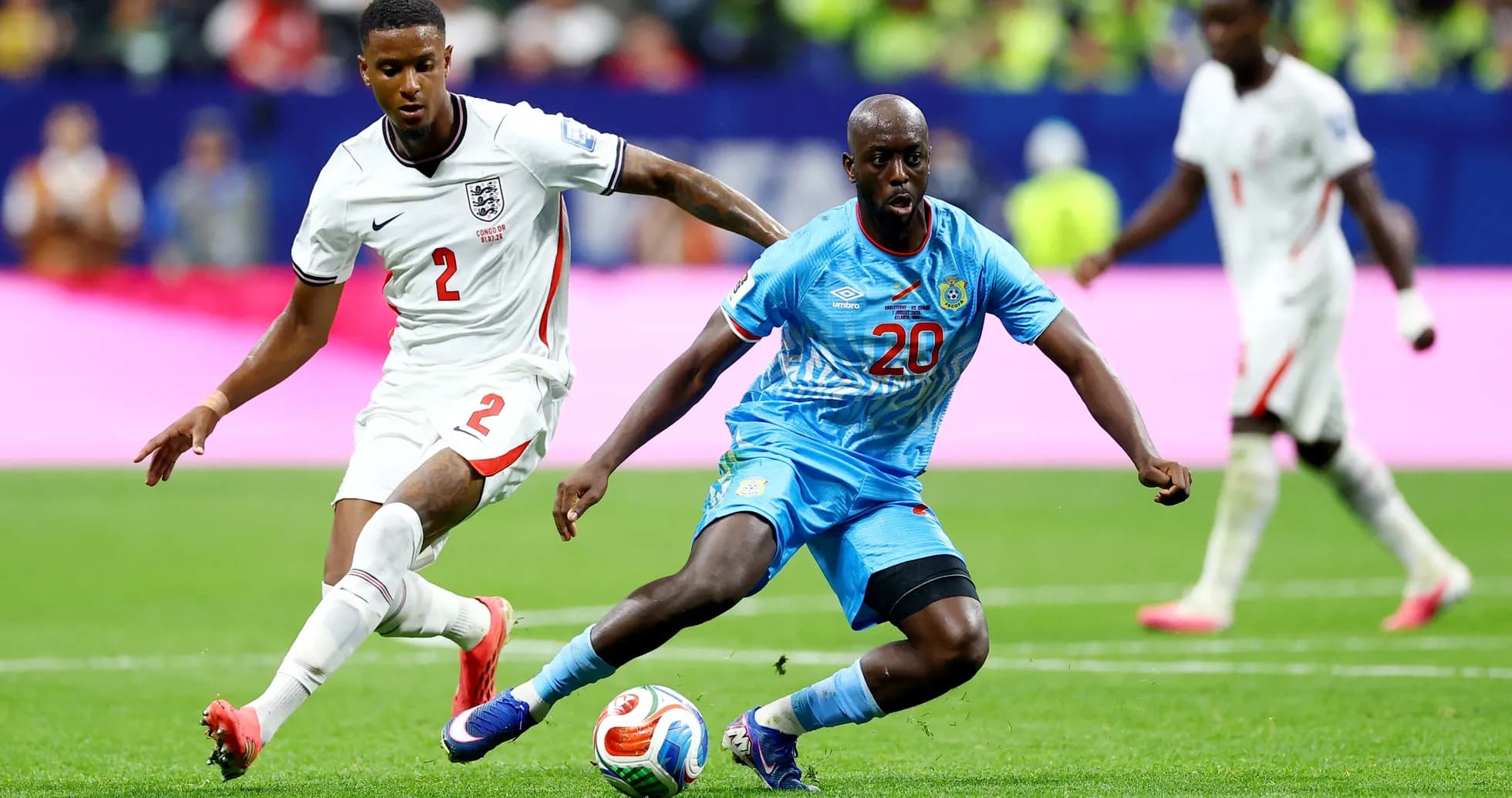
England’s 2-1 comeback over Congo DR at Mercedes-Benz Stadium was shaped less by chaos than by a gradual assertion of control. Across 90 minutes, Thomas Tuchel’s 4-2-3-1 evolved from sterile dominance into a structurally overwhelming platform, while Sebastien Desabre’s 4-3-3 slid from compact counter-punching to a deep, reactive block that could no longer get out.
Congo DR’s early lead through Brian Cipenga tilted the game-state in their favour and initially validated their plan. The front three of Cipenga, Yoane Wissa and Nathanaël Mbuku started high, looking to spring in transition from a mid-block. The central trio of Noah Sadiki, Samuel Moutoussamy and Ngal’ayel Mukau (before his later substitution) tried to screen passes into Jude Bellingham and Harry Kane, forcing England wide. That early goal allowed Congo DR to compress the pitch vertically, defending closer to their own box and prioritising protection of the central lane.
England, though, had the structure and technical quality to keep the ball and patiently turn that territorial edge into pressure. Their 60% possession and 517 passes, with 468 accurate at 91%, underline how Tuchel’s side controlled the rhythm. Declan Rice and Elliot Anderson formed a double pivot, with Rice anchoring circulation and Anderson stepping higher to link with Bellingham. Full-backs Djed Spence and Nico O’Reilly held relatively conservative starting positions but advanced in settled possession to create wide overloads, allowing Noni Madueke and Marcus Rashford to invert and attack half-spaces.
The shot profile tells the tactical story clearly: England generated 16 total shots, with 13 from inside the box and 7 on target. That volume and location reflect sustained occupation of Congo DR’s penalty area rather than speculative efforts. Congo DR, by contrast, managed only 7 shots in total, just 2 inside the box and 2 on target. Their attacks became increasingly dependent on longer-range efforts and isolated counters as England squeezed the pitch.
In goal, Jordan Pickford (England) was largely a manager of rest-defence rather than a shot-stopper, officially required for just 1 save. That low number, against a side that had led for over an hour, shows how effectively England’s back four and double pivot controlled space in front of their box after the early setback. Ezri Konsa and Marc Guéhi were able to defend high, with Rice screening second balls, which prevented Congo DR from building sustained pressure even when they tried to release Wissa in transition.
At the other end, Lionel Mpasi Nzau (Congo DR) faced a far more intense examination. He made 5 saves, and while the raw figure suggests a strong individual display, the broader pattern shows England repeatedly accessing high-value zones. England’s expected goals of 2.04 versus Congo DR’s 0.8 quantifies that disparity: Tuchel’s side created chances commensurate with a multi-goal return, while Congo DR’s threat was sporadic. The negative goals prevented figure for both goalkeepers (-0.04 each) indicates that finishing slightly exceeded the pure xG expectation on both sides, but within a very narrow margin.
Tuchel’s in-game management was decisive in converting territorial dominance into scoreboard impact. The double substitution on 60 minutes — Bukayo Saka (IN) came on for Noni Madueke (OUT) and Anthony Gordon (IN) came on for Marcus Rashford (OUT) — sharpened England’s wide threat. Saka provided more direct 1v1 penetration on the right, while Gordon’s movement from the left inside channel created new passing angles into Kane’s feet and Bellingham’s late runs. Both changes tilted England’s attacking structure from patient probing to more aggressive, vertical combinations.
That shift is reflected in the events that followed. With Congo DR increasingly pinned back, England’s box occupation intensified. Gordon’s impact was particularly clear: his assist on both of Harry Kane’s goals underscores how the left-sided dynamics changed. Gordon’s ability to receive between the lines and either drive at the defence or slip passes into Kane forced Congo DR’s back four to narrow, opening the half-spaces that had previously been congested. The introduction of Eberechi Eze for Djed Spence at 71 minutes further loaded England’s attacking midfield zones, effectively turning the shape into something closer to a 3-2-4-1 in possession, with O’Reilly tucking in and Rice anchoring transitions.
Desabre’s response — introducing Meschak Elia for Cipenga and Edo Kayembe for Ngal’ayel Mukau, then later Fiston Mayele and Joris Kayembe — aimed to refresh legs and preserve the 1-0, but the structural issue remained: Congo DR could no longer progress the ball cleanly. Their 365 passes, with 299 accurate (82%), highlight a competent but reactive possession game. As England’s press and counter-press improved, those figures increasingly came in their own half under pressure rather than as part of controlled build-up.
Discipline had a minor but telling tactical impact. Jude Bellingham’s yellow card for “Foul” at 19 minutes did not significantly alter England’s aggression without the ball, but it did ask Rice to shoulder even more responsibility in counter-press situations. Noah Sadiki’s booking, also for “Foul” at 27 minutes, constrained Congo DR’s midfield bite; from then on, they were more cautious stepping into duels around the edge of their own box, which contributed to England’s ability to receive and turn in dangerous central areas.
The VAR intervention at 44 minutes, where a potential penalty for Harry Kane was cancelled, was a brief tactical hinge. It underlined England’s growing penalty-area presence before the break, even if the scoreboard remained 0-1 at half-time. Crucially, though, England did not abandon their structure or resort to chaos after that setback. They continued to trust their possession framework, confident that the shot volume and xG trend would eventually turn into goals.
By full-time, the statistical verdict was emphatic in England’s favour despite the narrow 2-1 scoreline. They led in possession (60% to 40%), total shots (16 to 7), shots on target (7 to 2), corners (5 to 3) and passing efficiency (91% to 82%). Fouls were relatively balanced (10 for England, 12 for Congo DR), reinforcing that the game’s decisive edge lay in positional and technical superiority rather than pure physicality.
In World Cup knockout context, this was a textbook example of a stronger possession side methodically breaking down a disciplined underdog. Congo DR’s early execution and compact 4-3-3 gave them a platform, but once England’s rotations around Bellingham and Kane were supported by incisive wing substitutions, the underlying numbers — particularly the 2.04 to 0.8 xG split and the 13 shots inside the box to 2 — made the comeback feel like the logical tactical outcome rather than late drama.