.svg&w=384&q=75 "naujapitch logo")
Mexico Dominates Ecuador 2-0 in World Cup Round of 32
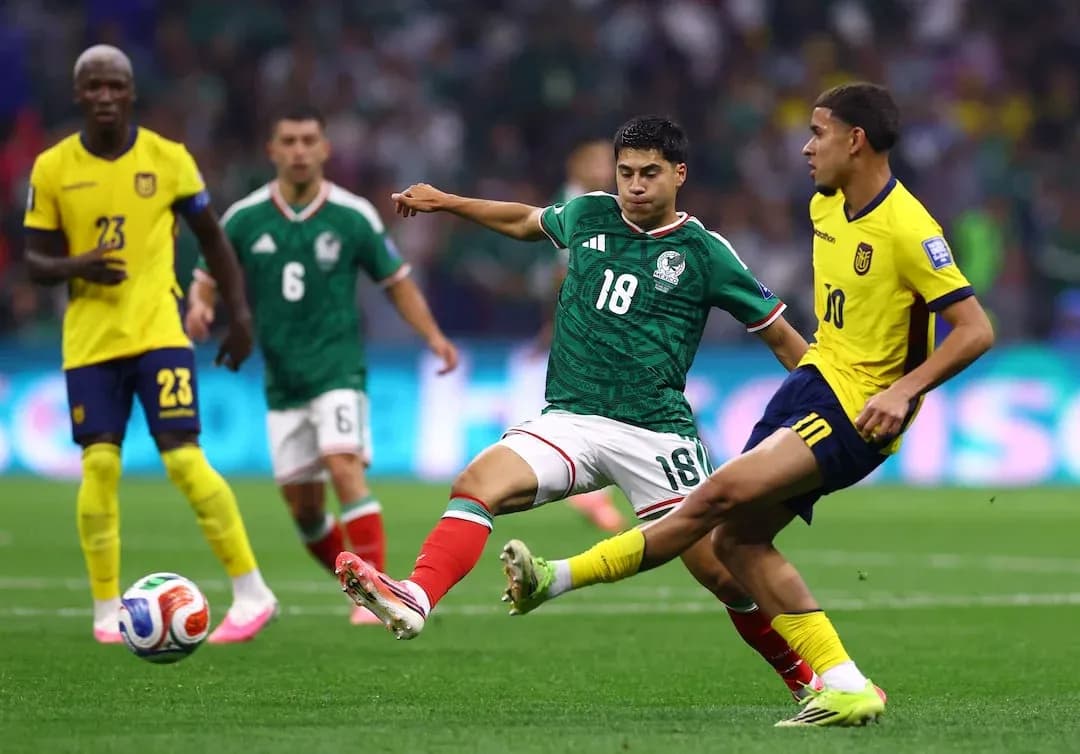
Mexico’s 2-0 win over Ecuador at Estadio Banorte in this World Cup Round of 32 tie was a classic case of early tactical clarity and then controlled risk management. Javier Aguirre’s side built their advantage in the first half through well-structured 4-3-3 pressing and vertical combinations, then accepted a lower share of the ball (43% possession) after the break without ever really losing defensive control. Ecuador, in Sebastian Beccacece’s 4-4-2, had more of the ball (57%), more corners (8 to 3) and cleaner passing (84% to 78%), but their territorial dominance rarely translated into high-quality chances, reflected in a modest 0.73 xG and just one shot on target.
The opening phase underlined Mexico’s attacking blueprint. With Raúl Rangel (Mexico) behind a back four of Jorge Sánchez, César Montes, Johan Vásquez and Jesús Gallardo, Mexico built from a relatively flat line but used the midfield three to create interior overloads. Erik Lira anchored centrally, with Gilberto Mora and Luis Romo stepping higher to form a narrow triangle that invited Roberto Alvarado and Julián Quiñones to invert from the wings around Raúl Jiménez.
The first goal on 22 minutes showcased this structure. Mexico’s 4-3-3 compressed into the right half-space, allowing Alvarado to receive between Ecuador’s midfield and defence. His assist to Quiñones, who had drifted off the left touchline into a central finishing lane, was the product of coordinated rotations: the full-backs stayed relatively conservative, the wingers came inside, and Romo’s presence between the lines pinned Ecuador’s double pivot. Quiñones’ finish capped one of Mexico’s three shots on goal from a total of 15 attempts, a shot profile (10 from inside the box) that matched their 1.02 xG and underlined the quality of their occupation of central spaces.
The second goal on 31 minutes reversed the roles of the front line and underlined Mexico’s flexibility. This time Quiñones assisted Jiménez, with the centre-forward attacking the space between Willian Pacho and Joel Ordóñez. Ecuador’s back four, stretched horizontally by Mexico’s wide starting positions, struggled to maintain compactness once their midfield line was bypassed. The 4-4-2 block, with John Yeboah and Nilson Angulo wide and Moisés Caicedo plus Pedro Vite centrally, could not consistently protect the half-spaces, leaving the centre-backs exposed to diagonal runs and quick combinations.
Defensively, Mexico’s 4-3-3 out of possession was disciplined. The front three pressed Ecuador’s centre-backs on cues, but the real control came from the midfield line. Lira screened passes into Enner Valencia’s feet, while Mora and Romo stepped out selectively to pressure Vite and Caicedo, limiting Ecuador to seven total shots and only one on target. With just 10 fouls and no cards, Mexico managed to defend aggressively without excessive risk, keeping their line compact and forcing Ecuador to circulate in front of them.
Rangel (Mexico) was rarely called into action, making 1 save. That low workload was the product of collective structure more than goalkeeping heroics: the back four won first contacts and kept Ecuador’s forwards facing away from goal. The negative goals prevented value (-0.57) suggests that the single on-target effort carried some danger, but Mexico’s two-goal cushion and stable block meant there was little sustained pressure.
Beccacece’s adjustments at half-time were an attempt to tilt that balance. The double change at 46 minutes — Yaimar Medina (IN) came on for Alan Franco (OUT) and Ángelo Preciado (IN) came on for Joel Ordóñez (OUT) — aimed to add more thrust from full-back and fresh legs in the back line. Later, Kevin Rodriguez (IN) for Enner Valencia (OUT) at 59 minutes, and then Jordy Caicedo (IN) for John Yeboah (OUT) plus Kendry Páez (IN) for Nilson Angulo (OUT) at 79 minutes, shifted Ecuador towards a more direct, striker-heavy configuration. Yet despite the extra forwards, Ecuador’s shot volume stayed modest and their box occupation remained predictable, often resulting in crosses that Mexico’s centre-backs dealt with comfortably.
Hernán Galíndez (Ecuador) also recorded 1 save, and Ecuador’s goals prevented figure (-0.57) implies that Mexico’s two goals were in line with the quality of their chances. Ecuador’s higher passing volume — 407 passes with 340 accurate (84%) — contrasted with Mexico’s 319 passes, 249 accurate (78%), but the distribution of those passes was telling: much of Ecuador’s circulation came in deeper and wide areas, while Mexico’s more modest passing load was oriented towards penetration and final-third actions.
Aguirre’s in-game management further consolidated control. On 58 minutes Brian Gutiérrez (IN) came on for Mora (OUT), adding fresh energy in midfield. Obed Vargas (IN) for Romo (OUT) at 73 minutes and Santiago Giménez (IN) for Jiménez (OUT) at 74 minutes refreshed the central lanes without altering the 4-3-3 shape. The double change on 80 minutes — Orbelín Pineda (IN) for Quiñones (OUT) and Israel Reyes (IN) for Alvarado (OUT) — allowed Mexico to transition into a more conservative posture, with Reyes able to tuck in as a third centre-back when needed and Pineda offering ball retention.
Ecuador’s late frustration was reflected in their discipline. They committed 14 fouls to Mexico’s 10 and collected three yellow cards plus one red. The bookings followed a clear pattern of increasingly desperate interventions: at 45+1' Alan Franco (Ecuador) — Tripping; at 90+3' Kendry Páez (Ecuador) — Tripping; at 90+5' Piero Hincapié (Ecuador) — Unsportsmanlike conduct, resulting in a red card; and at 90+9' Moisés Caicedo (Ecuador) — Tripping. Reduced to ten men in the final minutes, Ecuador’s ability to mount any structured late surge effectively disappeared.
From a statistical perspective, the match framed two contrasting game plans. Ecuador’s higher possession, passing accuracy, and corner count suggested territorial control, but their 0.73 xG and one shot on target exposed the sterility of that dominance. Mexico, with fewer passes and less of the ball, generated more total shots (15 to 7), more shots on goal (3 to 1), and a higher xG (1.02), aligning with the 2-0 scoreline. The blocked shots numbers — 3 for Mexico, 1 for Ecuador — further highlight how Mexico not only attacked with purpose but also protected their box more effectively.
In season terms, this performance fits a Mexico profile built on compactness, verticality, and efficiency rather than sustained possession. Ecuador’s metrics resemble a side comfortable in build-up but still searching for mechanisms to convert control into clear chances against a well-organized block. On the night, structure and clarity of roles in Mexico’s 4-3-3 decisively outperformed Ecuador’s more possession-heavy but less incisive 4-4-2.