.svg&w=384&q=75 "naujapitch logo")
Crystal Palace vs Everton: Premier League 2-2 Draw Analysis
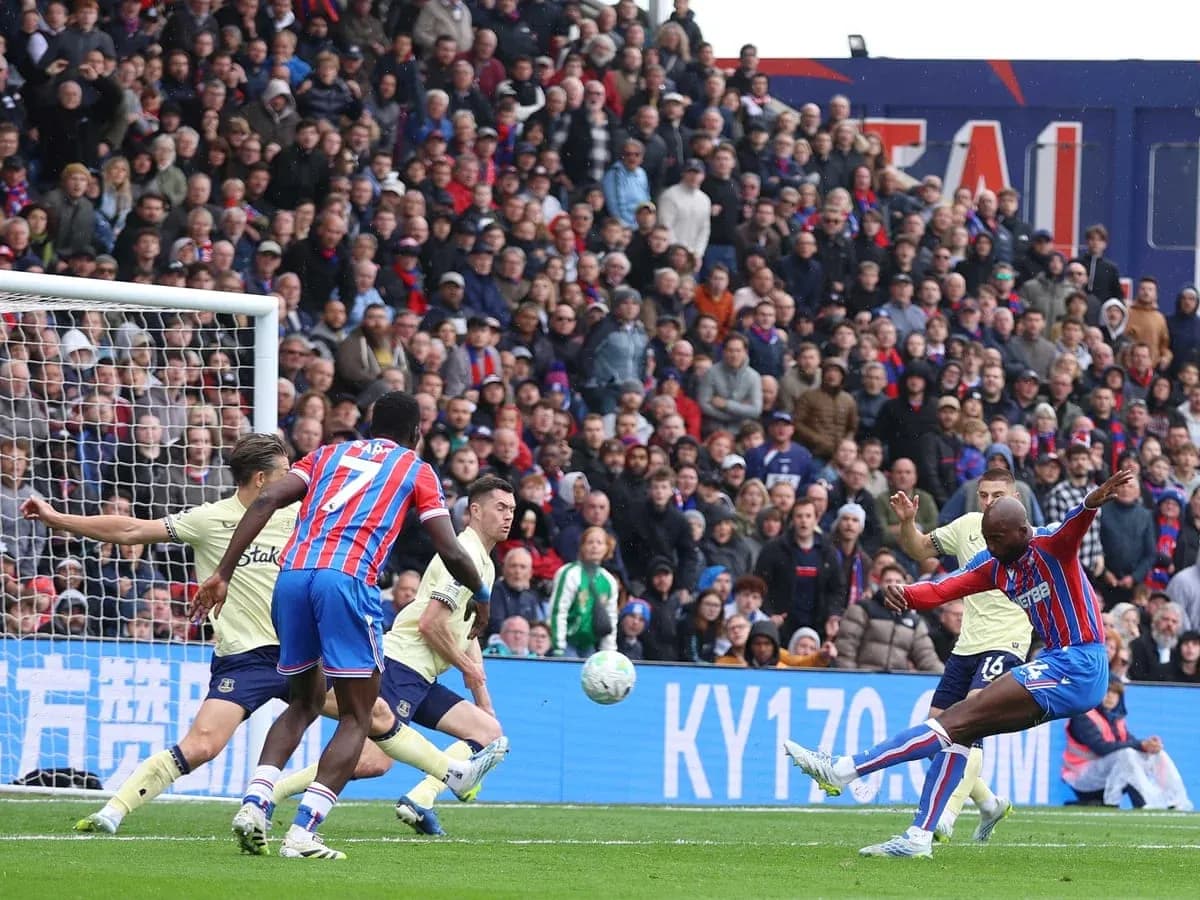
Crystal Palace and Everton shared a 2-2 draw at Selhurst Park in Premier League Regular Season - 36, a match that oscillated between Everton’s early set-piece punch and Palace’s sustained territorial control. The scoreline mirrored the xG balance (2.66 vs 1.44), with Palace’s possession-heavy 3-4-2-1 gradually pinning back an Everton side built in a 4-2-3-1 to counter and attack quickly through Beto and the advanced midfield line.
Executive Summary
Everton struck first and then again early in the second half, but Crystal Palace’s structural dominance with 59% possession, 21 total shots and superior passing volume (459 passes, 382 accurate, 83%) eventually forced parity. Everton, despite only 313 passes (232 accurate, 74%) and fewer shots (13 total), maximised set-piece and transition moments, leaning on Jordan Pickford’s six saves and a compact mid-block. Palace’s 3-4-2-1, orchestrated by Adam Wharton and Daichi Kamada, generated 15 shots inside the box, but needed Jean Philippe Mateta from the bench to rescue a point.
Scoring Sequence & Disciplinary Log
Scoring sequence (chronological):
- 6' — Everton 0-1 lead: James Tarkowski converted a “Normal Goal” for Everton, capitalising on early pressure and giving the visitors an immediate foothold.
- 34' — Crystal Palace 1-1 Everton: Ismaïla Sarr hit back with a “Normal Goal” for Palace, reflecting the home side’s growing control and direct threat from the right channel.
- 47' — Crystal Palace 1-2 Everton: Beto restored Everton’s lead with a “Normal Goal”, assisted by James Tarkowski, a classic centre-back-to-striker connection that punished Palace’s early second-half looseness.
- 77' — Crystal Palace 2-2 Everton: Jean Philippe Mateta, on as a substitute, delivered a “Normal Goal” to level the match, capping Palace’s pressure phase.
Disciplinary log (all cards, in event order):
- 30' James Garner (Everton) — Foul
- 45' Vitaliy Mykolenko (Everton) — Foul
Card verification step: Crystal Palace: 0, Everton: 2, Total: 2.
Substitutions (chronological, exact format):
- 65' — Jean Philippe Mateta (IN) came on for Jørgen Strand Larsen (OUT) for Crystal Palace.
- 70' — Thierno Barry (IN) came on for Beto (OUT) for Everton.
- 80' — Jefferson Lerma (IN) came on for Brennan Johnson (OUT) for Crystal Palace.
- 80' — Tyrique George (IN) came on for Merlin Röhl (OUT) for Everton.
- 90+4' — Carlos Alcaraz (IN) came on for Kiernan Dewsbury-Hall (OUT) for Everton.
Halftime score was Crystal Palace 1-1 Everton, with Sarr cancelling out Tarkowski’s opener before the interval.
Tactical Breakdown & Personnel
Crystal Palace set up in Oliver Glasner’s 3-4-2-1 with Dean Henderson behind a back three of Jaydee Canvot (left), Maxence Lacroix (central) and Chris Richards (right). Wing-backs Daniel Muñoz and Tyrick Mitchell provided width, with Adam Wharton and Daichi Kamada forming the central axis. Ahead of them, Brennan Johnson and Ismaïla Sarr operated as dual attacking midfielders/inside forwards behind Jørgen Strand Larsen.
In possession, Palace’s 3-2-5 structure was clear: Muñoz and Mitchell pushed high to line up with Johnson, Sarr and Strand Larsen, while Wharton dropped closer to the back three to orchestrate circulation. The 59% possession and 459 passes underline how Palace consistently built through the thirds rather than playing directly. With 21 total shots and 15 inside the box, the home side repeatedly managed to pin Everton deep, especially by overloading wide channels and then cutting back into central zones.
The first Palace equaliser reflected this: Sarr’s goal at 34' came after sustained pressure, exploiting the half-space between Everton’s full-back and centre-back. Everton’s fouls tally (13) and two yellow cards — both for “Foul” (James Garner and Vitaliy Mykolenko) — show how often they had to disrupt Palace’s rhythm with late challenges, particularly as Palace’s rotations dragged markers out of position.
Out of possession, Palace’s 3-4-2-1 morphed into a 5-4-1, with Muñoz and Mitchell dropping alongside the back three. However, the early 6' concession to Tarkowski suggests a vulnerability on set-pieces or second phases: a centre-back scoring so early indicates Everton exploited a static defensive moment rather than open-play disorganisation. The second Everton goal at 47', with Beto scoring from a Tarkowski assist, highlighted Palace’s transitional fragility at the start of the half — either from a long ball or quickly recycled attack where the back line was not fully set.
Glasner’s key adjustment came on 65': Jean Philippe Mateta (IN) for Jørgen Strand Larsen (OUT). Mateta’s more aggressive penalty-box presence sharpened Palace’s occupation of central spaces. His 77' goal to make it 2-2 validated the switch, as Palace converted territorial dominance into scoreboard pressure. The later introduction of Jefferson Lerma (IN) for Brennan Johnson (OUT) at 80' suggested a desire for more central ballast and second-ball control as Palace pushed for a winner without losing rest-defence stability.
Everton’s 4-2-3-1 featured Jordan Pickford in goal, a back four of Jake O'Brien, James Tarkowski, Michael Keane and Vitaliy Mykolenko, with Tim Iroegbunam and James Garner as the double pivot. Ahead, Merlin Röhl, Kiernan Dewsbury-Hall and Iliman Ndiaye supported Beto. In possession, Everton were more direct: 313 passes versus Palace’s 459, and only 41% possession. Their attacking pattern relied on early service into Beto and the advanced midfield line, with set-pieces and crosses a clear route — evidenced by Tarkowski’s goal and his assist for Beto.
Defensively, Everton’s mid-to-low block was designed to compress central lanes and force Palace wide. Yet Palace still generated 8 shots on goal and 5 blocked shots, suggesting Everton’s last-ditch defending and Pickford’s positioning were heavily tested. The 10 corner kicks earned by Everton, despite lower possession, underline their threat in moments rather than sustained control.
Goalkeeper reality:
- Dean Henderson (Crystal Palace) registered 5 saves, aligning with Everton’s 6 shots on goal and indicating he dealt with most of Everton’s clear efforts efficiently. With Everton’s xG at 1.44 and Henderson’s goals prevented at 1.2, he marginally outperformed expectation, keeping Palace in the game when exposed.
- Jordan Pickford (Everton) made 6 saves against Palace’s 8 shots on goal. Palace’s xG of 2.66 versus Everton’s goals prevented figure of 1.2 suggests Palace could have scored more, but Pickford’s interventions, combined with some wasteful finishing, kept the scoreline level.
The Statistical Verdict
From a statistical standpoint, Crystal Palace’s overall form in this match was that of a dominant home side: more possession (59%), significantly more shots (21 vs 13), and higher xG (2.66 vs 1.44). Their passing structure was superior — 459 passes, 382 accurate (83%) — reflecting a coherent build-up model that repeatedly accessed dangerous zones, as shown by 15 shots inside the box.
Everton’s defensive index, however, was respectable. Despite allowing 21 shots and 8 on target, they limited Palace to only two goals, aided by Jordan Pickford’s 6 saves and the back line’s 5 blocked shots. Their own 13 shots, 10 inside the box, and 10 corner kicks show that while they ceded territory, they were incisive when they did attack. Everton’s 313 passes, 232 accurate (74%), underline a pragmatic, lower-possession game plan built on verticality and set-pieces rather than sustained circulation.
Discipline-wise, the imbalance is clear and must not be smoothed over: Crystal Palace finished with 0 cards, Everton with 2 yellow cards (James Garner — Foul; Vitaliy Mykolenko — Foul), total 2. That disparity mirrors the flow — Palace probing with control, Everton forced into more disruptive defending. In pure tactical terms, Palace will feel they left a win on the table, while Everton can frame the 2-2 as a resilient away point extracted through efficiency and defensive grit under pressure.