.svg&w=384&q=75 "naujapitch logo")
Cristiano Ronaldo Honors Diogo Jota After Portugal's World Cup Victory
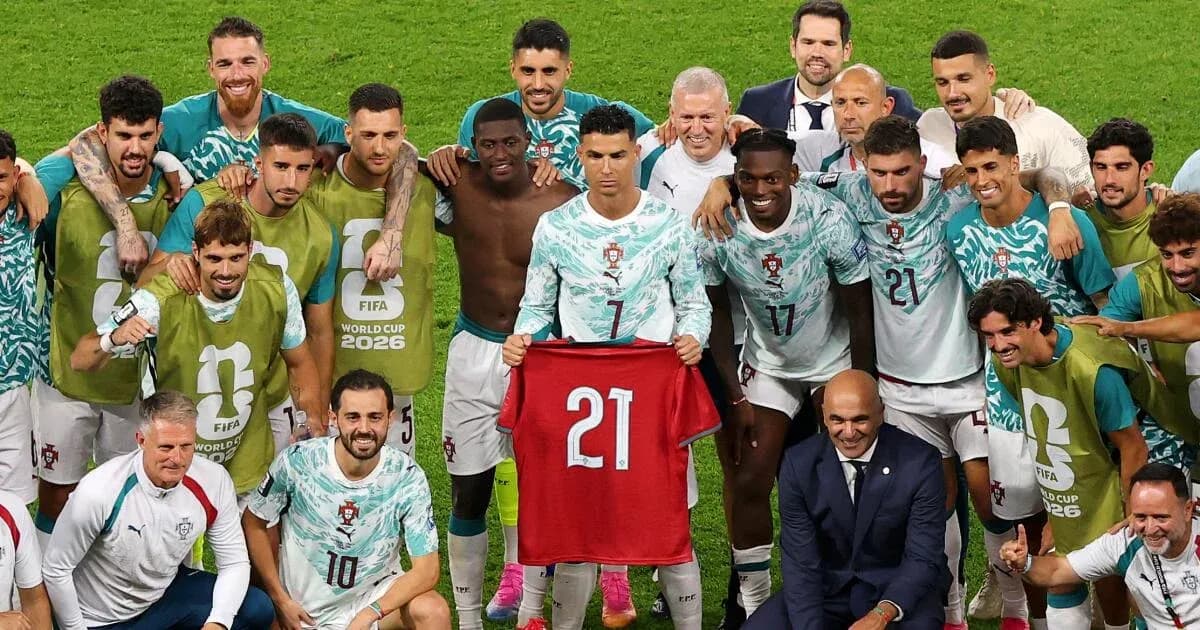
Cristiano Ronaldo stood alone in the glare of the floodlights, a red No. 21 jersey stretched between his hands and a stadium holding its breath.
Portugal had just dragged themselves past Croatia 2-1 in a World Cup knockout tie at Toronto Stadium on Thursday, a match that lurched from frustration to chaos to catharsis. Yet when the final whistle went, the celebrations did not belong to the scorers, the captain, or even the team. They belonged to the player who was no longer there.
Diogo Jota, gone a year, was everywhere.
A win wrapped in grief
As teammates laughed and shouted around him, Ronaldo stepped to the front of the post-match team photo, jaw set, eyes fixed, raising Jota’s Portugal shirt to the cameras. The others beamed. He didn’t. The gesture said enough.
Then he pulled the shirt on.
The 41-year-old walked slowly across the pitch, head turning to each stand, acknowledging the roar that swelled as fans realized what he was doing. The celebration of a comeback win slipped into something quieter, heavier.
“It’s a special day, for our Jota, who is up there illuminating us,” Ronaldo told Portugal’s Sport TV later. “We know he’s present with us and it only made sense to win today to honor him in the best way.”
On X, he posted the team photo and wrote: “We won for ourselves, for Diogo, and for Portugal!!! LET’S GO!!!!” The message was raw, not polished. It fit the night.
Drama on the pitch, a presence off it
The match itself had already been draining. Croatia led, Portugal chased. Time bled away. Then, in the 68th minute, the man wearing the armband dragged his country level, burying a penalty to make it 1-1 and ignite a game that had been slipping from Portugal’s grasp.
The pressure finally told in stoppage time. A deep cross, a desperate defense, and Goncalo Ramos arrived to meet it, his header flashing in for the winner. Portugal’s bench erupted, players spilling down the touchline.
The tension didn’t end there. Croatia thought they had snatched an equalizer in the dying seconds, only for the flag to go up and the goal to be ruled out for offside. Relief crashed over the Portuguese players as the final whistle sounded. They had survived.
When the noise eased, Ramos turned his thoughts to the teammate whose name and number had been woven through the night.
“We think about him every day,” he told Fox Sports, speaking about Jota. “It’s even more special to win this game in this day. And he gives us strength every day and for every game.”
A stadium remembers No. 21
The tributes had started long before the late winner.
During the national anthem, Jota’s image appeared on the big screen, his face looking down over the players lined up on the pitch. Heads tilted up. Some players closed their eyes. Others stared straight ahead.
In the 21st minute, the stadium shifted again. Portugal fans rose to their feet, a coordinated, quiet act in the middle of a storm of a knockout tie. A banner unfurled, carrying Jota’s image. Balloons floated upward, marked with his No. 21. For a brief spell, the match receded. The crowd chose memory over the scoreboard.
The symbolism was sharp. Jota, who wore 21 for his country, had been a clinical finisher, a player whose movement and timing brought clarity in tight games. Nearly 50 caps, a place in the 2022 World Cup squad stolen from him by injury, a career that always felt like it had another gear to find.
Just after midnight on July 3, 2025, that promise vanished. Jota and his brother, André Silva, died in a single-car crash near Zamora, Spain. Jota was 28. Silva was 25. The news cut through Portugal and far beyond, a sudden end for two young men whose lives were tied to the game and to each other.
Anfield’s permanent tribute
The echo of that loss has not faded. On Wednesday, Liverpool FC, where Jota carved out a reputation as a ruthless forward, unveiled a memorial at Anfield dedicated to “Jota and Silva.” He scored 65 goals in 182 games for the Reds, numbers that only hint at his influence.
The monument, designed by sculptor Emma Rodgers, carries a simple, loaded title: “Forever 20,” a nod to Jota’s Liverpool jersey number. It stands as a fixed point at a stadium built on memory and myth, a place where players are rarely forgotten and some are never allowed to leave in spirit.
Liverpool marked the anniversary on X with a message that underlined the scale of the loss and the reach of the brothers’ legacy.
“Today, as every day, we remember Diogo Jota and André Silva, who tragically passed away one year ago,” the club wrote. “Through immeasurable loss and incalculable pain, the impact they made and the legacies they left behind — not only within the footballing world, but in the hearts and minds of so many around the world — has shone through over the last 12 months.
“All of our love, support, thoughts and prayers continue to be with Diogo and André’s families, friends and all those whose lives were touched by them. Forever in our hearts, forever our number 20.”
Playing for the absent teammate
For Portugal, the World Cup is about more than progression now. Every knockout tie carries a second layer, an invisible name on the team sheet.
On Thursday, that weight did not drag them down; it seemed to drive them. The penalty, the stoppage-time header, the disallowed Croatian goal — all of it fed into a night that felt scripted for emotion.
Ronaldo’s slow walk in Jota’s shirt, Ramos’ words, the 21st-minute tribute, the balloons rising into the night sky: they turned a tense football match into a vigil with a scoreboard.
Portugal move on in the tournament. The story of their World Cup is still being written. But as long as they play, and as long as No. 21 is lifted to the lights, one question will linger over every game they win: how far can a team go when it believes it is carrying someone with it?