.svg&w=384&q=75 "naujapitch logo")
Spain Dominates Austria 3-0 in World Cup Round of 32
Spain’s 3-0 win over Austria at SoFi Stadium in this World Cup Round of 32 tie was a controlled, almost textbook example of territorial dominance and structured possession. Spain led 1-0 at half-time and never allowed the game state to drift, turning their technical superiority and field position into a steady accumulation of chances that eventually overwhelmed Austria’s resistance.
Executive Summary
From the outset, Spain imposed a high-possession, position-based game, finishing with 65% of the ball and a 23–5 shot advantage. The 3-0 scoreline reflects both their attacking volume and Austria’s inability to transition out of pressure. Spain’s midfield, built around Rodri and Pedri, dictated rhythm and access to the half-spaces, while wide players and full-backs relentlessly attacked the flanks. Austria, under Ralf Rangnick, tried to compress central zones and spring direct counters through Marcel Sabitzer and Michael Gregoritsch, but produced no shots on target and failed to win a single corner. Ultimately, Spain’s structure, counter-press, and passing security (629 passes at 91% accuracy) ensured a largely one-sided contest and a comfortable passage to the next round.
Scoring Sequence & Disciplinary Log
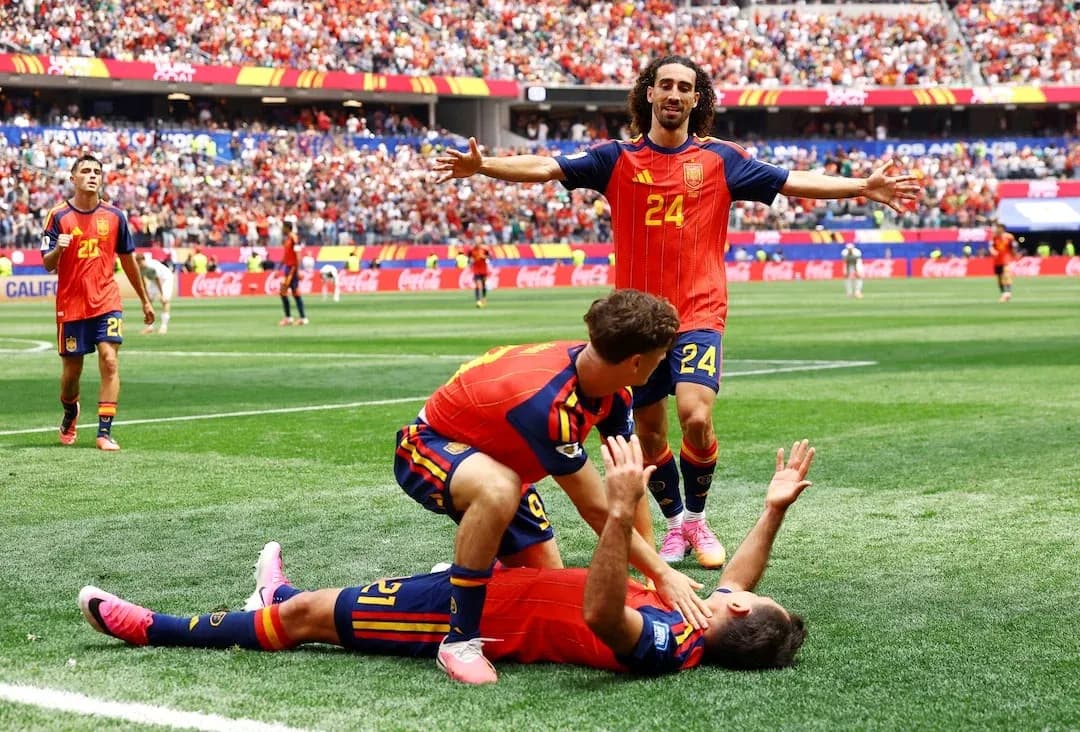
The breakthrough came on 36', the product of Spain’s patient left-sided overloads. After sustained pressure, Mikel Oyarzabal (Spain) finished a move created down the flank, with Marc Cucurella (Spain) providing the assist. That goal crystallized Spain’s dominance in territory and possession and set the tone for the rest of the evening; at half-time the score was 1-0 to Spain.
Austria’s response at the interval was structural, with a double change at 46': Carney Chukwuemeka (IN) came on for Nicolas Seiwald (OUT), and Florian Grillitsch (IN) came on for Xaver Schlager (OUT). The idea was to refresh the midfield line and find more verticality, but Spain’s control of the ball limited their impact.
At 60', Austria adjusted again in the attacking line: Marko Arnautović (IN) came on for Michael Gregoritsch (OUT), and Saša Kalajdžić (IN) came on for Romano Schmid (OUT), moving towards a more direct, target-man profile. Yet, just six minutes later, Spain doubled their lead. On 66', Pedro Porro (Spain), pushing high from the defensive line, scored after a combination that involved Alex Baena (Spain), who supplied the assist. This second goal rewarded Spain’s persistent use of full-backs as auxiliary attackers.
Spain then rotated their midfield and attacking structure at 71'. Mikel Merino (IN) came on for Dani Olmo (OUT), and Ferran Torres (IN) replaced Alex Baena (OUT), adding fresh legs and a more vertical threat between the lines and in depth.
Discipline surfaced on 83'. Stefan Posch (Austria) received a yellow card — Foul — reflecting Austria’s increasing desperation to halt Spain’s circulation and wide combinations. Two minutes later, both coaches tweaked their shapes again. At 85', Pablo Gavi (IN) came on for Lamine Yamal (OUT), reinforcing Spain’s midfield control, while Alexander Prass (IN) replaced Stefan Posch (OUT) for Austria, altering their defensive left side.
Spain’s third goal, on 89', again showcased the Cucurella–Oyarzabal connection. Marc Cucurella (Spain) delivered his second assist of the night, with Mikel Oyarzabal (Spain) finishing clinically to make it 3-0 and close the contest. In the final minute of normal time, Luis de la Fuente secured game management and minutes for squad players: Marc Pubill (IN) came on for Aymeric Laporte (OUT), and Fabián Ruiz (IN) replaced Pedri (OUT) at 90', locking in a fresh back line and midfield for the closing phases.
Card summary: Spain 0, Austria 1, Total 1.
83' Stefan Posch (Austria) — Foul.
Tactical Breakdown & Personnel
Without an explicit formation listed, Spain’s structure can be inferred from roles and patterns. With Unai Simón (Spain) in goal and a back four of Pedro Porro, Pau Cubarsí, Aymeric Laporte, and Marc Cucurella, Spain built in a flexible 2-3-5/3-2-5 shape in possession. Rodri anchored the midfield, dropping between or alongside the centre-backs to facilitate progression. Pedri, Lamine Yamal, Dani Olmo, Alex Baena, and Mikel Oyarzabal formed a fluid line of advanced midfielders and forwards, constantly rotating between half-spaces and wide channels.
The numbers underline Spain’s territorial dominance: 65% possession, 629 passes with 570 accurate (91%), and 23 total shots, of which 10 were on goal. Their 15 shots inside the box reflect sustained occupation of the penalty area, supported by nine corner kicks and seven blocked shots that show how frequently Austria had to defend deep. Spain’s xG of 2.84 aligns closely with their three-goal return, suggesting the scoreline was an accurate reflection of chance quality.
Defensively, Spain’s control is evident in Austria’s attacking impotence: only 5 total shots, 0 on goal, and 0 corners. Austria’s xG of 0.32 indicates they rarely created clear openings, with Spain’s counter-press and rest-defense—anchored by Rodri and the centre-backs—snuffing out transitions before they could develop. Unai Simón (Spain) was statistically untested, with 0 saves recorded, a direct consequence of Austria failing to register a shot on target.
Austria’s approach under Ralf Rangnick leaned towards compactness and direct transitions. Their 35% possession, 346 passes (284 accurate, 82%), and 5 offsides illustrate attempts to break Spain’s high line with early balls toward Gregoritsch and later Arnautović and Kalajdžić. However, the lack of width and inability to secure second balls meant these attacks rarely developed into sustained pressure. The team committed 15 fouls, a function of reactive defending and late challenges as they chased Spain’s circulation.
Alexander Schlager (Austria) was heavily involved, making 6 saves. That figure, alongside Spain’s 10 shots on goal, indicates that some Spanish efforts missed the target or were blocked before reaching him, but also highlights his role in keeping the scoreline from becoming even more lopsided. Austria’s goals prevented value of -0.57 suggests the goals conceded slightly exceeded what would be expected from the shots faced.
Spain’s in-game management was notable. The introduction of Mikel Merino and Fabián Ruiz maintained their passing structure and pressing intensity, while Ferran Torres and Pablo Gavi added vertical runs and ball-carrying. Marc Pubill’s late entry for Laporte secured defensive freshness and preserved the clean sheet. Throughout, Spain balanced aggression with control, conceding only 8 fouls and no cards, a sign of disciplined pressing and well-timed interventions.
The Statistical Verdict
From a statistical perspective, this was a comprehensive, structurally coherent performance from Spain. A 3-0 scoreline built on 65% possession, a 23–5 shot count, 10–0 shots on goal, and a 9–0 corner advantage speaks to sustained superiority in every phase. Their passing volume and accuracy—629 passes, 570 accurate (91%)—ensured they could repeatedly probe Austria’s block until spaces appeared, especially down the left where Cucurella and Oyarzabal combined decisively.
Austria’s 0 shots on target and xG of 0.32 underline how effectively Spain suppressed both central progression and counter-attacks. With 15 fouls and the only yellow card of the match, Austria were often a step late to duels, forced into stopping Spain’s combinations rather than dictating any rhythm of their own.
Spain’s xG of 2.84 closely matches the three goals scored, suggesting their finishing was in line with the quality of chances created rather than overperformance. The negative goals prevented value for both teams (Spain -0.57, Austria -0.57) points to finishing having a slight edge over goalkeeping in this fixture, though in Spain’s case it is more a reflection of how little Unai Simón (Spain) was required to intervene.
In sum, the numbers reinforce what the eye test suggests: Spain produced a high-control, high-territory display that translated their structural superiority into a deserved and largely untroubled 3-0 victory, while Austria were restricted to speculative efforts and never found a consistent route into the game.