.svg&w=384&q=75 "naujapitch logo")
Cremonese's Tactical Victory Over Udinese in Serie A
Under the cold May light of Friuli, this was a meeting of very different anxieties. Udinese arrived at the Bluenergy Stadium for Round 37 of Serie A with safety secured and a top‑half finish in sight, sitting 10th on 50 points. Cremonese, 18th on 34 points and staring at relegation, came north needing substance more than style. Over 90 tight minutes, the visitors’ desperation hardened into discipline, and a 1–0 away win rewrote the tone of their season’s penultimate act.
Following this result, the league table underlines the contrasting campaigns. Udinese’s overall record from 37 games stands at 14 wins, 8 draws and 15 defeats, with 45 goals for and 47 against, a goal difference of -2 that neatly captures their season: competitive, but rarely dominant. Cremonese’s path has been more tortured: 8 wins, 10 draws and 19 losses, with 31 goals scored and 53 conceded, leaving them on a goal difference of -22 and still trapped in the relegation zone.
Tactical Approaches
Tactically, both coaches leaned into familiarity. Kosta Runjaic sent Udinese out in their trusted 3‑5‑2, a structure they have used in 19 league matches, while Marco Giampaolo mirrored it with a 3‑5‑2 of his own, the shape that has defined Cremonese in 25 games this campaign. The symmetry on the whiteboard belied a very different emotional context: Udinese playing for positioning and pride, Cremonese playing for survival.
Runjaic’s back three of T. Kristensen, C. Kabasele and O. Solet were tasked with building from deep, with M. Okoye behind them as the sweeper‑keeper option. Ahead, a broad five‑man band – J. Arizala, L. Miller, J. Karlstrom, A. Atta and H. Kamara – was designed to suffocate the middle third, while the front two of A. Buksa and K. Davis offered a blend of penalty‑box presence and channel running.
Yet Udinese came into this contest with a subtle imbalance. At home this season they have scored only 18 goals in 19 matches, an average of 0.9 per game, while conceding 21 at 1.1 per match. Their away output – 27 goals at 1.5 per game – has been far more incisive. Here, the same pattern resurfaced: plenty of structure, not enough incision.
The absences only deepened that sense of a blunted edge. Suspended wing‑back K. Ehizibue and injured creators J. Ekkelenkamp and N. Zaniolo removed vertical thrust and final‑third craft from the Udinese toolkit, while A. Zanoli’s knee injury limited options at wing‑back. Without Zaniolo’s 6 league assists and off‑script dribbling, the responsibility for line‑breaking passes fell heavily on Karlstrom and Miller, neither a natural risk‑taker between the lines.
Cremonese had their own wounds. F. Baschirotto, W. Bondo, F. Ceccherini and F. Moumbagna were all unavailable, stripping Giampaolo of defensive depth and some physicality. But the starting XI he fielded was compact and experienced. The back three of F. Terracciano, M. Bianchetti and S. Luperto shielded E. Audero, with G. Pezzella and T. Barbieri as wide midfielders who, in reality, spent much of the night as auxiliary full‑backs.
In the engine room, M. Thorsby and A. Grassi formed the combative axis, with Y. Maleh shuttling to close half‑spaces. Up front, the pairing of F. Bonazzoli and J. Vardy gave Cremonese a dual threat: Bonazzoli as the all‑round forward, Vardy as the depth‑runner waiting for one moment of transition.
Key Matchups
The “Hunter vs Shield” duel was always likely to pit K. Davis against a fragile Cremonese defence that has conceded 53 goals overall, 28 of them on their travels at an away average of 1.5 per game. Davis entered the fixture with 10 league goals and 4 assists, a genuine reference point in the Udinese attack. But with service hampered by the missing Zaniolo and a congested midfield, Davis was often receiving with his back to goal against a set block, rather than attacking space. Bianchetti and Luperto were able to engage him early, using numbers rather than individual duels to neutralise his presence.
On the other side, Bonazzoli – Cremonese’s leading scorer with 9 goals and 1 assist – was the spear tip against an Udinese back line that has been solid but not impermeable, conceding 47 in total at 1.3 per game. His movement between Kristensen and Kabasele, combined with Vardy’s runs beyond, forced Udinese’s central trio to turn and run more than they would have liked. The decisive first‑half goal, arriving before the interval to make it 0–1 at half‑time, crystallised that threat: Cremonese needed only one clean transition to tilt the night.
Engine Room Battle
In the “Engine Room” battle, Karlstrom’s role as Udinese’s metronome was clear. With 378 passes and 29 key passes this season from Davis further up the pitch, Udinese normally build patterns that drag opponents wide before hitting the box. Here, though, Thorsby and Grassi disrupted the rhythm, pressing just high enough to force sideways circulation without over‑committing. Maleh’s work in the left half‑space denied Miller and Atta the time to thread vertical balls into Buksa’s feet.
Discipline was always likely to be a sub‑plot. Heading into this game, Udinese’s yellow‑card profile showed a late‑match spike: 27.94% of their bookings arriving between 61–75 minutes and 22.06% between 76–90, a sign of a side that often chases games and fouls under fatigue. Cremonese, meanwhile, carry their own edge, with 26.09% of their yellows also in the final quarter‑hour and G. Pezzella among Serie A’s most card‑prone players, on 8 yellows and 1 red. That shared volatility threatened to turn the closing stages into a test of nerve as much as tactics.
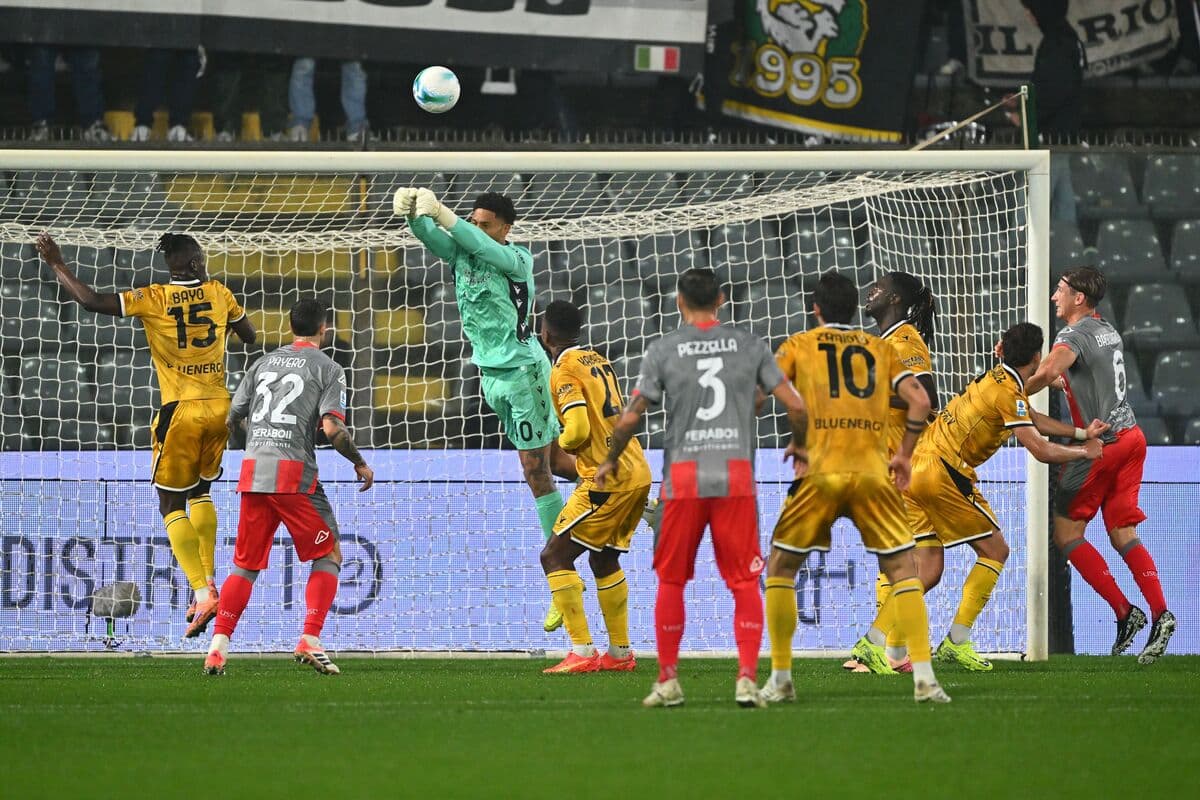
Yet where Udinese grew ragged, Cremonese grew narrower. Giampaolo’s late‑game adjustments tightened the 3‑5‑2 into a low 5‑3‑2, with Pezzella and Barbieri dropping almost level with the centre‑backs. The visitors leaned into a season‑long identity: they have kept 11 clean sheets overall, 5 of them away, despite their defensive record. Protecting the box became the only priority, and Audero’s command of crosses and timing off his line completed the barricade.
From a statistical prognosis, the story is stark. Udinese’s overall scoring average of 1.2 goals per game, and just 0.9 at home, again met a night where they failed to convert territory into chances. Cremonese, who average only 0.7 goals per game away and have failed to score in 10 away fixtures this season, found an atypical ruthlessness in the one moment that mattered and then leaned on structure.
Following this result, Udinese’s top‑half finish looks more like a ceiling than a springboard, and Runjaic will know that upgrading the creative layers behind Davis is essential. For Cremonese, the 1–0 away win is more than three points: it is proof that their 3‑5‑2 can bend but not break under pressure. Survival is still in doubt, but on a tense evening in Udine, their tactical clarity gave them a lifeline.