.svg&w=384&q=75 "naujapitch logo")
Como vs Parma: Season Finale Highlights and Tactical Insights
Stadio Giuseppe Sinigaglia closed its Serie A season with a narrow, telling verdict: Como 1–0 Parma, a result that distilled the broader story of both campaigns into ninety tense minutes on the lakeside.
I. The Big Picture – A result that fits the season’s script
Following this result, Como sit 5th with 68 points and a goal difference of +33, the product of 61 goals scored and 28 conceded in total across 37 matches. It is the profile of a side that has married attacking ambition with defensive control, particularly at home. At Stadio Giuseppe Sinigaglia they have played 19 league games, winning 10, drawing 6 and losing only 3, with 35 goals for and 15 against. The averages tell the same tale: 1.8 goals scored at home per match, just 0.8 conceded.
Parma, by contrast, remain 13th on 42 points, with a total goal difference of -19 (27 scored, 46 conceded in total). Their season has been defined by scarcity in attack and vulnerability without the ball. On their travels, Parma have played 19 times, winning 6, drawing 6 and losing 7, with only 12 away goals scored and 21 conceded. An away scoring average of 0.6 against an away defensive average of 1.1 underlines why a 1–0 defeat here feels almost archetypal.
In tactical terms, this fixture was also a clash of identities. Como leaned again on their favoured 4-2-3-1 – a shape they have used 33 times this season – under Cesc Fabregas, while Carlos Cuesta’s Parma arrived in their most-used 3-5-2, a system that has framed 18 of their league outings. The scoreline might be tight, but structurally this was a meeting of a polished, top-five side against a still-fragile mid-table unit.
II. Tactical Voids – Absences that reshaped the chessboard
Both coaches were forced into significant recalibrations by injuries and suspensions.
Como were without J. Addai (Achilles tendon injury), N. Paz (knee injury) and A. Valle (injury). The absence of Paz, in particular, ripped a creative and goalscoring hub out of Fabregas’s midfield: 12 total league goals and 6 assists from deep, plus 51 key passes and 125 dribble attempts, are not numbers you simply replace. His penalty record – 0 scored and 2 missed in Serie A – has already forced Como to rethink their hierarchy from the spot, but his open-play influence is harder to replicate.
Parma’s list was even longer and more damaging to their attacking variety: A. Bernabe (muscle injury), S. Britschgi (suspended after a red card), B. Cremaschi (knee injury), M. Frigan (knee injury), J. Ondrejka (leg injury) and G. Oristanio (knee injury) were all missing. That stripped Cuesta of creative midfielders, wide threats and rotation options up front, forcing him to double down on structure and resilience rather than expansive play.
Disciplinary trends also hovered over the contest. Como’s season-long card profile shows a late-game spike: 20.25% of their yellow cards arrive between 61–75 minutes and another 20.25% between 76–90, with all of their red cards (3 in total) coming in that same 76–90 window. Parma, meanwhile, scatter their cautions more broadly but have a worrying red-card pattern of their own: 40.00% of their reds in the 31–45 range and a further 20.00% each in 61–75, 76–90 and 91–105. This is a team that can lose control in key phases, and that ill-discipline has shaped their season as much as their low scoring.
III. Key Matchups – Hunter vs Shield, and the battle for control
The headline duel was always going to be “Hunter vs Shield”: T. Douvikas against Parma’s defensive block.
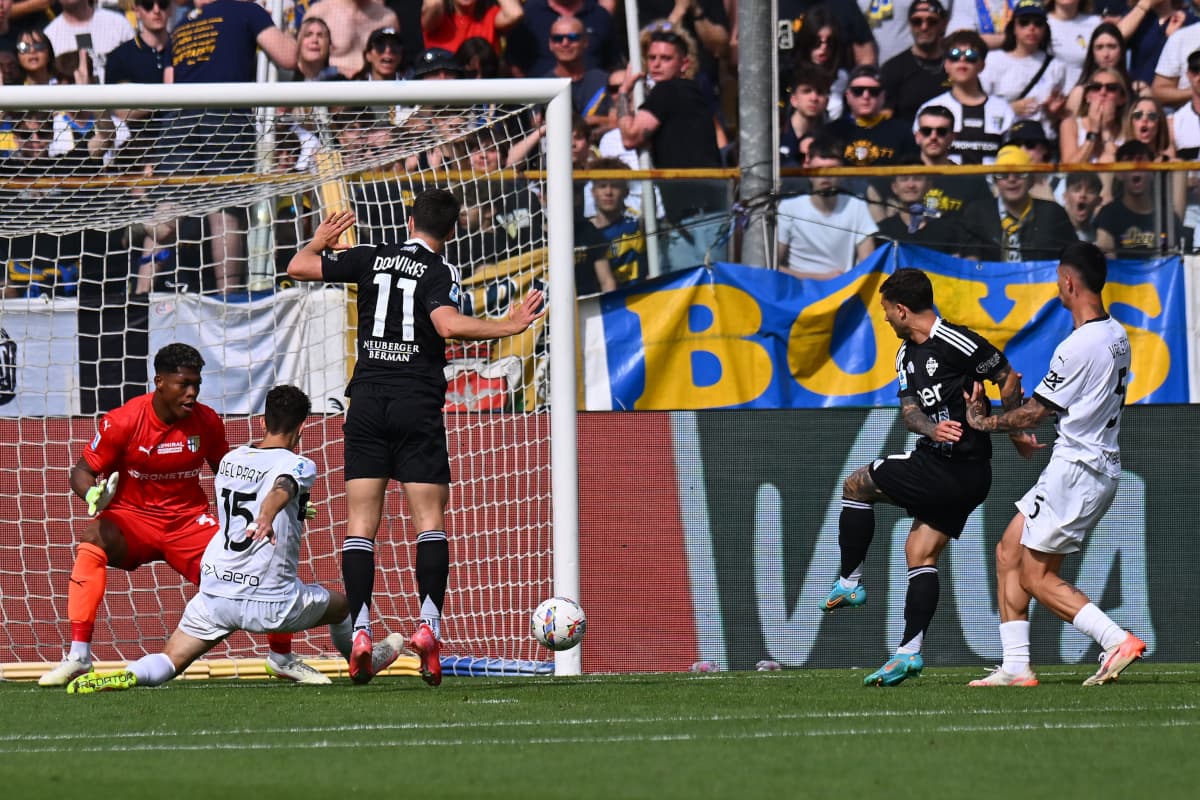
Douvikas, starting as Como’s lone forward in the 4-2-3-1, came into the fixture with 13 total league goals and 1 assist, converting from 46 total shots with 28 on target. His profile is that of a complete attacker rather than a pure poacher – 23 key passes, 33 dribble attempts and 40 fouls drawn show how much he contributes to link play and pressure. Against a Parma side that has conceded 46 goals in total, and 21 away, his movement between the lines and in the channels was always likely to stretch the back three.
Opposite him, Parma’s shield was anchored by M. Troilo and L. Valenti in the back three. Troilo’s statistical footprint is that of a proactive, sometimes overzealous stopper: 25 tackles, 18 blocked shots, 16 interceptions and 7 yellow cards, plus both a yellow-red and a straight red across 20 league appearances. He is aggressive in stepping out, often successfully, but his disciplinary record makes every duel with a striker like Douvikas a tightrope act. Here, that tension defined Parma’s last line: committed, combative, but always one mis-timed challenge from disaster.
In the “Engine Room” battle, Como’s double pivot of M. Perrone and L. Da Cunha had to compensate for the missing Paz. Perrone’s season shows why Fabregas trusts him: 2,111 completed passes at 91% accuracy, 56 tackles, 22 interceptions and 8 yellow cards. He is both metronome and enforcer, dictating tempo while sweeping up transitions. Alongside him, M. Caqueret higher up the pitch added creative thrust – 5 assists, 24 key passes and 31 dribble attempts – and helped link the pivot to the advanced trio of M. Baturina, A. Diao and Douvikas.
Parma’s midfield five, led by H. Nicolussi Caviglia in the central spaces, tried to compress that zone. But with Como used to playing through pressure – 890 passes from Caqueret at 87% accuracy and 2,043 from Jacobo Ramon at 91% show how comfortable they are in possession – the visitors were often forced deeper, turning their 3-5-2 into a 5-3-2 out of possession.
One under-the-radar duel was set-piece and aerial control. Jacobo Ramon, with 195 cm of height, 17 blocked shots and 36 interceptions, has been one of Serie A’s standout young defenders, even if his 11 yellow cards and 1 red underline a rugged edge. Up front for Parma, Mateo Pellegrino – 193 cm, 8 total goals, 50 shots and 67 fouls drawn – offered a direct, aerially dominant focal point. This was classic target man vs dominant centre-back territory, and Como’s ability to keep Pellegrino quiet was central to preserving their 1–0 advantage.
IV. Statistical Prognosis – Why the 1–0 felt inevitable
Following this result, the numbers align neatly with the narrative. Como’s total scoring average of 1.6 goals per game and total defensive average of 0.8 suggest a side comfortable winning by slim but controlled margins. Their 19 total clean sheets – 10 at home – reinforce that defensive reliability. Parma’s total scoring average of 0.7 and total concession rate of 1.2 point in the opposite direction: they simply do not create or convert enough to regularly overturn deficits, especially away.
Penalty data adds a small but telling layer. Como have earned 4 penalties this season, scoring all 4 in total, despite Paz’s personal record of 0 scored and 2 missed in the league – a sign that Fabregas has already adjusted the taker order. Parma, with 2 penalties scored from 2 in total, are perfect from the spot but generate so few chances in open play that these moments rarely swing games on their own.
Blend those metrics with the tactical realities – Como’s ball-dominant 4-2-3-1, Parma’s depleted 3-5-2 and their reliance on Pellegrino’s physicality – and the 1–0 home win feels less like a surprise and more like the season’s logic playing out on a sunlit afternoon by the lake. Como controlled, Parma resisted, and in the end the numbers, as much as the football, dictated that the margin would be narrow, but the direction clear.