.svg&w=384&q=75 "naujapitch logo")
Chelsea's 2-1 Derby Win Over Tottenham: A Tactical Analysis
Under the Stamford Bridge floodlights, Chelsea’s 2-1 victory over Tottenham felt less like a routine derby win and more like a manifesto for what this squad wants to become. Following this result in Round 37 of the Premier League season, the league table confirms the direction of travel: Chelsea sit 8th with 52 points, a positive goal difference of 7 (57 scored, 50 conceded), while Tottenham remain in peril at 17th on 38 points, their goal difference of -10 (47 for, 57 against) a blunt summary of a troubled campaign.
I. The Big Picture – Systems, Stakes, and Setting
Both sides mirrored each other structurally, lining up in a 4-2-3-1, but the shared numbers disguised two very different identities.
Chelsea’s season-long profile is clear. Heading into this game they had scored 57 goals in total, with an average of 1.4 at home and 1.7 on their travels, and conceded 50 overall at 1.3 per home game and 1.4 away. This is a side built on front-foot football, prepared to live with some defensive exposure in exchange for attacking volume. Their most-used shape, the 4-2-3-1 (32 league appearances), has become a framework for controlled chaos.
Tottenham’s numbers tell a more fragile story. Heading into this game they had 47 goals in total at 1.3 per match, but their defensive line has buckled too often: 57 conceded overall, with a worrying 1.7 per home match and 1.4 away. The away record – 7 wins, 5 draws, 7 defeats, 26 scored and 26 conceded – suggests a team more comfortable spoiling than dictating, even under a coach like Roberto De Zerbi who is ideologically committed to proactive football.
At Stamford Bridge, those season-long patterns reasserted themselves. Chelsea controlled the key phases, Tottenham chased.
II. Tactical Voids – Absences Shape the Chessboard
The team sheets carried the scars of a long campaign. Chelsea were without L. Colwill (rest), J. Gittens (muscle injury), M. Gusto (injury), Joao Pedro (knock), R. Lavia (knock) and the suspended M. Mudryk. For a squad that leans heavily on technical progression from deep and dynamism in the final third, those absences forced Calum McFarlane to lean into his depth.
The back four of J. Acheampong, W. Fofana, J. Hato and Marc Cucurella was both experimental and intriguing. Fofana’s aggression and Hato’s left-footed balance gave Chelsea a platform to hold a higher line, while Cucurella’s engine on the left became a key outlet. In midfield, the double pivot of Andrey Santos and M. Caicedo offered a blend of verticality and destruction, freeing E. Fernandez, C. Palmer and P. Neto to occupy the three advanced midfield lanes behind L. Delap.
Tottenham’s absentees were even more structurally disruptive. B. Davies (ankle), M. Kudus, D. Kulusevski, W. Odobert, C. Romero, X. Simons and D. Solanke were all missing. Losing Romero, one of the league’s most aggressive defenders and a top red-card magnet, stripped De Zerbi’s back line of its natural enforcer. The centre-back pairing of K. Danso and M. van de Ven had to defend space without Romero’s front-foot interventions, while the absence of Kudus, Kulusevski and Simons robbed the visitors of ball-carrying and creative variety between the lines.
Disciplinary trends underpinned the risk. Chelsea’s season card map shows a late-game surge in yellow cards between 76-90 minutes at 25.81%, reflecting how their intensity can spill into recklessness as they protect or chase games. Tottenham’s own peak for yellows sits at 61-75 minutes with 25.51%, often coinciding with tactical reshuffles and fatigue. This was always a contest in which control of emotion would be as important as control of territory.
III. Key Matchups – Hunter vs Shield, Engine Room vs Enforcer
The “Hunter vs Shield” narrative centred on Richarlison, Tottenham’s leading scorer with 11 league goals, against a Chelsea defence that, heading into this fixture, had conceded 50 overall but just 25 at home. Richarlison’s profile – 45 shots, 26 on target, 19 key passes – marks him as a volume threat rather than a pure finisher, and the plan was clear: use R. Kolo Muani, C. Gallagher and M. Tel in the three behind him to drag Chelsea’s back four out of shape and open pockets in the box.
But Chelsea’s shield was more sophisticated than the raw goals-against numbers suggest. Caicedo, one of the league’s most prolific ball-winners with 87 tackles and 57 interceptions, patrolled the space in front of Fofana and Hato, cutting off the service lines into Richarlison’s feet. When Tottenham tried to go wide, Cucurella and Acheampong were aggressive in stepping out, with Caicedo sliding across to cover the vacated channels.
In the “Engine Room” duel, the contrast was compelling. For Tottenham, J. Palhinha and R. Bentancur are natural stoppers – Palhinha in particular is a destroyer who thrives on contact. Their task was to disrupt Chelsea’s creative triangle of Fernandez, Palmer and Neto. Fernandez arrived as one of the league’s most complete midfielders: 10 goals, 4 assists, 67 key passes and an 86% pass accuracy heading into this match. He is both metronome and spearhead, equally comfortable threading passes between lines or arriving late at the edge of the box.
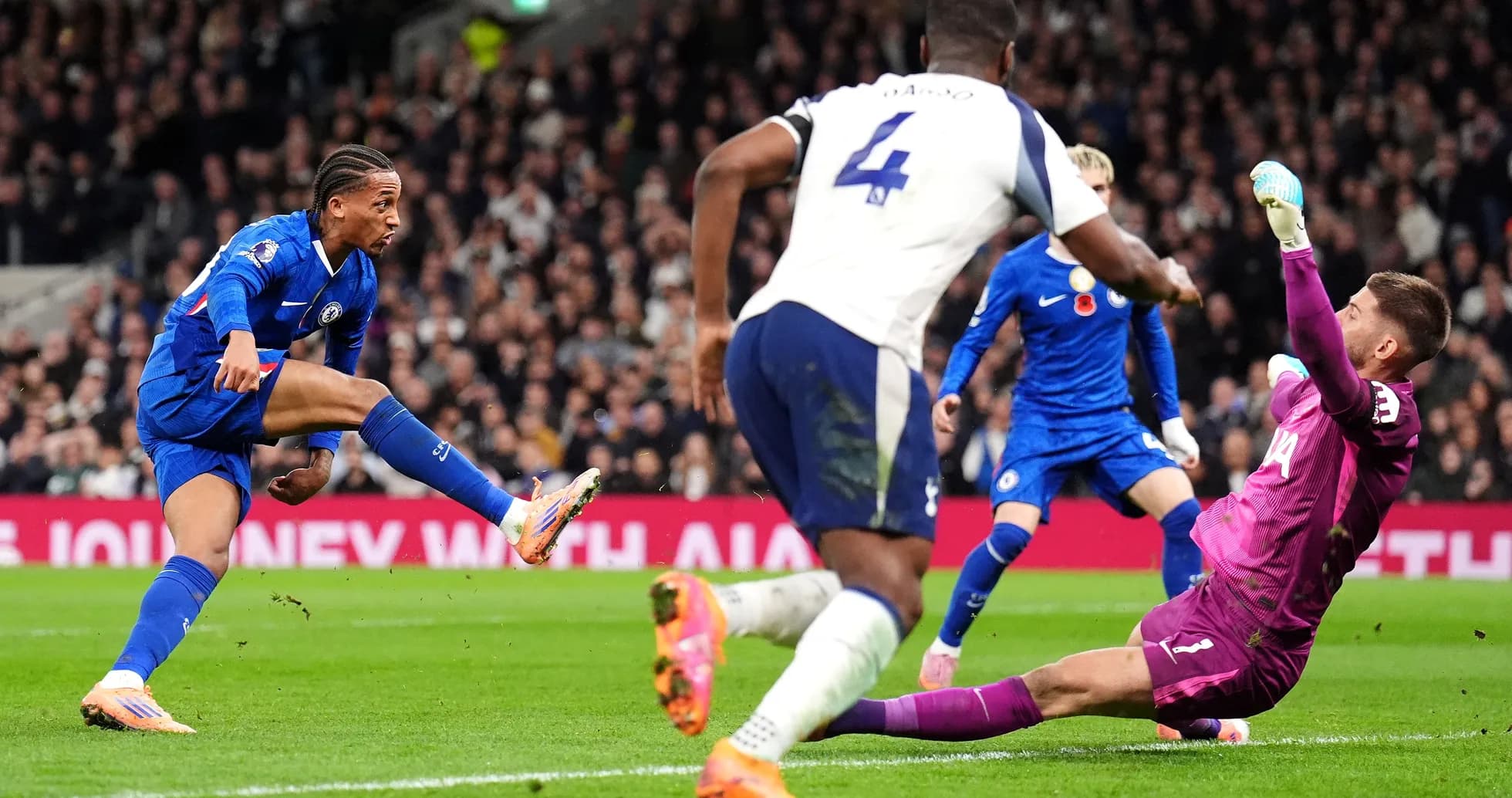
Palhinha and Bentancur tried to compress his space, but the problem for Tottenham was numerical. Chelsea’s 4-2-3-1 morphs into a 2-3-5 in settled possession, with Santos dropping alongside Caicedo and both full-backs pushing high. That left Tottenham’s double pivot outnumbered against Chelsea’s interior rotations. Palmer drifted into the right half-space, Neto hugged and then underlapped from the left, and Fernandez orchestrated from the central pocket. The second Chelsea goal, arriving after sustained pressure, felt like the inevitable outcome of that overload.
IV. Statistical Prognosis – Why the Result Fit the Numbers
Even without explicit xG values, the season data sketches the expected pattern. Chelsea, with 1.5 goals per game overall and 9 clean sheets, are built to create more than they concede. Tottenham, with 1.3 goals for and 1.5 against per match, particularly vulnerable at home but merely average away, are statistically predisposed to live on the edge.
At Stamford Bridge, the 2-1 scoreline mirrored those underlying trends. Chelsea’s attacking structure, powered by Fernandez’s passing range and Caicedo’s ball-winning, consistently tilted the pitch. Tottenham’s best hope was to exploit transitions and individual moments from Richarlison and Kolo Muani, but without their missing creators and with a patched-up back line, their margin for error was thin.
Following this result, the tactical verdict is clear. Chelsea’s squad, even shorn of Joao Pedro and Mudryk, has the depth and tactical clarity to impose a high-possession, high-risk model. Tottenham, depleted and structurally compromised, remain a side whose numbers and narrative align: dangerous in flashes, but too porous and too brittle to control matches against top-half opposition.