.svg&w=384&q=75 "naujapitch logo")
Burnley and Wolves Battle to 1-1 Draw at Turf Moor
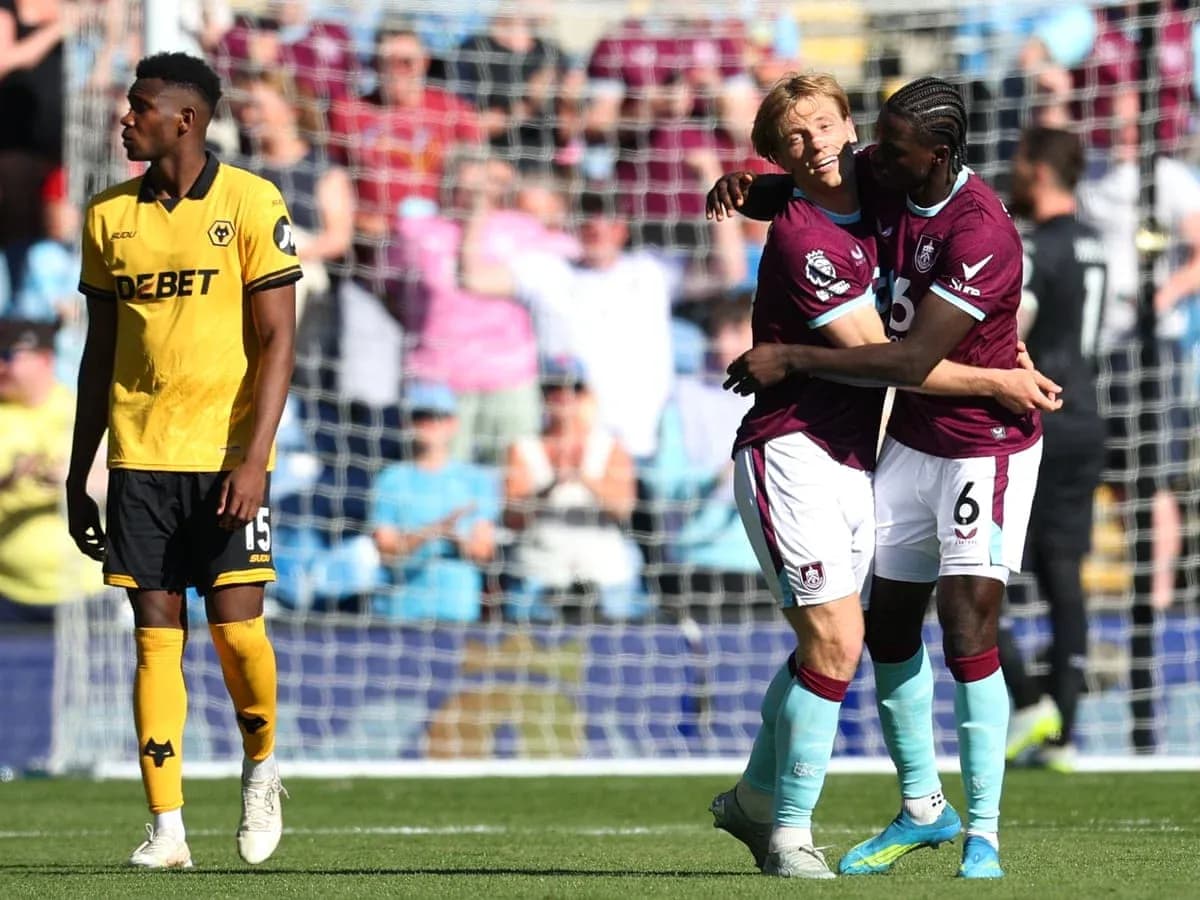
Burnley’s 1-1 draw with Wolves at Turf Moor was a study in territorial dominance versus vertical punch. Mike Jackson’s side, in a 4-2-3-1, controlled the game with 70% possession and a 558–223 passing advantage, but Rob Edwards’ compact 3-4-2-1 carried the greater threat in pure chance quality, reflected in Wolves’ higher xG of 2.05 to Burnley’s 1.06. The scoreline mirrored the strategic tension: Burnley’s structure and pressure gradually suffocated Wolves after an early penalty concession, yet Wolves’ transitional routes and penalty-box presence consistently looked capable of stealing more than a point.
Burnley’s build-up was methodical and clearly choreographed around the double pivot of Florentino and L. Ugochukwu. With the centre-backs A. Tuanzebe and B. Humphreys splitting and full-backs K. Walker and Lucas Pires pushing high, the pivots created a 2-2 base that allowed the three attacking midfielders to stay advanced between the lines. The 87% passing accuracy (488 accurate from 558) underlines how secure Burnley were in circulation, particularly in the middle third, but the shot profile tells a more nuanced story: 16 total shots, yet only 7 inside the box and 8 on goal, with 6 blocked. Wolves’ back three plus the double screen repeatedly forced Burnley to shoot from distance or through crowds.
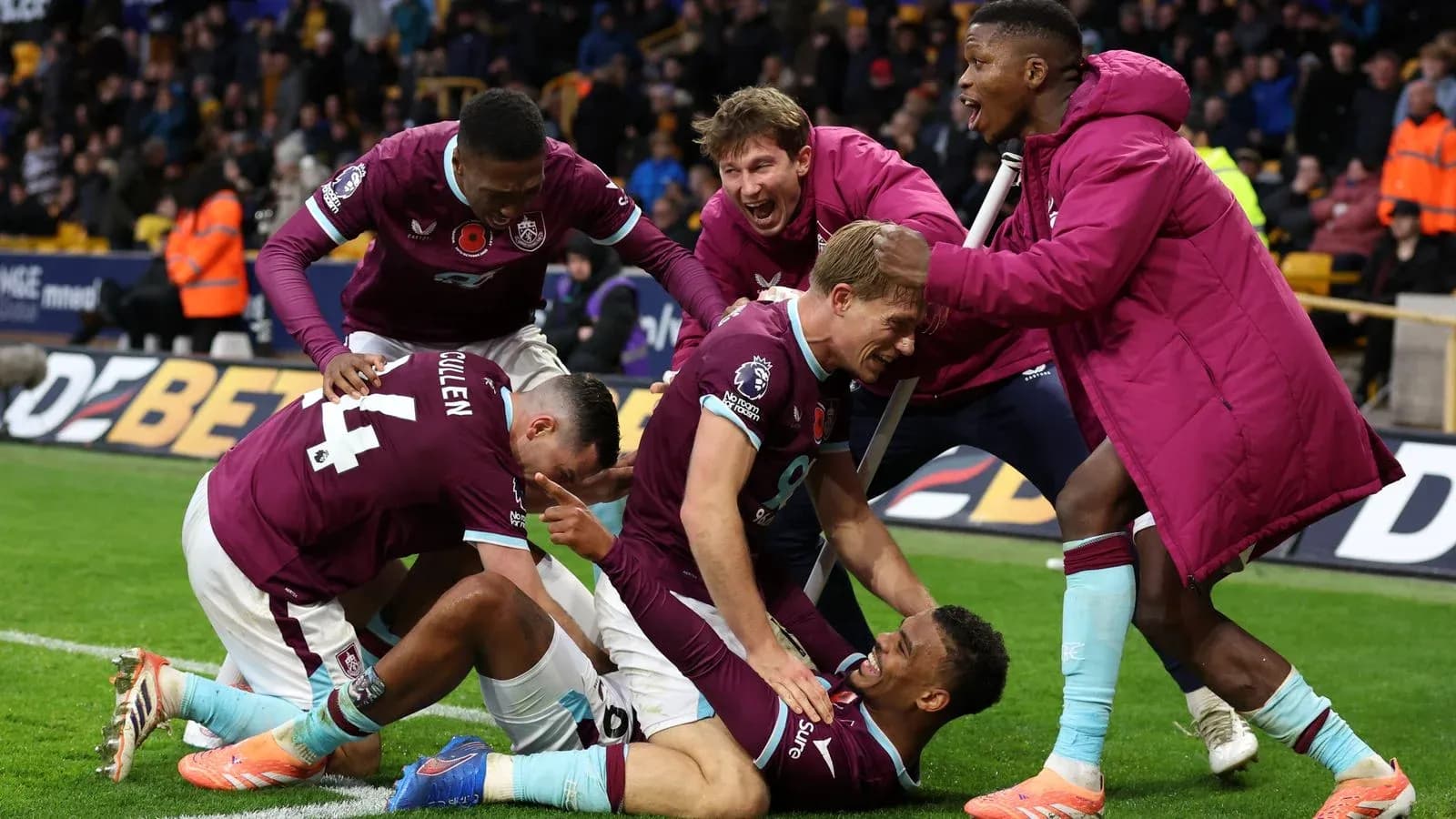
Within that structure, Z. Flemming was the key reference between the lines. Operating as the nominal “10”, he continually tried to find pockets behind Andre and A. Gomes, and his second-half equaliser – assisted by L. Tchaouna – was the logical payoff of Burnley’s positional occupation. L. Tchaouna and J. Anthony, starting wide, were encouraged to come inside, narrowing Wolves’ wing-backs and opening corridors for overlapping full-backs. However, Wolves’ 7 blocked shots show how often their defensive line held its box shape and stepped out at the right moment to smother shooting lanes.
Without the ball, Burnley’s press was measured rather than wild. The front four staggered their positions to screen passes into Wolves’ midfield, trying to funnel play towards one flank where the ball-side full-back and pivot could trap. The relatively low foul count (10) for a side chasing the game for long stretches suggests a controlled, structure-first defensive approach rather than frantic counter-pressing. When Burnley did lose their shape, it was usually in defensive transition after committing full-backs high; those moments fed directly into Wolves’ best situations.
Wolves’ 3-4-2-1 was unapologetically vertical. With only 30% possession and 223 passes (164 accurate at 74%), they had no interest in long spells of sterile circulation. Instead, they prioritised first and second balls into the front three of M. Mane, Hwang Hee-Chan and A. Armstrong. The early penalty – confirmed by VAR from a Ladislav Krejčí incident and converted by A. Armstrong – encapsulated their plan: attack the box quickly, force duels and exploit Burnley’s back line facing its own goal. The fact Wolves generated 10 shots inside the box out of 16 total, despite seeing so little of the ball, is a clear indicator of how efficiently they turned territory into danger.
The wing-backs and wide midfielders were central to this. R. Gomes and D. M. Wolfe, supported by Andre and A. Gomes inside, looked to spring forward the moment possession was won, often bypassing the middle third entirely. Hwang Hee-Chan’s yellow card for an “Off the ball foul” at 41' also hints at Wolves’ combative edge in those transition moments: disrupting Burnley’s rest defence and preventing immediate counters. As the game wore on, Edwards used his bench to refresh that intensity: T. Arokodare for A. Gomes, Toti for L. Krejci, H. Bueno for D. M. Wolfe, J. Abbey for A. Armstrong and Pedro Lima for R. Gomes all maintained the 3-4-2-1 skeleton while injecting new legs into the pressing and running lanes.
In goal, M. Weiss (Burnley) and J. Sa (Wolves) anchored two very different defensive experiences. Weiss, behind a side that monopolised the ball, faced 4 shots on target and made 3 saves, with a goals prevented figure of 0.29. That suggests he performed slightly above expectation on the quality of chances faced, stabilising Burnley after the early setback and ensuring Wolves’ superior xG did not translate into a second goal. Sa, by contrast, was under near-constant territorial pressure: Burnley hit 8 shots on target and he made 7 saves, also with 0.29 goals prevented. His shot-stopping, particularly against medium-range efforts through traffic, was a major reason Wolves held the point despite spending long spells in their own half.
The disciplinary pattern added another tactical layer. Wolves finished with 2 yellow cards (Hwang Hee-Chan for “Off the ball foul” at 41', Yerson Mosquera for “Argument” at 90+4'), matching Burnley’s 2 (Hannibal Mejbri for “Argument” at 45+9', Ashley Barnes for “Argument” at 90+4'). Hannibal’s booking just before half-time reflected Burnley’s frustration at chasing a game they largely controlled territorially; Barnes’ late caution came after he had been introduced for Flemming to add penalty-box presence and aggression. These moments showed how the emotional temperature rose as Burnley pushed numbers forward in search of a winner and Wolves dug in to protect their point.
Statistically, the game underlines a classic trade-off. Burnley’s overall form on the day – measured by possession, pass accuracy and shot volume – was strong, and their structure allowed them to dictate where the game was played. Yet Wolves’ defensive index, blending 7 blocked shots, 7 saves from J. Sa and a compact low block, was equally impressive. The xG split – Wolves 2.05, Burnley 1.06 – hints that, chance for chance, Wolves’ approach was more incisive even if less aesthetically dominant.
Set plays and wide restarts also reflected this balance. Both sides earned 7 corner kicks, but Burnley’s were typically the culmination of long possessions, while Wolves’ tended to arrive from fast breaks and forced saves. Burnley’s inability to convert those territorial platforms into higher-quality box chances is the central tactical regret of their afternoon; Wolves’ regret is that, having engineered the better looks at goal from limited ball, they lacked the final touch to turn a clever away game-plan into a final-day win.
Ultimately, the 1-1 at Turf Moor was a draw defined by contrasting identities: Burnley as the structured, ball-dominant side whose attacking patterns yielded only one breakthrough, Wolves as the low-possession, high-impact unit whose compact 3-4-2-1 and penalty-box efficiency nearly stole the game despite living without the ball.