.svg&w=384&q=75 "naujapitch logo")
Burnley vs Aston Villa: Tactical Analysis of 2-2 Premier League Draw
Burnley and Aston Villa shared a 2-2 draw at Turf Moor in Round 36 of the Premier League, a contest defined by contrasting structures in identical 4-2-3-1 shapes. Burnley, under Mike Jackson, leaned into verticality and transitional aggression; Aston Villa, coached by Unai Emery, imposed long spells of possession and territorial control. The scoreline mirrored the underlying balance: Burnley’s direct, punchy attacks produced 1.77 xG against Villa’s 1.42, while Villa’s 66% of the ball and 510 passes framed a game where the visitors dictated tempo but never fully broke the home side’s compact defensive block.
Disciplinary Log
- 49' Tyrone Mings (Aston Villa) — Foul
- 60' Zian Flemming (Burnley) — Persistent fouling
Total cards: Burnley: 1, Aston Villa: 1, Total: 2.
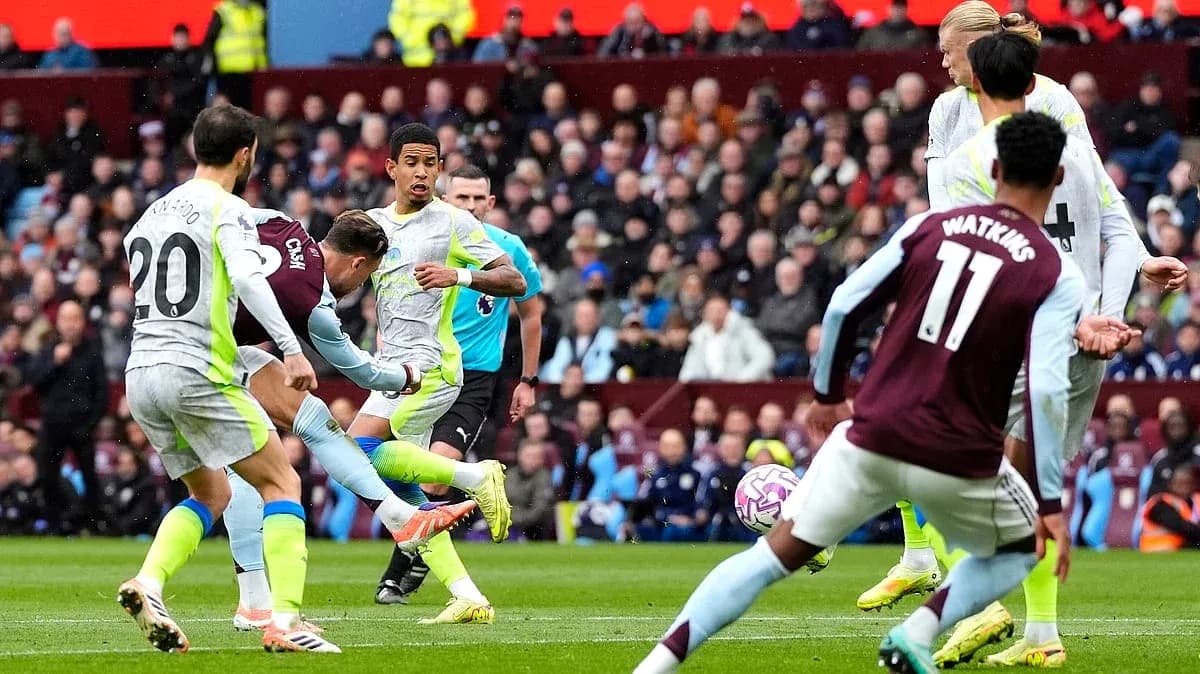
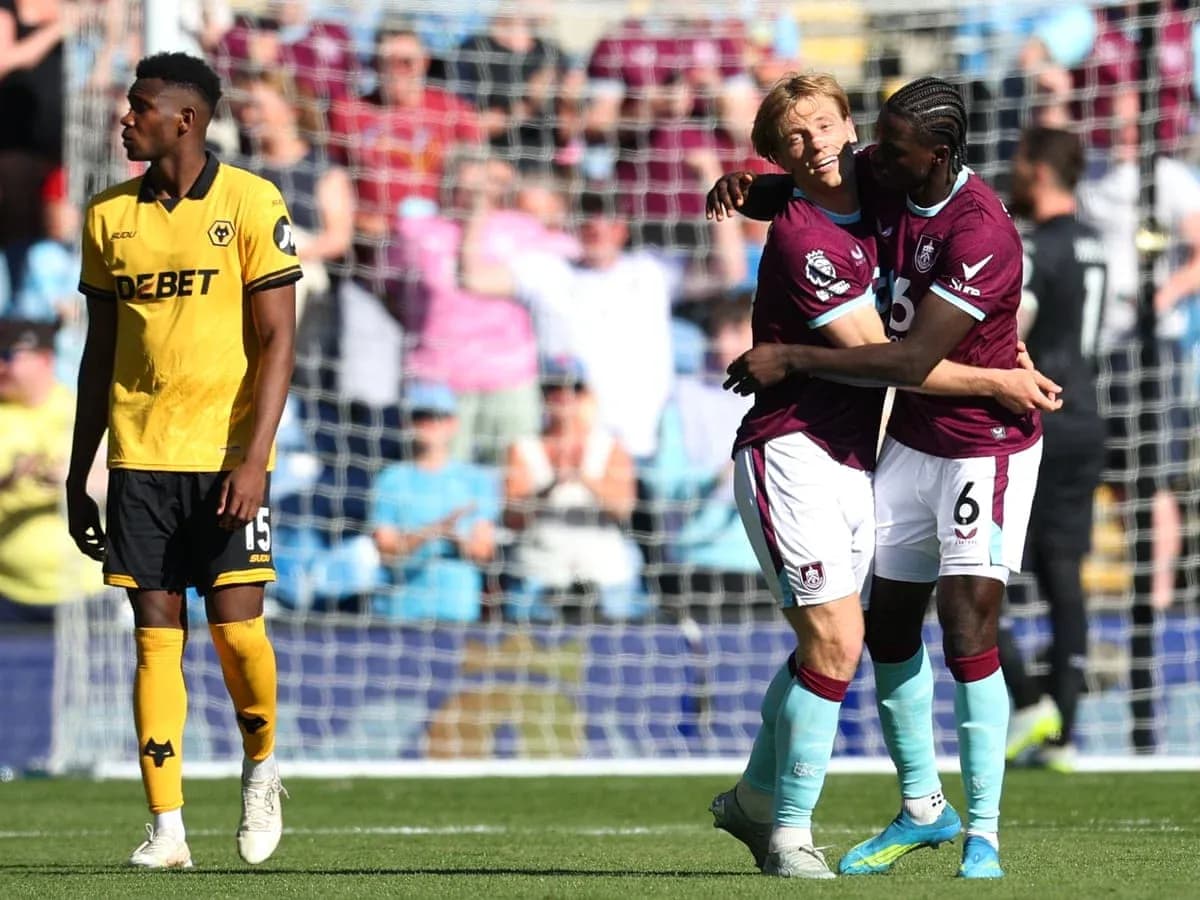
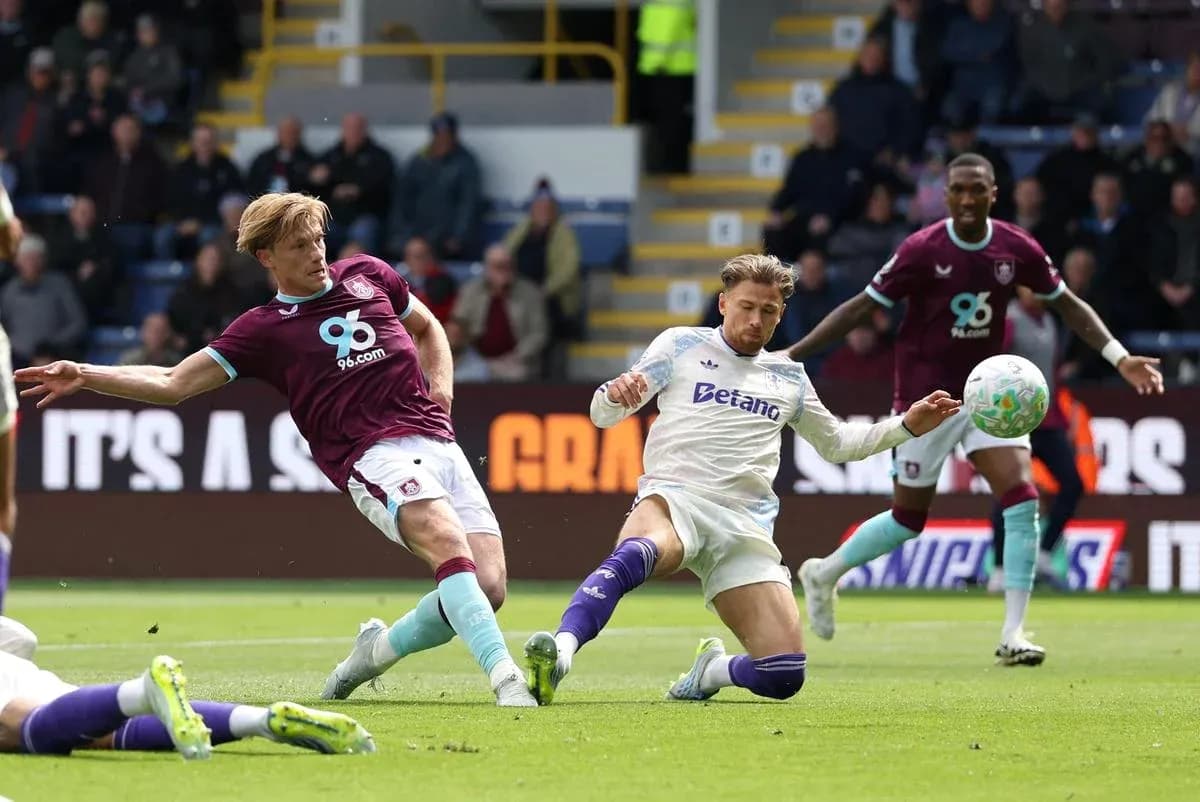
The scoring sequence opened early. At 8', Jaidon Anthony struck for Burnley, capitalising on the home side’s aggressive use of the three behind the striker to attack Villa’s full-back channels. Villa thought they had responded when a potential goal by Ollie Watkins was disallowed by VAR at 40', a key moment that underlined Burnley’s vulnerability to runs in behind but spared them on the scoreboard. Villa did level before the break: at 42', Ross Barkley finished after a combination with John McGinn, whose assist from the No. 10 lane punished Burnley’s midfield spacing between the double pivot and back four.
After the interval, Villa’s structural dominance turned into a lead at 56', when Ollie Watkins scored from a direct involvement by Emiliano Martínez, highlighting Villa’s capacity to turn controlled build-up into quick vertical release. Burnley replied almost immediately: at 58', Zian Flemming equalised from a pass by Hannibal Mejbri, a classic Burnley pattern where the No. 10 received between the lines and fed the forward attacking the half-space. The game’s edge then shifted into discipline and energy management. Mings’ yellow at 49' for “Foul” came as Burnley tried to break through Villa’s high line, while Flemming’s caution at 60' for “Persistent fouling” reflected his dual role as pressing leader and disruptive presence in midfield.
Tactically, both teams lined up in 4-2-3-1 but used the shape very differently. Burnley’s back four of Kyle Walker, Axel Tuanzebe, Maxime Estève and Lucas Pires sat relatively narrow, with Walker and Pires selective in their forward runs. In possession, Florentino Luís and Lesley Ugochukwu formed a flat double pivot, tasked with screening transitions more than orchestrating long possession spells. The attacking three of Loum Tchaouna, Hannibal Mejbri and Jaidon Anthony operated very vertically, looking to receive early and drive at Villa’s full-backs, while Zian Flemming played as a physically assertive No. 9, pinning centre-backs and attacking crosses.
Burnley’s approach was built around fast progression rather than circulation: 255 total passes, 186 accurate (73%), and just 34% possession. Yet their shot profile was efficient: 15 total shots, 6 on target, split almost evenly between inside (7) and outside (8) the box. The 1.77 xG underscores that their chances were of relatively high quality, often arriving from quick breaks once Villa’s double pivot was bypassed. Out of possession, Burnley accepted long defending phases, committing 17 fouls and relying on compactness and aggressive duels, especially from Flemming and the pivots, which eventually produced his yellow for “Persistent fouling”.
Aston Villa’s 4-2-3-1 was more positional. Matty Cash and Ian Maatsen provided width from full-back, with Ezri Konsa and Tyrone Mings holding a high line. Victor Lindelöf and Youri Tielemans, starting as a midfield pair, gave Villa a stable base to recycle possession and step into Burnley’s half. Ahead of them, John McGinn and Ross Barkley rotated between No. 8 and No. 10 spaces, with Morgan Rogers tucking in from the left and Ollie Watkins stretching the line. Villa’s 510 passes, 439 accurate (86%), and 66% possession illustrate a game plan focused on control and patient probing, reflected in 18 total shots, 7 on target, and a balanced shot map (9 inside, 9 outside the box).
The substitutions were tactical refinements rather than systemic overhauls. For Burnley, Lyle Foster (IN) came on for Hannibal Mejbri (OUT) at 69', adding more penalty-box presence and direct running, while Josh Laurent (IN) replaced Lesley Ugochukwu (OUT) at 79' to bring fresh legs and ball-carrying from deep. Zeki Amdouni (IN) for Zian Flemming (OUT) at 79' shifted Burnley’s attack toward more mobility and combination play, and late changes — James Ward-Prowse (IN) for Florentino Luís (OUT) and Jacob Bruun Larsen (IN) for Jaidon Anthony (OUT) at 87' — signalled a push for better delivery and fresh wide threat in the closing minutes.
For Villa, Lucas Digne (IN) for Ian Maatsen (OUT) at 74' preserved attacking width on the left with a stronger crossing profile. Emiliano Buendía (IN) for Victor Lindelöf (OUT) at 74' tilted the structure toward a more attacking 4-1-4-1 in possession, with extra creativity between the lines. Douglas Luiz (IN) for Ross Barkley (OUT) at 80' rebalanced the midfield to protect against counters, while Lamare Bogarde (IN) for Matty Cash (OUT) at 80' and Leon Bailey (IN) for John McGinn (OUT) at 85' injected fresh energy on the right flank and additional 1v1 threat.
In goal, Max Weiss for Burnley and Emiliano Martínez for Villa each faced 7 shots on target (Burnley 7 conceded, Villa 6 conceded). The statistics list 5 goalkeeper saves for Burnley and 4 for Villa, with both keepers posting -0.16 in goals prevented, indicating that neither overperformed against the quality of shots faced. Defensively, this suggests that the back lines allowed chances broadly in line with the eventual goals conceded: Burnley’s Defensive Index, inferred from 17 fouls and 5 saves, reflects a high-work, high-contact approach under pressure; Villa’s, with 8 fouls and 4 saves, points to a more controlled but occasionally exposed high line.
The statistical verdict reinforces the narrative of stylistic contrast with genuine parity in outcome. Burnley’s Overall Form in this match was that of a low-possession, high-impact side: fewer passes, more direct entries, and an xG edge (1.77 vs 1.42) that validates their attacking plan. Villa’s Overall Form was defined by structure and volume — more possession, more shots, and superior passing accuracy — but without a decisive margin in chance quality.
Discipline was minimal but meaningful: 1 yellow card for Burnley and 1 for Aston Villa, 2 in total, each rooted in clear behavioural patterns — Mings’ “Foul” in defending space behind the line, Flemming’s “Persistent fouling” as the spearhead of Burnley’s disruptive press. In the end, the 2-2 scoreline, Burnley 2-2 Aston Villa, accurately reflects a contest where Villa’s control and Burnley’s direct threat cancelled each other out, leaving both sides with a point and a clear tactical identity on display.