.svg&w=384&q=75 "naujapitch logo")
Brighton Dominates Wolves 3–0: A Premier League Overview
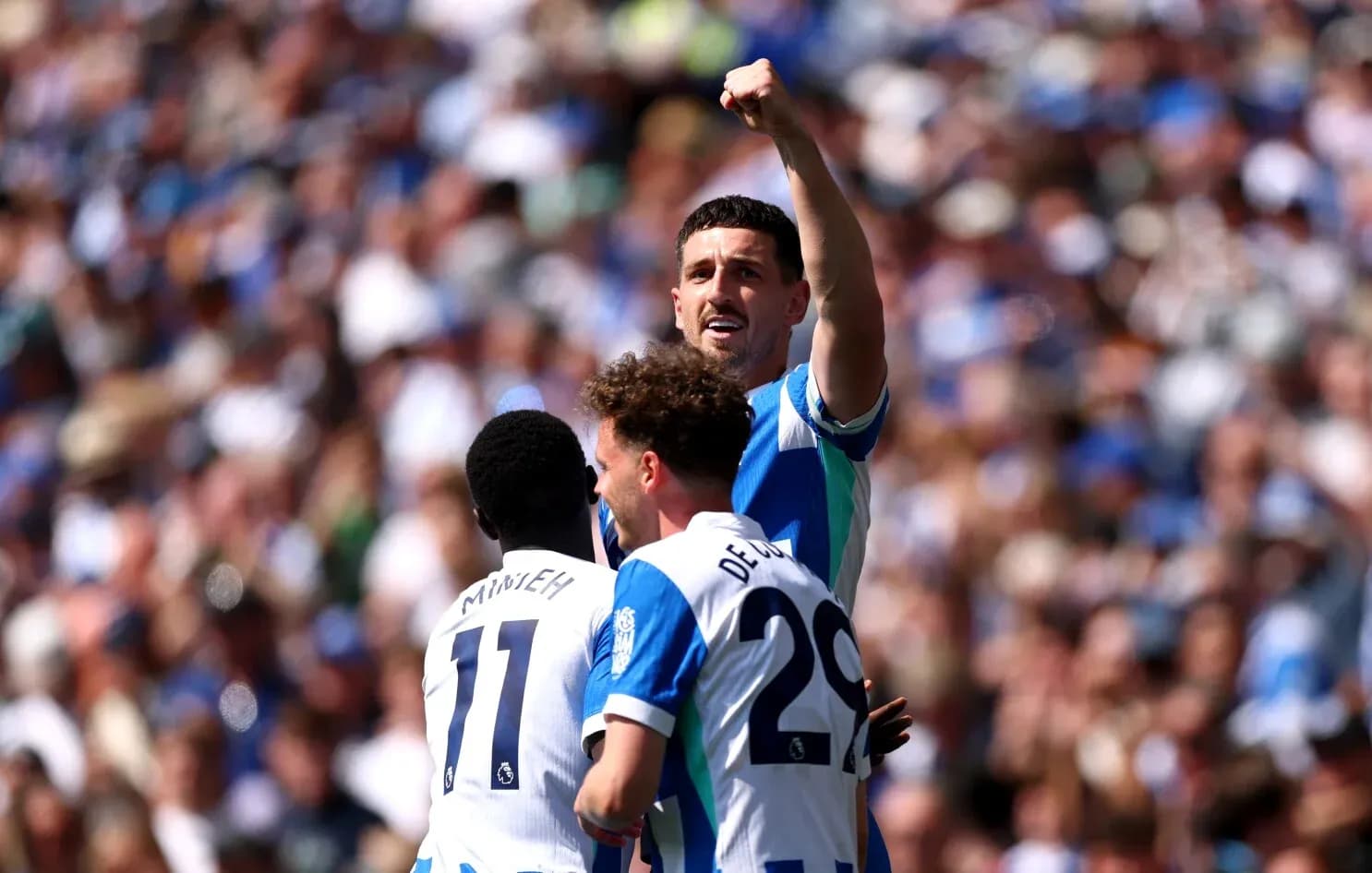
Under a flat grey sky at the Amex Stadium, Brighton’s 3–0 dismantling of Wolves felt less like a routine home win and more like a live demonstration of where these two clubs now sit in the Premier League hierarchy. Following this result in Round 36, the table tells its own story: Brighton in 7th with 53 points and a positive goal difference of 10, Wolves marooned in 20th on 18 points with a goal difference of -41. But it was the way the squads were constructed and deployed that truly underlined the gap.
I. The Big Picture – contrasting identities
Brighton’s season-long DNA has been clear. Overall this campaign they have scored 52 goals and conceded 42 across 36 matches, a balanced, front-foot side with an attacking edge. At home they average 1.7 goals for and 0.9 against, numbers that matched the authority of this 3–0 scoreline. Clean sheets at the Amex are not a rarity either, with 5 at home and 10 overall.
Wolves, by contrast, arrived with the profile of a side permanently on the back foot. On their travels they average just 0.4 goals for and 1.8 against, and across the season they have failed to score in 12 away matches and 19 in total. The 25 goals scored overall against 66 conceded paints the picture of a team lacking both punch and protection.
The coaches’ choices reflected these trajectories. Fabian Hurzeler trusted a progressive core: Bart Verbruggen in goal, a ball-playing back line of Ferdi Kadioğlu, Jan Paul van Hecke, Lewis Dunk and Maxim De Cuyper, and a midfield axis of Carlos Baleba and Pascal Groß behind a fluid band of Yankuba Minteh, Jack Hinshelwood, Kaoru Mitoma and the veteran finisher Danny Welbeck. Rob Edwards, meanwhile, leaned into resilience, with Daniel Bentley behind a three-man defensive spine of Yerson Mosquera, Santiago Bueno and Toti Gomes, a hard-running midfield including Pedro Lima, João Gomes, André and Hugo Bueno, and a front line of Adam Armstrong, Mateus Mané and Hwang Hee-chan asked to live off scraps.
II. Tactical Voids – absences and discipline
Both sides were forced to adapt to significant absences, but the impact was uneven.
Brighton were without D. Gómez, S. Tzimas, A. Webster and M. Wieffer, all ruled out with injuries. In theory that stripped Hurzeler of a dynamic ball-winner in midfield (D. Gómez) and an experienced centre-back (A. Webster). In practice, the robustness of the remaining spine – Dunk and van Hecke at the back, Baleba screening, Groß orchestrating – meant the structure held firm. The bench options of Joël Veltman, Olivier Boscagli and James Milner offered additional defensive and positional cover if the game state demanded it.
Wolves’ absentees cut closer to the bone. L. Chiwome and E. Gonzalez were missing, but more telling was the double blow in goal: S. Johnstone and J. Sa both out, leaving Bentley as the de facto number one with Josh Gracey as understudy. For a side already conceding 33 goals away and 66 overall, that lack of continuity in the most sensitive position added a layer of fragility.
Disciplinary profiles also shaped the tone. Brighton’s yellow-card distribution this season peaks between 46–60 minutes at 27.91%, while Wolves’ highest yellow window is also 46–60 minutes at 28.57%. That shared tendency to collect bookings just after half-time framed the middle third of the match as a likely flashpoint. Yet crucially, Brighton have not seen a red card in any time segment, whereas Wolves have been reduced to ten men in three distinct windows (31–45, 46–60, 61–75). That underlying volatility made Edwards’ side wary in duels, particularly once they fell behind.
III. Key Matchups – Hunter vs Shield, Engine Room wars
The most compelling individual storyline was the “Hunter vs Shield” duel between Brighton’s leading scorer and Wolves’ embattled defence.
Danny Welbeck came into this fixture as one of the league’s sharper forwards: 13 goals and 1 assist in 35 appearances, with 45 shots and 27 on target. His numbers tell of a striker who still finds space and finishes moves, but also of a player who lives on the edge – he has missed 2 penalties from 3 taken, underlining that Brighton’s attacking threat is not built on spot-kick reliability but on open-play patterns.
Against him stood a Wolves rearguard that, collectively, has been overrun. On their travels they have conceded 33 goals, mirroring their 33 against at home. Yerson Mosquera, one of the league’s most carded defenders with 11 yellows, is a symbol of that desperate resistance: 14 blocked shots, 57 tackles, 26 interceptions, but also a high foul count and a tendency to be dragged into last-ditch challenges.
Here, Welbeck’s movement between the lines, supported by Mitoma’s dribbling threat and Minteh’s direct running, repeatedly forced Mosquera and Toti Gomes into uncomfortable territory. With Brighton averaging 1.7 home goals and Wolves conceding 1.8 away, the statistical trend was always likely to bend in the striker’s favour – and a three-goal haul for the hosts simply extended that curve.
In the “Engine Room” the clash was equally stark. For Wolves, André and João Gomes are high-volume, high-intensity presences. André has amassed 76 tackles and 12 blocked shots, while João Gomes leads with 108 tackles and 34 interceptions; together they form a double-pivot built to break rhythm rather than dictate it. Their disciplinary records – 11 and 10 yellows respectively – underline just how often they operate at the limit.
Opposite them, Pascal Groß and Baleba offered a different kind of control. Groß’s season-long passing influence, combined with Baleba’s physical coverage, allowed Brighton to use the ball as their first line of defence. Dunk and van Hecke then reinforced that structure from behind: Dunk has blocked 26 shots and made 29 interceptions, van Hecke 28 blocks and 43 interceptions, numbers that explain why Brighton’s overall goals-against average is just 1.2, and only 0.9 at home.
IV. Statistical Prognosis – a result that fits the numbers
Strip away the narrative and the xG logic of this contest is blunt. Heading into this game, Brighton were a top-seven side with a positive goal difference and a home attack averaging 1.7 goals, Wolves a bottom-placed team with a negative goal difference of -41, scoring 0.4 goals away and conceding 1.8. Brighton had 10 clean sheets overall; Wolves had failed to score in 12 away matches.
Overlay the squad realities – Brighton’s depth even with key injuries, Wolves’ patched-up goalkeeping situation and reliance on overworked midfield enforcers – and a Brighton win by multiple goals was the most probable outcome. A 3–0 scoreline does not flatter Hurzeler’s side; if anything, it simply translates season-long trends into a single afternoon at the Amex.
Following this result, Brighton look every inch a side ready to push their Conference League ambitions over the line, their squad profile balanced, their defensive metrics robust. Wolves, by contrast, remain a team whose structure and personnel point squarely towards the Championship, their season-long numbers and the evidence of this match aligned in uncomfortable symmetry.