.svg&w=384&q=75 "naujapitch logo")
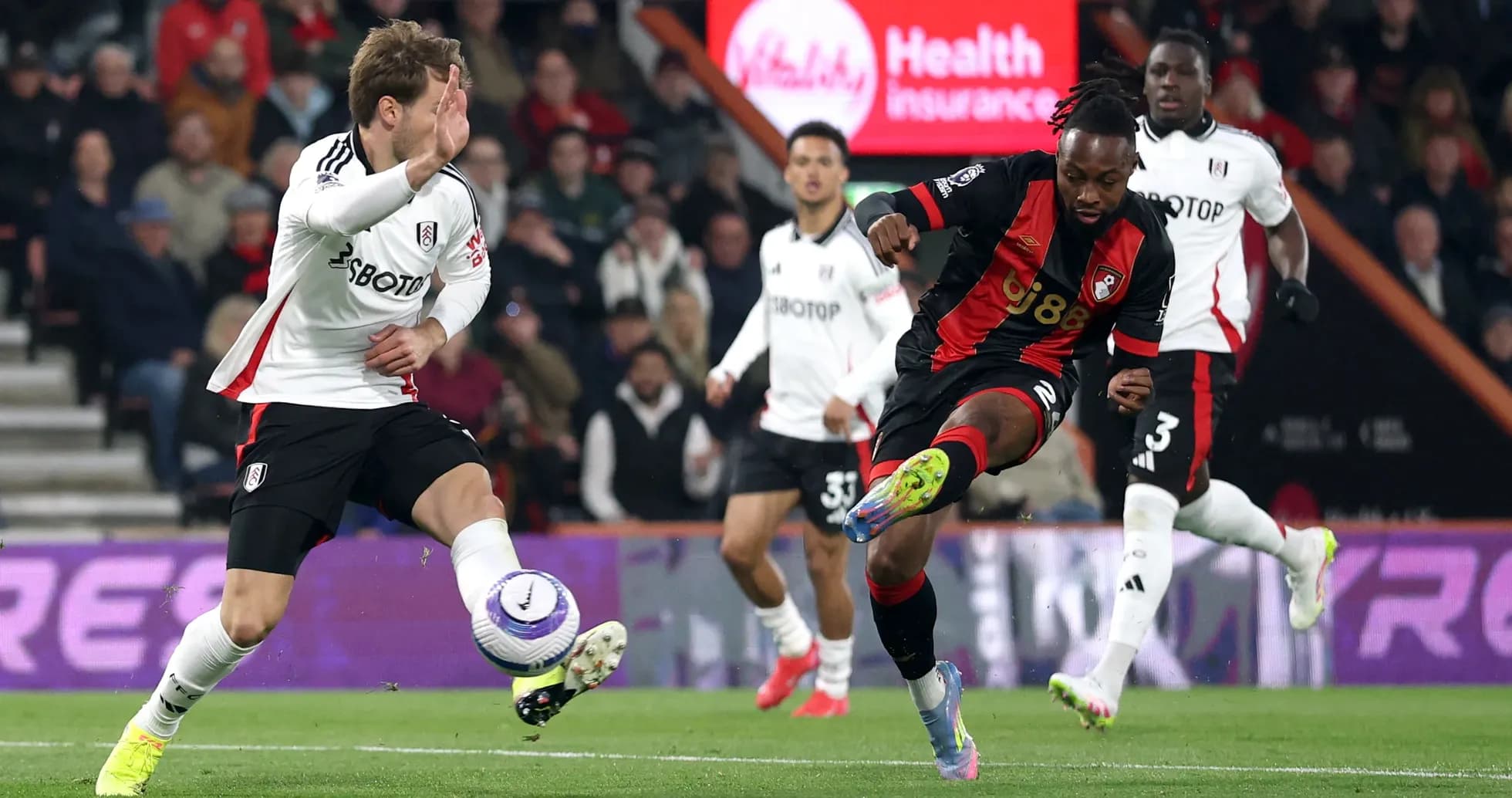
Bournemouth's 1-0 Victory at Craven Cottage: A Season Contrast
Craven Cottage felt tight and tense as the final whistle confirmed a narrow 1–0 Bournemouth win, a result that sharpened the contrast between these two seasons as much as the scoreline itself. Following this result, Fulham sit 11th on 48 points with a goal difference of -6 (44 scored, 50 conceded overall), while Bournemouth’s Europa League push remains on track from 6th place with 55 points and a goal difference of 4 (56 scored, 52 conceded overall).
I. The Big Picture – Styles Colliding on the Thames
Across the campaign, Fulham’s identity has been clear: strong at Craven Cottage, fragile on their travels. At home they have taken 10 wins from 18, scoring 28 and conceding 20. That 1.6 goals scored at home against only 1.1 conceded paints a picture of a side comfortable on the front foot in familiar surroundings. Yet the broader form line – “DDLWWLLLLWLWWLLWWWDDWLWLLLWWLDWLDWLL” – hints at volatility, streaks of promise undercut by abrupt collapses.
Bournemouth, by contrast, have built their season on consistency and resilience. Heading into this game they had lost just 7 of 36 league matches overall, with 13 wins and a remarkable 16 draws. Their attacking output has been balanced: 28 goals at home and 28 on their travels, averaging 1.6 goals both at home and away. The defensive picture is more uneven – only 19 conceded at home but 33 away – yet their overall goal difference of 4 (56 for, 52 against) reflects a side that tends to find a way to stay in matches.
II. Tactical Voids – Absences and Discipline
Fulham arrived without A. Iwobi and R. Sessegnon, both ruled out with injury. Iwobi’s absence stripped Marco Silva of a versatile connector between midfield and attack, the sort of player who can knit together phases when the game becomes stretched. Without Sessegnon, Fulham lost an alternative left-sided option, forcing Antonee Robinson into another heavy workload down that flank.
Bournemouth were also undermanned. L. Cook’s hamstring injury removed a metronomic presence from the base of midfield, while J. Soler’s own hamstring issue further thinned Andoni Iraola’s creative options between the lines. The most notable absentee, though, was Álex Jiménez, suspended after a season in which he has collected 10 yellow cards. His blend of aggression and front-foot defending has defined Bournemouth’s right side, and his suspension forced a reconfiguration of the back line and pressing triggers.
Disciplinary trends framed the contest even before kick-off. Heading into this game, Fulham’s yellow card profile showed a late-game spike: 23.29% of their yellows arrived between 91–105 minutes, with another 20.55% between 76–90. Bournemouth’s distribution was even more dramatic: 27.71% of their yellows came from 76–90 minutes and 20.48% from 91–105, underlining a team that pushes the physical edge as matches reach their decisive phase. Red-card history added another layer: Joachim Andersen has already seen red once this season, while Ryan Christie carries his own dismissal. Both sides, then, walked a familiar disciplinary tightrope.
III. Key Matchups – Hunter vs Shield, Engine Room vs Enforcer
The “Hunter vs Shield” narrative centred on Bournemouth’s attacking threats against Fulham’s home defensive record. Overall, Fulham concede 1.1 goals at home, a respectable figure underpinned by Bernd Leno’s presence and the central pairing of Andersen and Calvin Bassey. Andersen’s numbers this season – 19 blocked shots, 36 interceptions and a single red card – tell the story of a defender who steps out aggressively but usually with control. Bassey’s physicality complements him, allowing Fulham to hold a relatively high line at Craven Cottage.
Bournemouth’s “Hunter” profile, however, is multi-headed. Eli Junior Kroupi has emerged as a breakout force with 12 league goals, 20 shots on target from 29 attempts and 21 key passes. Operating nominally as an attacking midfielder or wide forward, he brings a directness that tests the space between full-back and centre-back. Alongside him in the attacking hierarchy stands Antoine Semenyo, also on 10 goals, with 27 shots on target from 42 attempts and 25 key passes. Semenyo’s 72 dribbles attempted, with 33 successful, underline his willingness to drive at defenders one-v-one.
Against Fulham’s back four of Timothy Castagne, Andersen, Bassey and Robinson, the duel was as much about timing as talent. Fulham’s home strength has often relied on compressing space early, but Bournemouth’s forwards thrive when the game opens up. With Fulham’s season-long tendency to collect cards late, there was always a danger that tired legs and wary challenges would grant Kroupi and Semenyo the half-yard they needed.
In the “Engine Room”, Saša Lukić embodied Fulham’s enforcer role. Across the season he has committed 50 fouls and taken 9 yellow cards, while still contributing 27 key passes and 44 tackles. His job here was to disrupt Bournemouth’s central rhythm, particularly the distribution of Alex Scott and the roaming influence of Christie. On the other side, Bournemouth’s midfield aimed to crowd Harry Wilson, Fulham’s creative heartbeat.
Wilson’s numbers are elite for a mid-table side: 10 goals, 6 assists, 38 key passes and 761 total passes at 81% accuracy. He is simultaneously Fulham’s top scorer and top assister in the league, the player most likely to turn sterile possession into penetration. Bournemouth’s plan, with Christie and Scott buzzing around him, was to deny him the pockets where he can receive on the half-turn and feed Rodrigo Muniz or the wide runners Samuel Chukwueze and Emile Smith Rowe.
IV. Statistical Prognosis – xG Logic and Defensive Solidity
Heading into this game, the underlying profiles pointed towards a tight contest with marginal attacking edges for Bournemouth. Fulham’s overall scoring average of 1.2 goals per match (44 in total across 36 games) is solid but not explosive, and they have failed to score in 11 league matches overall. Bournemouth, by contrast, have failed to score only 7 times and maintain that 1.6 goals per game both home and away.
Defensively, both sides share an overall concession average of 1.4 goals per match, but the split matters: Fulham are stronger at home (1.1 conceded) than Bournemouth are away (1.8 conceded). The xG-style reading of this is that Fulham usually keep games under control at Craven Cottage, while Bournemouth’s away matches tend to open up.
Yet Bournemouth’s clean-sheet record on their travels – 5 away shutouts, 11 overall – hinted at a capacity to deliver disciplined defensive performances when it matters. With no penalties missed by either side this season (Fulham 4 scored from 4, Bournemouth 5 from 5), any spot-kick would always have loomed as a high-probability decider.
In the end, the 1–0 Bournemouth win at Craven Cottage felt like the statistical tightrope breaking in favour of the more balanced, resilient side. Fulham’s strong home platform and Wilson-centric creativity were not enough to crack a Bournemouth unit that, even shorn of Jiménez and Cook, defended their box with clarity and managed the late, card-heavy phases with just enough composure. From an expected goals perspective, this was always likely to be a game of fine margins; Bournemouth’s season-long habit of staying in contests and finding moments of quality ensured they were the ones to walk away with the points, and with their European push still firmly in their own hands.