.svg&w=384&q=75 "naujapitch logo")
Barcelona's Tactical Mastery in 2-0 Win Over Real Madrid
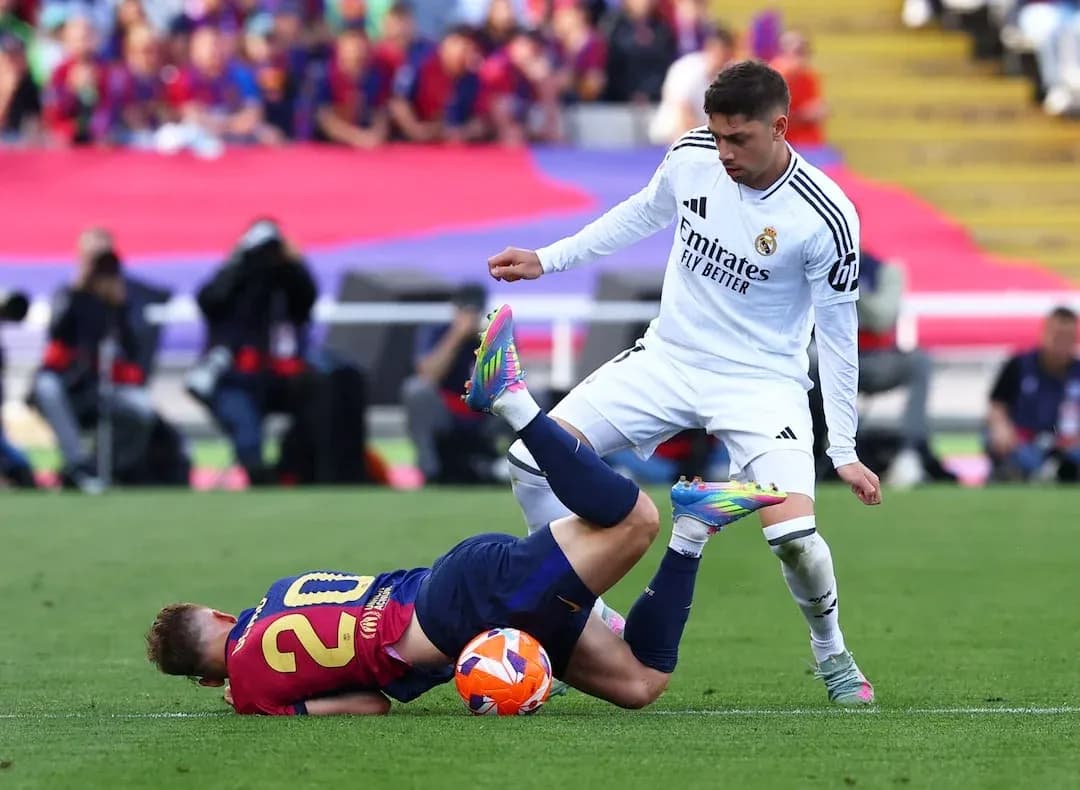
Barcelona’s 2-0 win over Real Madrid at Camp Nou in La Liga’s Regular Season - 35 was built on an aggressive, front-foot interpretation of Hansi Flick’s 4-2-3-1. Early verticality through Marcus Rashford and Ferran Torres established a decisive two-goal lead inside 18 minutes, after which Barcelona controlled tempo with superior passing security and compact counter-pressing. Alvaro Arbeloa’s Real Madrid mirrored the 4-2-3-1 on paper but never translated it into stable progression, relying on flanks and set pieces rather than sustained central access. The final scoreline matched the underlying dynamics: Barcelona more incisive in the box, Madrid structurally reactive and technically short.
I. Executive Summary
Barcelona finished the match with 57% possession and a 2-0 scoreline, reflecting their authority in both territory and control phases. The hosts produced 10 total shots to Real Madrid’s 8, but crucially generated 7 shots on goal versus Madrid’s single effort on target. Expected goals underline the balance between control and efficiency: Barcelona at 0.99 xG, Real Madrid at 0.79 xG, suggesting the hosts translated marginally better chances into a decisive early lead, then managed the game with discipline and structure.
II. Scoring Sequence & Disciplinary Log
Scoring sequence (chronological):
- 9' — Marcus Rashford (Barcelona) opened the scoring with a Normal Goal, attacking from his advanced midfield role and exploiting early space in Madrid’s defensive block.
- 18' — Ferran Torres (Barcelona) doubled the lead with a Normal Goal, assisted by Dani Olmo. The pattern reinforced Barcelona’s ability to connect the No. 10 zone with the lone forward against Madrid’s double pivot.
Halftime score was Barcelona 2-0 Real Madrid, with both goals arriving in an aggressive first-quarter spell that set the tactical tone.
Card verification and full disciplinary log (locked totals):
- Barcelona: 2 yellow cards
- Real Madrid: 4 yellow cards
- Total: 6 cards
Chronological card log (exact reasons):
- 40' Eduardo Camavinga (Real Madrid) — Foul
- 52' Dani Olmo (Barcelona) — Argument
- 52' Raúl Asencio (Real Madrid) — Foul
- 55' Jude Bellingham (Real Madrid) — Unallowed field entering
- 81' Raphinha (Barcelona) — Argument
- 81' Trent Alexander-Arnold (Real Madrid) — Argument
The pattern shows Madrid’s midfield under stress (Camavinga, Asencio) and emotional escalation on both sides in the final phase (three cards for “Argument” across the second half).
III. Tactical Breakdown & Personnel
Barcelona’s 4-2-3-1
Joan García started in goal behind a back four of Joã o Cancelo, Gerard Martín, Pau Cubarsí and Eric García. The double pivot of Pablo Gavi and Pedri sat beneath a line of three — Fermín López, Dani Olmo, Marcus Rashford — supporting Ferran Torres as the nominal striker.
In possession, Barcelona’s structure tilted into a 3-2-5. Cancelo frequently inverted from the right, forming a three with Cubarsí and Eric García, while Gerard Martín held the opposite flank slightly deeper. Gavi and Pedri operated as stabilizing pivots, enabling the advanced line to remain high and narrow. Rashford’s early goal at 9' came from this dynamic: his starting “midfielder” label belied his role as an aggressive half-space runner, often the highest player when Torres dropped.
Torres’ 18' goal, assisted by Dani Olmo, highlighted Barcelona’s occupation of the central lane. Olmo, as the central playmaker, found pockets between Madrid’s midfield and defense, turning under minimal pressure. With Madrid’s double pivot stretched laterally, Torres attacked the channel between center-back and full-back, converting Barcelona’s 0.99 xG into a two-goal cushion.
Out of possession, Barcelona’s 4-4-2 press saw Rashford step alongside Torres, with Olmo and Fermín López tucking in to compress the middle. The 18 fouls committed reflect an aggressive counter-pressing approach rather than deep defending. Barcelona allowed only 1 shot on goal and required Joan García to make just 1 save, underlining how well the first line of pressure and the compact mid-block protected the box.
Substitutions were used to protect intensity and control. At 64', Frenkie de Jong (IN) came on for Dani Olmo (OUT), adding press-resistance and helping Barcelona consolidate possession under Madrid’s attempts to push higher. Simultaneously, Raphinha (IN) came on for Marcus Rashford (OUT), shifting the threat profile from central running to wider ball-carrying and transition control.
At 77', Robert Lewandowski (IN) came on for Ferran Torres (OUT), giving Barcelona a stronger reference point for long phases of Madrid pressure, while Marc Bernal (IN) replaced Gavi (OUT), adding fresh legs to the pivot. Late on, at 88', Alejandro Balde (IN) came on for Fermín (OUT), effectively turning the left side into a more defensive, ball-carrying outlet to kill counters.
Real Madrid’s 4-2-3-1
Thibaut Courtois, with 5 saves, was central to keeping Madrid in the contest after the early collapse of their rest-defense. The back four of Trent Alexander-Arnold, Raúl Asencio, Antonio Rüdiger and Fran García struggled to manage Barcelona’s rotations between lines. Eduardo Camavinga and Aurélien Tchouaméni formed the double pivot, with Brahim Díaz, Jude Bellingham and Vinicius Júnior behind Gonzalo García.
Madrid’s 4-2-3-1 morphed into a 2-3-5 in attack, Alexander-Arnold and Fran García pushing high. However, with only 394 total passes and 342 accurate (87%), they were consistently out-possessed and forced into longer, riskier progressions. Their 8 total shots, 7 inside the box, suggest that when they did reach the final third, they created proximity to goal, but Barcelona’s block reduced shot quality (0.79 xG and just 1 shot on target).
The disciplinary profile illustrates Madrid’s difficulties in transition: Camavinga’s 40' yellow for “Foul” and Asencio’s 52' yellow for “Foul” came as they were forced to halt counters. Jude Bellingham’s 55' yellow for “Unallowed field entering” reflected frustration and game-state pressure rather than tactical foul management. Later, at 81', simultaneous “Argument” yellows for Raphinha and Trent Alexander-Arnold indicated rising emotional temperature as Madrid chased the game.
Arbeloa’s changes aimed at injecting energy and creativity. At 70', Thiago Pitarch (IN) came on for Eduardo Camavinga (OUT), trying to add progressive passing. At 79', Franco Mastantuono (IN) replaced Brahim Díaz (OUT), and César Palacios (IN) came on for Gonzalo García (OUT), rebalancing the attack with fresh legs and more vertical running. Yet Barcelona’s defensive index — 1 save required, minimal box entries conceded after the early storm — showed these changes did not fundamentally alter the dynamic.
IV. The Statistical Verdict
Barcelona’s statistical profile aligns with a controlled, proactive performance: 57% possession, 527 total passes with 484 accurate (92%), and 7 shots on goal from 10 total shots. Their 0.99 xG for 2 actual goals suggests a slightly above-average finishing return but well within the pattern of territorial dominance and repeated box occupation (9 shots inside the box).
Real Madrid’s 43% possession and 394 passes, 342 accurate (87%), show a side more often reacting than dictating. Their 8 shots (7 in the box) for 0.79 xG underline that while they reached dangerous zones, they were typically forced into less favorable angles or heavily contested efforts. Both goalkeepers posted identical “goals prevented” values at -0.53, but the distribution of work was asymmetric: Courtois with 5 saves versus Joan García’s 1 save.
Discipline also mirrored tactical realities: Barcelona’s 2 yellow cards, both for “Argument”, contrasted with Madrid’s 4 yellows split between “Foul”, “Unallowed field entering”, and “Argument”. The 18-9 foul count in Barcelona’s favor reflects their aggressive counter-press, yet Madrid’s higher card count indicates greater strain and reactive defending. Across overall form and defensive index, Barcelona’s structure and early attacking clarity decisively outperformed a Madrid side that never fully solved the hosts’ pressing and vertical threat.