.svg&w=384&q=75 "naujapitch logo")
Scotland's 1-0 Victory Over Haiti: Tactical Insights and Group C Dynamics
Gillette Stadium in Boston hosted a quietly pivotal opening to Group C, a World Cup night that finished with the narrowest of margins yet carried a seismic shift in early group dynamics. Following this result, Scotland’s 1-0 victory over Haiti not only delivered three points but also sketched out the tactical identities of both sides in this tournament: Scotland as a disciplined, system-first unit, and Haiti as a courageous, still‑raw debutant trying to translate individual flair into collective structure.
I. The Big Picture – Systems and Stakes
Both coaches mirrored each other on the board, sending their teams out in 4-4-2. Sebastien Migne’s Haiti, already 0-1 down in total this campaign for goals against and still searching for a first goal for, leaned into a classic two‑banks‑of‑four with Frantzdy Pierrot and Wilson Isidor up front. Steve Clarke’s Scotland, sitting top of Group C with 3 points and a total goal difference of +1 (1 goal for, 0 against), opted for a similarly orthodox shape but with very different intentions: slow suffocation through structure, not chaos.
In total this campaign, Haiti have played 1 match, lost 1, failed to score, and conceded 1. Their total average goals for stands at 0.0, with 1.0 goals against at home. Scotland, by contrast, have played 1 away match, won it, scored 1 goal on their travels (an away average of 1.0), and kept a clean sheet. Those numbers frame the story: Scotland arrived to do a job; Haiti to prove they belonged.
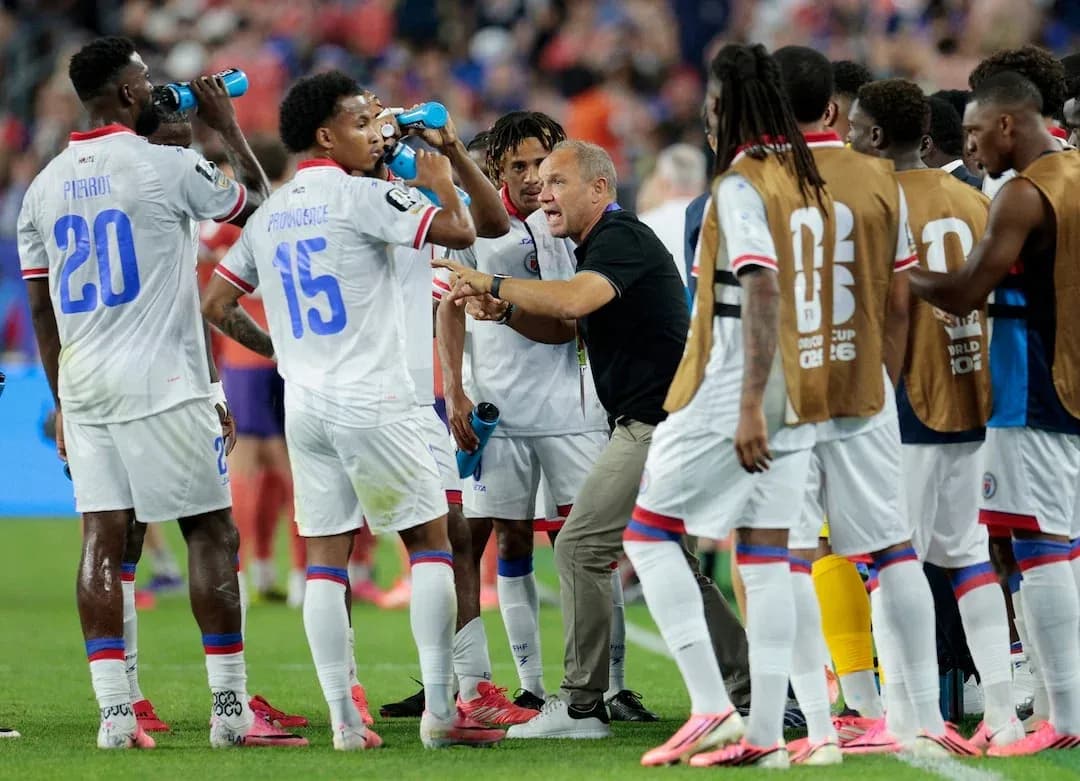
The first half belonged, structurally, to Scotland. The back four of Aaron Hickey, Grant Hanley, Jack Hendry and Andy Robertson set a high, controlled line, allowing the midfield four to compress the central spaces where Danley Jean Jacques and Jean-Ricner Bellegarde wanted to build. Haiti’s 4-4-2, on paper symmetrical, was in practice deeper and more reactive, with Louicius Don Deedson and Ruben Providence often pinned back into a 4-4-1-1 or even 4-5-1 out of possession.
II. Tactical Voids – Discipline, Nerves, and the Card Map
The disciplinary map across the 90 minutes hints at where the game frayed. Haiti’s season card profile shows a single yellow in the 31-45 minute window, accounting for 100.00% of their total bookings so far. That late‑first‑half caution speaks to a team forced into emergency defending once Scotland’s patterns settled.
Scotland’s card distribution is more layered. In total this campaign, they have 1 yellow between 46-60 minutes (33.33% of their yellows) and 2 yellows in the 91-105 window (66.67%). That late‑game spike in cautions underlines a side willing to absorb pressure and manage the closing stages with tactical fouls and game management, even at the cost of bookings.
Individually, the Scottish caution list tells its own story. Aaron Hickey, who has already received 1 yellow card in the tournament, played 75 minutes, committing 2 fouls and drawing 4. His card is the natural by‑product of an aggressive full‑back asked to lock down a flank and still drive forward. From the bench, Findlay Curtis and Kenny McLean both came on for 15‑minute cameos and each collected a yellow, committing 1 foul apiece. Their impact was less about creativity and more about shoring up a narrow lead in a tense finale.
For Haiti, the absence list offers no alibi—there is “No data” for missing players, so this was close to full strength. The void, instead, was structural: a lack of progressive passing lanes from back to front and an inability to turn midfield possession into penalty‑box jeopardy.
III. Key Matchups – Hunter vs Shield, Engine Room vs Enforcer
Hunter vs Shield
With no top‑scorer data available, the “Hunter vs Shield” duel is defined more by roles than raw numbers. For Haiti, Pierrot and Isidor were the nominal hunters, living off transitions and hopeful service from wide areas. Yet heading into this game, Haiti’s total goals for stood at 0; following it, that remained unchanged. Their forwards were forced to feed on half‑chances, often isolated against Scotland’s central pairing of Hanley and Hendry.
On the other side, Scotland’s forwards Lawrence Shankland and Che Adams were better integrated into the system. The away team’s total of 1 goal in 1 match may not scream firepower, but it underscores efficiency: 1.0 goals for on their travels, 0.0 against. The “Shield” in this duel was Haiti’s back four of Carlens Arcus, Ricardo Adé, Hannes Delcroix and Martin Expérience, who actually limited Scotland to a single breakthrough. Given Haiti’s total goals against of 1 in 1 home match, the defensive framework is not broken; the problem lies further ahead.
Engine Room – Midfield Battle
The midfield contest defined the game’s rhythm. For Haiti, Jean Jacques and Bellegarde were tasked with bridging the gap between a cautious back line and a front two needing service. Yet Scotland’s central axis of Scott McTominay and Lewis Ferguson, flanked by John McGinn and Ben Gannon-Doak, repeatedly won the second balls and slowed transitions.
McTominay’s presence as the enforcer allowed Ferguson and McGinn to step higher, pinning Haiti’s wingers back and forcing them into long, low‑percentage passes into Pierrot and Isidor. The result was that Haiti’s 4-4-2 often collapsed into a 4-5-1 in practice, with the second striker dropping so deep that counter‑attacks lost their bite.
IV. Statistical Prognosis – What This Game Tells Us
Without explicit xG data, the pattern of play and season stats still offer a clear prognosis. Scotland’s defensive solidity is already evident: 1 away game, 0 goals conceded, 1 clean sheet on their travels, and a total goals against average of 0.0. Their willingness to accept late yellow cards—2 of their total cautions arriving between 91-105 minutes—signals a side comfortable managing risk when protecting a lead.
Haiti, meanwhile, sit bottom of Group C with 0 points, a total goal difference of -1 (0 scored, 1 conceded), and a total average of 0.0 goals for. They have failed to score in their only match, and their attacking minute distribution is literally empty so far—no recorded peaks, no established pattern of when they are most dangerous.
The intersection of these trends is stark. Against compact, structure‑heavy teams like Scotland, Haiti’s current 4-4-2 lacks a reliable mechanism to progress the ball and overload the box. Their best route forward may be to lean into the individual qualities of Deedson, Providence and Bellegarde, accepting more risk in central areas and pushing a full‑back like Arcus higher to create 2v1s wide.
For Scotland, this win confirms the blueprint: a disciplined 4-4-2, a back four that rarely gets stretched, and a midfield willing to trade flair for control. If they can nudge their total goals for upwards while keeping that total goals against at 0.0 for as long as possible, this will not be the last time a tight, controlled 1-0 becomes the defining scoreline of their World Cup story.