.svg&w=384&q=75 "naujapitch logo")
AS Roma Dominates Lazio in Derby della Capitale
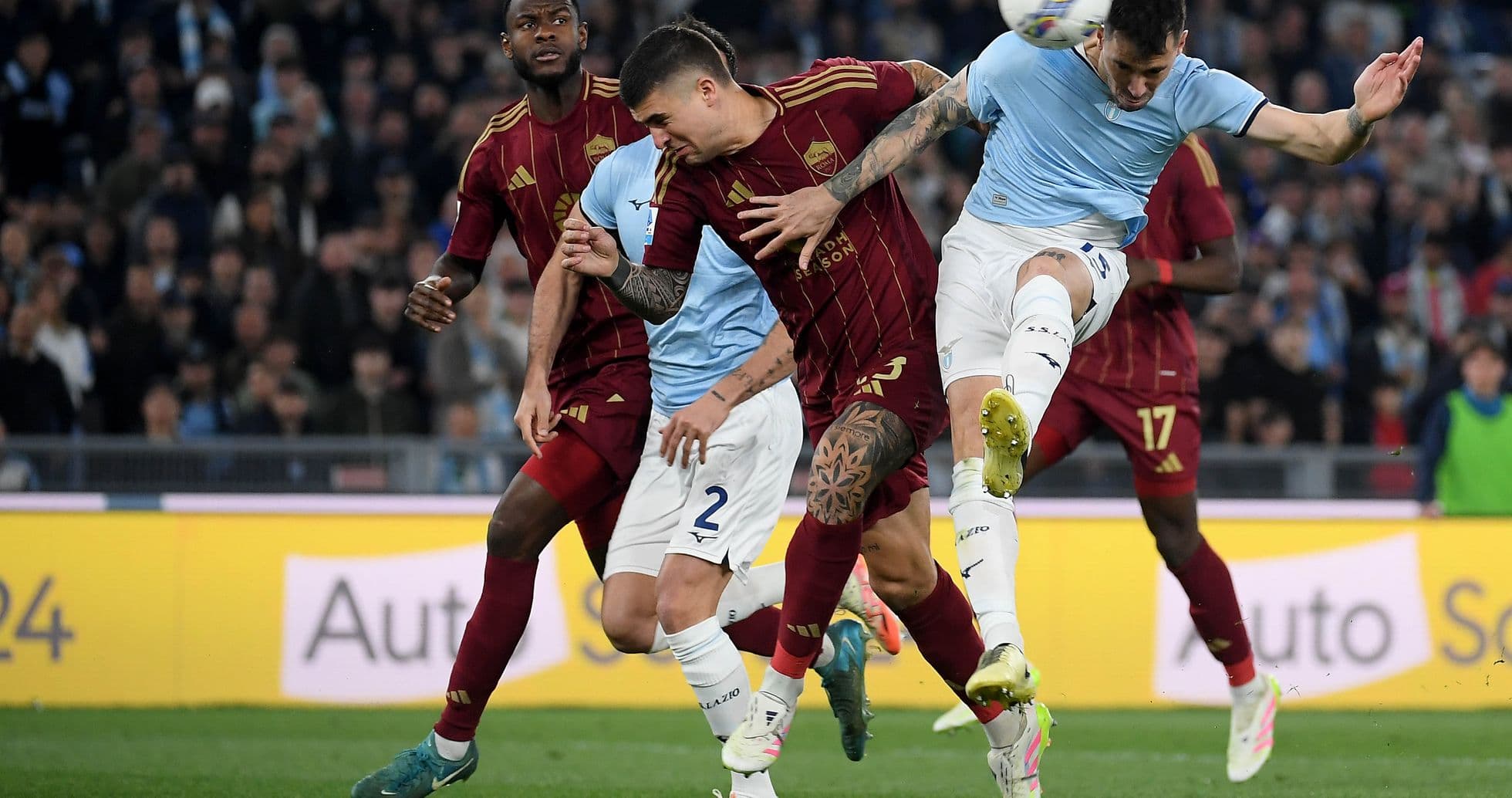
Under the Roman sun at Stadio Olimpico, the Derby della Capitale closed its Serie A chapter for 2025–26 with a statement. AS Roma, already shaping a Champions League-bound season, imposed a 2–0 victory on Lazio, a result that neatly encapsulated the contrasting trajectories of fourth against ninth in the table following this result.
I. The Big Picture – Derby as a Season in Microcosm
Heading into this game, Roma’s seasonal DNA was clear: aggressive, front-foot football from a 3-4-2-1 base, underpinned by one of the league’s most reliable home records. At home they had played 19 league matches, winning 13, drawing 3 and losing only 3, scoring 33 and conceding just 10. That home defensive average of 0.5 goals against per game met a Lazio side whose away goalsFor average stood at 0.7 and goalsAgainst at 0.8. The geometry of the season suggested a tight contest, but the derby intensity and Roma’s form – four wins and a draw in their last five league games – tilted the balance.
The final 2–0 scoreline, built on a 1–0 half-time lead, was the tactical confirmation of Roma’s superiority. The 3-4-2-1 allowed them to dominate central zones, while Lazio’s familiar 4-3-3 never quite solved the puzzle of Roma’s extra man between the lines.
II. Tactical Voids – Absences and Discipline
Both coaches walked into the derby with significant voids to patch. For Piero Gasperini Gian, the absence of E. Ferguson and B. Zaragoza removed two attacking options from the rotation, but not from the core structure. The starting front three of P. Dybala, N. Pisilli and D. Malen kept Roma’s offensive identity intact, with Wesley Franca and Z. Çelik providing width and ball-carrying from the “4” line.
Maurizio Sarri, however, had to rewire his back line and attacking edge. I. Provedel’s shoulder injury handed the gloves to A. Furlanetto, while the suspension of A. Romagnoli for a red card forced Mario Gila into a leadership role in central defence, partnered by O. Provstgaard. The absence of M. Zaccagni stripped Lazio’s left side of its most natural one-v-one threat and penalty-winning presence, leaving M. Cancellieri and T. Noslin to shoulder wide responsibilities around B. Dia.
The disciplinary profiles of both squads added an undercurrent. Roma’s season-long yellow card distribution shows a late-game spike: 23.88% of their yellows come between 76–90 minutes, with 22.39% each in the 46–60 and 61–75 windows. Lazio mirror that late volatility, with 26.32% of yellows between 76–90 and 22.37% between 61–75. This derby, as so many before, was always likely to become more fractious as legs tired and emotions spiked.
On the red card front, Roma’s Wesley and Z. Çelik both arrived with prior dismissals this campaign, while Lazio’s disciplinary ledger featured Romagnoli, M. Zaccagni, M. Guendouzi and Mario Gila all carrying red histories. The fact that Romagnoli and Zaccagni were missing through those very sanctions underlined how previous flashpoints shaped this match before a ball was kicked.
III. Key Matchups – Hunter vs Shield, and the Engine Room
Hunter vs Shield was headlined by D. Malen against a patched-up Lazio defence. Malen entered the fixture with 13 total league goals and 3 penalties scored from 3 attempts, a ruthless finisher operating as Roma’s spearhead. Behind him, Dybala and Pisilli occupied the half-spaces, forcing Lazio’s midfield to collapse centrally and exposing the full-backs.
The Shield, in theory, was Mario Gila. Over the season he has been one of Lazio’s standout defenders, with 17 blocked shots and 199 total duels, winning 134. Gila blocked 17 shots in total this campaign, a testament to his reading of danger and willingness to step in front of goal-bound efforts. Yet without Romagnoli’s experience beside him and without Provedel’s authority behind, the back four lacked its usual hierarchy.
In midfield, the Engine Room duel pitted Roma’s double pivot of B. Cristante and N. El Aynaoui against T. Basic, N. Rovella and K. Taylor. Cristante’s positional discipline allowed Wesley Franca to push high from the left of the “4”, effectively turning Roma’s 3-4-2-1 into a 3-2-4-1 in possession. Wesley’s profile this season – 53 tackles, 5 blocked shots, 23 interceptions and a blend of 5 goals with high-intensity duels (317 total, 149 won) – made him the hinge between solidity and thrust. His prior red card underlined the risk-reward edge of his game, but in this derby he stayed on the right side of that line, constantly pinning Lazio back.
On the flanks, Z. Çelik’s duel with N. Tavares and Cancellieri was equally decisive. Çelik, with 62 tackles and 26 key passes across the campaign, balanced defensive aggression with progressive passing. His previous red card this season hinted at a combustible streak, but his control of the right lane allowed Dybala to drift inside and overload central pockets.
For Lazio, B. Dia’s central role was to stretch Roma’s back three of G. Mancini, E. Ndicka and M. Hermoso. Mancini’s season numbers – 51 tackles, 14 blocked shots, 47 interceptions and 69 fouls committed – mark him as an aggressive front-foot defender who lives on the edge of confrontation. Yet the 3-4-2-1 structure protected him: with Ndicka and Hermoso covering, Mancini could step out to meet Dia without leaving vast spaces behind.
IV. Statistical Prognosis and Tactical Verdict
Roma’s season-long metrics framed this performance as no anomaly. Overall they had scored 57 and conceded 31, a goal difference of +26 built on a total goalsFor average of 1.5 and goalsAgainst average of 0.8. At home, that sharpened to 1.7 goalsFor and 0.5 goalsAgainst. Lazio, by contrast, arrived with 39 scored and 39 conceded overall – a goal difference of 0 – and an away profile of 14 goals scored and 15 conceded, averaging 0.7 for and 0.8 against on their travels.
In xG terms, the shape of the game was almost pre-written: Roma’s structured pressure, volume of shots generated by Malen, Dybala and the advanced wing-backs, and their set-piece threat from Mancini and Hermoso tend to produce a steady, sustainable xG stream. Lazio’s away pattern – low scoring, reliant on moments rather than sustained pressure, and with 11 away matches where they failed to score – pointed towards a narrow margin for error.
The 2–0 final scoreline therefore feels like the natural meeting point of trend and occasion. Roma’s clean-sheet culture – 11 at home and 17 overall – met a Lazio side that has failed to score 17 times in total this campaign. The derby narrative may be emotional, but the numbers are coldly consistent.
Following this result, Roma’s 3-4-2-1 once again proved its worth as a big-game structure: three centre-backs to suffocate transitions, industrious wing-backs to stretch the pitch, and a front three capable of exploiting any defensive uncertainty. Lazio’s 4-3-3, shorn of key pillars like Provedel, Romagnoli and Zaccagni, lacked the vertical punch and defensive stability required to disrupt a top-four side in full flow.
In the end, this derby was not just about bragging rights. It was a tactical signature: Roma’s season, distilled into 90 minutes, written in deep red across the city.