.svg&w=384&q=75 "naujapitch logo")
Argentina's Old Guard Faces Final Challenge in Kansas City
Argentina’s old guard lands in Kansas with one more mountain to climb. The faces are familiar, the story less so.
Seventeen of the 26 players who delivered the World Cup in Qatar are here again. From Lusail to Kansas City, Lionel Scaloni has kept his core intact, trimming only where time has forced his hand. Ángel Di María, the hero of so many decisive nights and the Player of the Match in the 2024 Copa America final, has finally stepped away. The rest of that starting XI against France? All here, bar the injured and the retired.
It is loyalty bordering on obsession – and it has worked.
A golden generation… running on fumes?
Scaloni’s tenure has been built on continuity. Sixteen members of this squad were already with him when Argentina ended their drought at the 2021 Copa America. Brazil, by comparison, have brought just 11 players from their 2019 group to North America, three of them goalkeepers. England, from their Euro 2020 finalists, have kept only nine.
Argentina have built something different: a club-style core at international level. A brotherhood. Shared scars. Shared glory.
But the calendar does not care about chemistry.
Nine of Scaloni’s players are now the wrong side of 30. Key pillars like Emiliano Martínez, Rodrigo De Paul and, of course, Lionel Messi are deep into the back nine of their careers. Messi will be 39 during what will be his record sixth World Cup. The mind is still razor sharp. The left foot still decisive. The question is whether the legs around him can keep up.
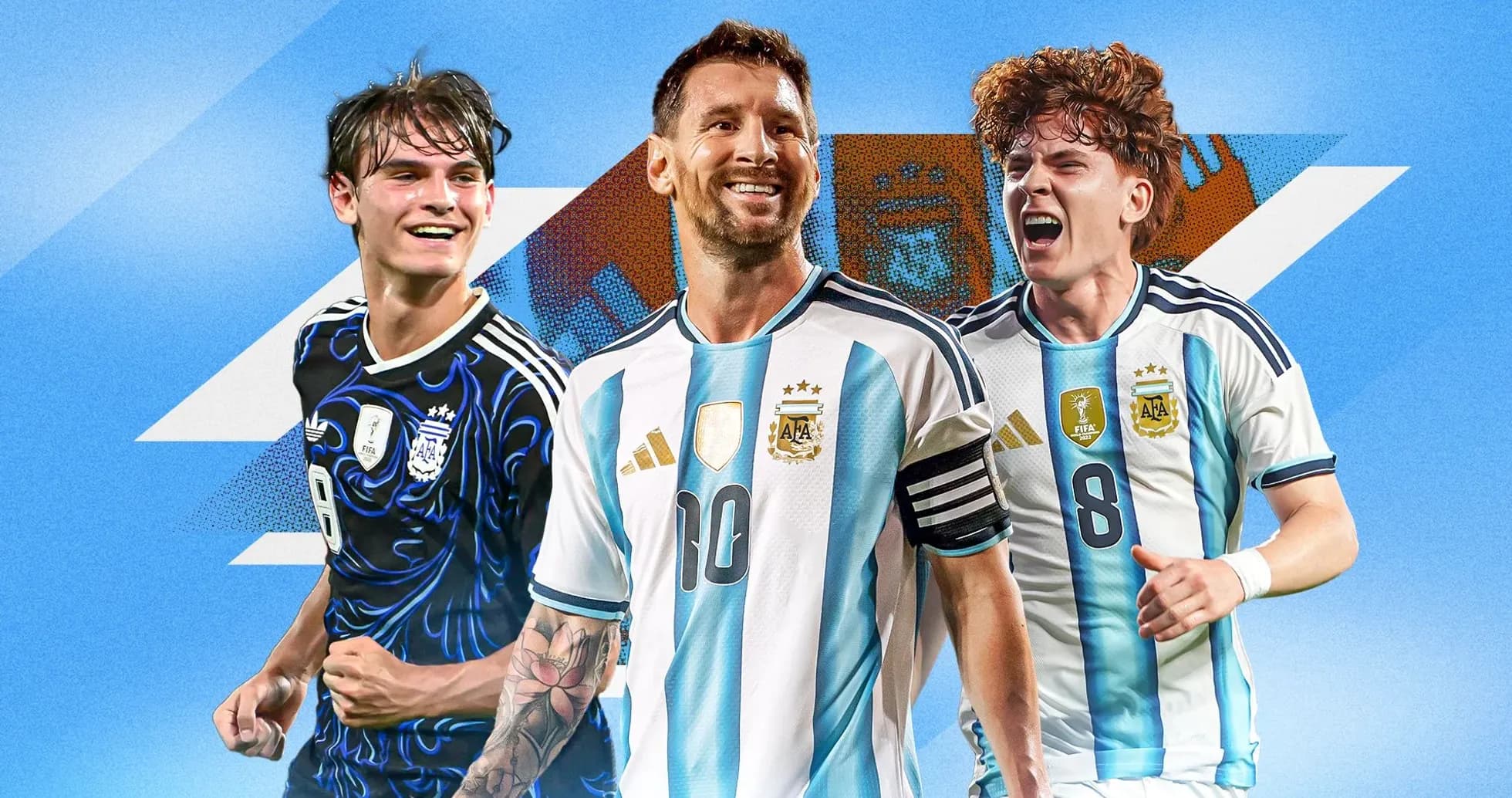
At the other end of the age profile, the picture is no less stark. Only three players – Giuliano Simeone, Valentín Barco and Nico Paz – are under 25. The likes of Franco Mastantuono and Alejandro Garnacho have been left at home. The average age is north of 29, and this is a group that has been flogged across every competition available.
The numbers are brutal. Since the start of the 2024-25 season, Enzo Fernández and Julián Álvarez have each played 121 games for club and country. That is not a workload; it is a grindstone. Álvarez limped through the end of Atlético Madrid’s season with an ankle problem. Fernández, still only 25 and in peak physical condition, has covered so many miles that fatigue feels less a possibility and more an inevitability.
Alexis Mac Allister tells a similar story. No Club World Cup in his schedule, yet 119 appearances for Liverpool and Argentina over the past two seasons. The output has dipped. The sharpness has dulled. He is still expected to start against Algeria at Arrowhead Stadium on Tuesday, but the leash will be short.
Former Liverpool winger Jermaine Pennant captured the mood when he spoke to TalkSport after publicly criticising Mac Allister during Liverpool’s defeat to Manchester City in February. “I was watching the game and I was frustrated and I tweeted… I was angry. It was constructive angry… I touched on that, ‘after your injury in pre-season, you’ve come back a shadow of what you are; it seems like your legs have gone’. In that [City] game, he was literally a bystander, he didn’t really get into it at all and that’s what I touched on, it was an observation.”
It was harsh, but it was not random. The miles are visible now. In the sprints that don’t quite come. In the duels that are half a second late.
Scaloni’s loyalty vs the ticking clock
None of it has shaken Scaloni’s faith. When Argentina walk out to face Algeria, seven of the starters from the 2022 World Cup final are set to be in the XI again. That number would likely have been 10 had Álvarez, Nicolás Tagliafico and Nahuel Molina not arrived with minor injuries.
Cristian Romero, Nicolás Otamendi, Fernández, De Paul, Mac Allister, Messi – the spine remains the same. Lautaro Martínez, Golden Boot winner at the 2024 Copa America, will step in for Álvarez up front. This is a team that knows how to manage moments, how to suffer, how to win.
But it is also a team that is ageing together.
The tension in this squad is not about talent. It is about timing. Can Scaloni squeeze one more tournament out of this group without freshening it up? Or does he gamble now, in what might be Messi’s last dance, on younger legs that have never known this kind of pressure?
That dilemma shows up clearly at left-back.
With Tagliafico out, the obvious call would be Barco. The left-sided Strasbourg player, widely expected to join Chelsea this summer, has impressed in recent friendlies. He has scored in two of Argentina’s last three matches, often from a more advanced role. His natural position is left-back, and at 21 his energy and willingness to bomb forward could inject badly needed dynamism down that flank.
Scaloni, though, is ready to go the other way. Lisandro Martínez is set to start there instead, tasked with handling Riyad Mahrez, Algeria’s veteran talisman. Martínez is a defender’s defender – aggressive, sharp in duels, positionally sound. But he is a centre-back by trade. He will not give Argentina the same thrust Barco offers in transition.
On the opposite side, youth will be used out of necessity rather than design. Giuliano Simeone is expected to start at right-back, a role he does not naturally own. With Molina and Gonzalo Montiel still working back from injuries, Simeone will cover until one of the specialists can handle more than a cameo.
The Nico Paz question
The most intriguing fault line in this squad, though, runs straight through Nico Paz.
At 21, Paz has lit up Serie A over the past two seasons with Como. Under the guidance of Cesc Fàbregas, he scored 13 goals and added seven assists this season, driving a newly promoted side to a fourth-place finish and a Champions League spot. The league named him Best Midfielder at its end-of-season awards. Real Madrid are widely expected to trigger the buy-back clause in his contract.
This is not a prospect. This is a player.
Paz’s game brings something Argentina’s midfield has increasingly lacked: risk. He sees passes others ignore. He forces the tempo. He plays on the half-turn, looking forward, not sideways. His exuberance stands in sharp contrast to the more laboured recent showings from players like Mac Allister.
He is carrying a minor knee issue and is likely to start the tournament on the bench. Even so, the pressure on Scaloni to turn to him if the established names labour through group games will be immense.
Scaloni has walked this path before. In Qatar, he threw Enzo Fernández into the starting line-up midway through the group stage, a call that changed the entire trajectory of Argentina’s tournament. His loyalty to his old guard is real, but it is not blind. He has shown he can make a ruthless decision when the football demands it.
This World Cup might require more of those calls than any tournament he has managed.
A treacherous road, and one last duel?
The bracket offers no comfort. Win Group J ahead of Algeria, Austria and Jordan, and Argentina will likely see the runners-up from Group H in the round of 32 – potentially Spain, more probably Uruguay. Survive that, and a last-16 tie against the runners-up from Group D (currently Australia) or Group G (potentially Belgium, Egypt or Iran) looks manageable on paper.
Then the real test arrives.
If the seedings hold, Portugal wait in the quarter-finals. Messi vs Cristiano Ronaldo. One more time. Almost certainly for the last time on this stage.
By then, Scaloni cannot still be searching. He will need to know exactly which version of Argentina he trusts: the battle-hardened core that has carried him to three straight titles, or a slightly retooled side that dares to lean on Barco’s legs, Simeone’s energy, Paz’s imagination.
Kansas City is not just another base camp for Argentina. It is the staging ground for a final act. One more run with the band that changed everything – and perhaps, if Scaloni is brave enough, with a couple of new faces ready to write the next chapter while the greatest of them all chases the perfect goodbye.