.svg&w=384&q=75 "naujapitch logo")
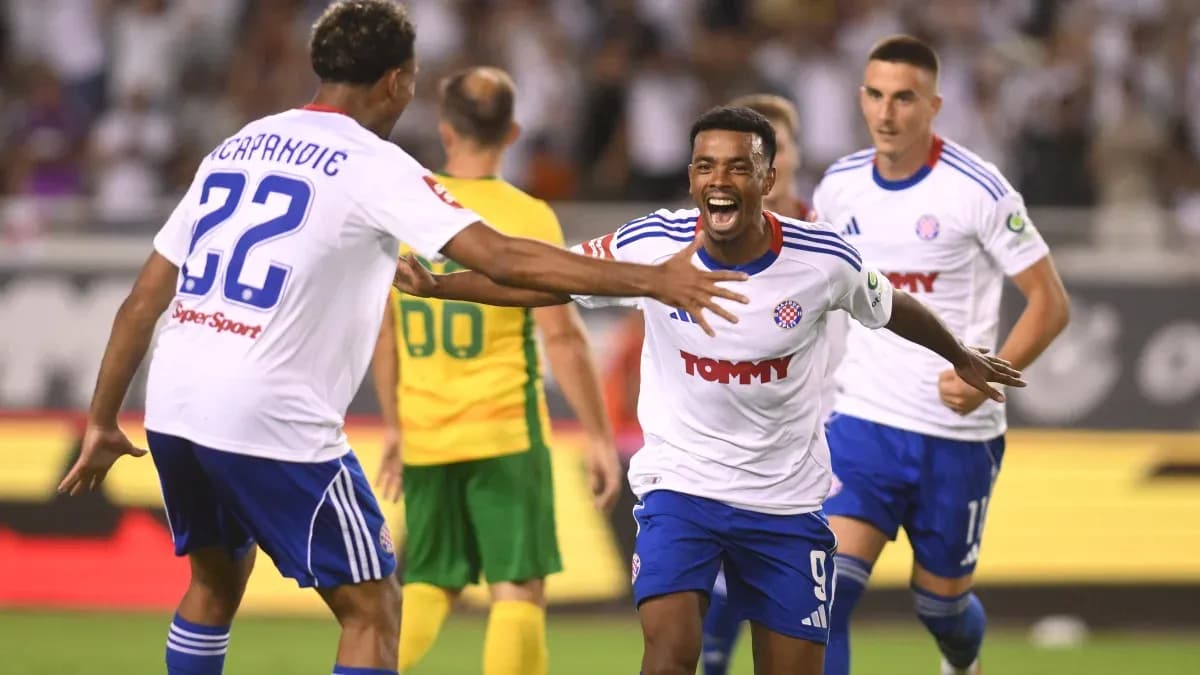
Žilina's Tactical Shift in 2-1 Comeback Win Over Hajduk Split
Žilina’s 2-1 comeback win over HNK Hajduk Split at Štadión pod Dubňom in the UEFA Europa League 1st Qualifying Round was defined far more by structural and in-game tactical shifts than by raw statistical trends, because almost all numerical performance metrics are absent from the data. What is clear is the game-state arc: Hajduk led 0-1 at half-time, Žilina overturned it to 2-1 by full time, and both sides finished with two yellow cards and no reds, suggesting a physically committed but controlled contest.
Tactical Overview
Tactically, Žilina’s declared 3-4-3 under Pavol Stano provided the framework for their second-half surge. The back three of T. Paliscak, J. Minarik and A. Narimanidze, with T. Hranica stepping up from the nominal defensive line into wider or more advanced zones, offered a flexible base. In possession, this likely resembled a 3-2-5 or 3-4-2-1, with wing and half-space occupation coming from K. Bari and M. Kacer centrally, and the front trio of F. Kosa, M. Roginic and P. Ilko stretching Hajduk’s back four.
The first half, however, belonged to Hajduk’s 4-2-3-1. Gonzalo Garcia’s side used a classic structure: full-backs M. Acapandie and Šimun Hrgović providing width, A. Van Hoorenbeeck and S. Hrgovic combining on the left, with R. Pukstas and A. Pajaziti as the double pivot. Ahead of them, R. Brajkovic, N. Skoko and D. Melnjak supported lone forward M. Sego. The key moment came at 45': A. Van Hoorenbeeck scored with an assist from S. Hrgovic, and the goal was subsequently confirmed by VAR at 45+3'. That pattern – a full-back combining with the left-sided centre-back stepping into advanced zones – underlines how Hajduk tried to overload the wide channels against Žilina’s wing-backs and outside centre-backs.
Discipline Data
Discipline data adds another layer to the tactical reading. Both early yellow cards were against Hajduk defenders: Šimun Hrgović (21' — Foul) and Alec Van Hoorenbeeck (30' — Foul). This strongly suggests Žilina were already targeting the flanks and half-spaces, forcing last-ditch interventions from the Croatian side’s back line. Even before Žilina’s comeback, Hajduk’s defensive unit was under enough pressure to draw two cautions, which would have constrained their aggression in duels as the game progressed.
Second Half Adjustments
The turning point in structure came at half-time and early in the second half. Immediately at 46', T. Paliscak (OUT) was replaced by M. Okal (IN) for Žilina. This like-for-like defensive change within a back three likely aimed at refreshing the right side of the defence to better cope with Hajduk’s left-leaning attacks, while also giving Žilina a more proactive ball-carrier or more secure defender in wide build-up.
The equaliser at 52' encapsulates Žilina’s attacking idea: M. Roginic scored for Žilina, assisted by F. Kosa. That combination between a wide or half-space attacker (Kosa) and the central forward (Roginic) fits the 3-4-3 logic: wing-forward to central striker in a vertical or diagonal connection. VAR confirmed Roginic’s goal at 54', underlining how aggressively Žilina were attacking the box and pushing Hajduk’s defensive line back towards their own penalty area.
Stano then doubled down on tempo and attacking width. At 66', two changes: M. Kacer (OUT) was replaced by F. Bzdyl (IN), and F. Kosa (OUT) by M. Fasko (IN). Removing Kacer, a central midfielder, for Bzdyl and swapping the assisting wide player Kosa for a fresh forward in Fasko suggests a shift towards more direct, higher-risk attacking, likely with more runners beyond the ball and less emphasis on patient circulation. The booking of Xavier Adang at 67' (Persistent fouling) reflects how Žilina’s central midfielders were tasked with aggressive counter-pressing and breaking up Hajduk transitions, even at the cost of disciplinary risk.
By 72', Žilina pushed further: P. Ilko (OUT) made way for S. Datko (IN). Rotating one of the forwards indicates a desire to maintain high pressing intensity and fresh movement across the front line. At 82', the final key change: X. Adang (OUT) for A. Florea (IN). Given Adang’s yellow for Persistent fouling, this substitution both removed a disciplinary risk and injected a more attacking or progressive profile into midfield. Florea later received a yellow card himself at 90+2' (Foul), a sign he was also used in a combative role to protect the lead and disrupt late Hajduk pushes.
Hajduk's Response
Hajduk’s response was more conservative and reactive. At 64', N. Skoko (OUT) was replaced by D. de Almeida (IN), a midfield-for-midfield change aimed at regaining control in the central band after Žilina’s equaliser. The double switch at 75' – Šimun Hrgovic (OUT) for A. Sanyang (IN) and R. Brajkovic (OUT) for A. Guram (IN) – reshaped the right side and attacking midfield. With Hrgović on a booking, this was also a risk-management move, while Sanyang and Guram likely offered more energy and ball-carrying in wide and advanced areas to chase a second goal. The 84' change, M. Sego (OUT) for M. Livaja (IN), introduced a more experienced forward profile to lead the line for the closing phase, signalling Hajduk’s intent to turn territorial pressure into late chances.
Decisive Outcome
The decisive tactical outcome, however, was the late own goal. At 90', D. Melnjak put the ball into his own net, credited as an own goal for Žilina. For a left-sided defender in a 4-2-3-1 to score an own goal at that stage typically reflects sustained pressure on crosses or low balls into the box. Structurally, Hajduk’s back four, already reshuffled and carrying earlier bookings, were forced deep and into reactive defending, while Žilina’s 3-4-3 – reinforced by attacking substitutions – maintained enough presence in the area to force the error.
From a statistical standpoint, the data is extremely sparse: there are no recorded values for shots, possession, passes, saves, xG or goals prevented for either side. The only hard numbers are disciplinary: Žilina received two yellow cards (Xavier Adang for Persistent fouling at 67', Andrei Florea for Foul at 90+2'), and HNK Hajduk Split also received two yellow cards (Šimun Hrgović for Foul at 21', Alec Van Hoorenbeeck for Foul at 30'). No red cards were shown. Within this limited statistical frame, the tactical story is carried by formations, substitutions and event timing: Žilina’s structural bravery in a 3-4-3, aggressive midfield pressing and attacking substitutions gradually overwhelmed Hajduk’s initially well-organised 4-2-3-1, turning a 0-1 deficit into a 2-1 advantage by full time at Štadión pod Dubňom.