.svg&w=384&q=75 "naujapitch logo")
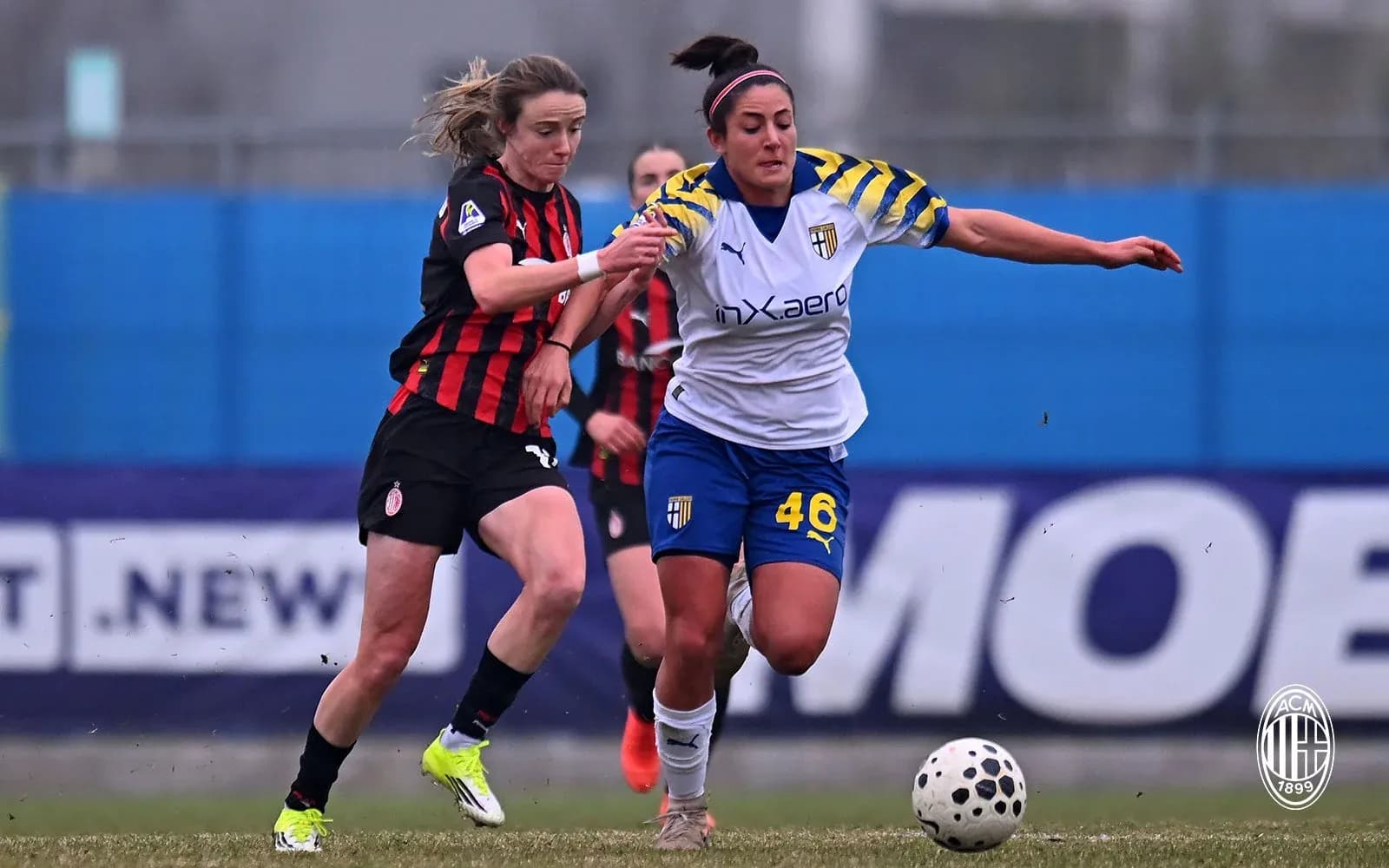
AC Milan W vs Parma W: Serie A Women Mid-Table Clash
In the league phase, this is a mid-table vs relegation-battle clash in Serie A Women Regular Season - 21 at Centro Sportivo Peppino Vismara in Milan. AC Milan W sit 7th with 29 points from 20 games and a +4 goal difference (28 scored, 24 conceded), while Parma W are 10th on 16 points with a -11 goal difference (14 scored, 25 conceded). For Milan, it is a key opportunity to consolidate a safe upper-mid position and keep faint hopes of climbing, while for Parma it is a high-stakes survival fixture where any point away from home can be decisive.
Head-to-Head Tactical Summary
The recent head-to-head record tilts clearly towards AC Milan W. On 17 January 2026 at Stadio Ennio Tardini in Parma, the sides drew 0-0 (HT 0-0), a tight contest suggesting Parma can contain Milan when compact. On 15 January 2023 at Puma House of Football - Centro P. Vismara in Milano, Milan won 2-0 (HT 1-0), showing the hosts’ ability to control and convert at home. Earlier, on 24 September 2022 at Stadio Ennio Tardini, Milan recorded a 4-0 away win (HT 2-0), underlining a clear attacking edge when given space. Across these three meetings, Milan have 2 wins and 1 draw, with an aggregate 6-0, indicating a consistent defensive grip on Parma and a pattern where Milan’s structure has limited Parma’s attacking threat.
Global Season Picture
- League Phase Performance: In the league phase, AC Milan W are 7th with 29 points from 20 matches, scoring 28 and conceding 24. Their home record is balanced (4 wins, 3 draws, 3 losses, 15 goals for, 14 against), reflecting a side that is competitive but not dominant. Parma W are 10th with 16 points from 20 matches, with 14 goals for and 25 against. Away from home they have yet to win (0 wins, 5 draws, 5 losses, 1 goal scored, 11 conceded), highlighting a very blunt attack on the road.
- All-Competition Metrics: Across all phases of the competition, Milan’s attack is steady rather than explosive, averaging 1.4 goals per game (28 in 20) and conceding 1.2 per game (24 in 20), with 7 clean sheets and 7 matches failed to score, indicating a balanced but sometimes inconsistent side. Their use of a 4-3-3 in 10 matches points to a stable, possession-oriented structure, with discipline tested by a spread of yellow cards peaking late in games (31.58% of yellows between minutes 76-90). Parma’s profile across all phases is far more polarized: they average only 0.7 goals per game (14 in 20) while conceding 1.3 (25 in 20), with 11 games where they failed to score. Notably, they have 4 away clean sheets despite scoring just 1 away goal, suggesting a low-block, risk-averse approach that sacrifices attacking output for defensive solidity.
- Form Trajectory: In the league phase, Milan’s recent form string “LDWDW” shows a stop-start but positive trend: 2 wins, 2 draws, and 1 loss in the last five, pointing to a side edging upwards but lacking sustained momentum. Parma’s “LDWDD” reflects marginal improvement: 1 win, 2 draws, and 2 losses, with draws indicating resilience but also underlining their difficulty in turning tight games into victories. The contrast is of a Milan team stabilizing in mid-table versus a Parma side grinding for points without a clear breakout.
Tactical Efficiency
Without explicit comparison indices, the season data still sketches contrasting efficiency profiles. Across all phases, Milan’s attack operates at a moderate efficiency (1.4 goals per match) aligned with a flexible 4-3-3 base and occasional shifts to 4-2-3-1 or 4-1-4-1, supporting controlled possession and multi-line pressing. Their defensive output (1.2 goals conceded per match, 7 clean sheets) is consistent with a reasonably compact block that can be exposed in isolated heavy defeats (biggest home loss 1-5), but generally holds mid-table standards. Discipline-wise, the clustering of late yellow and red cards indicates that intensity in the closing stages sometimes turns into risky challenges, which can undercut game management.
Parma’s efficiency is far more skewed: across all phases they concede at a similar rate (1.3 goals per match) but produce just 0.7 goals per match, and away from home only 0.1 goals per match (1 goal in 10 away fixtures). This underlines a very low conversion of attacking phases into chances and goals, with 11 total matches failing to score. Their multiple back-three and back-five formations (3-4-2-1, 3-4-3, 5-4-1, among others) show a clear defensive-first strategy. The four away clean sheets suggest that, structurally, the defensive block can be efficient, but the attack lacks the quality or numbers to threaten consistently. In efficiency terms, Milan’s balance between goals for and against is mid-table standard, while Parma’s profile is that of a survival-focused side whose defensive structure outperforms its attack by a wide margin.
The Verdict: Seasonal Impact
In the league phase, this fixture carries asymmetrical but significant implications. For AC Milan W, a home win would push them further clear of any residual relegation concerns and keep them in touch with the cluster above, preserving a pathway to a stronger final ranking and a more positive platform for 2026. Dropped points, especially at home to a bottom-side away attack that has scored just once on the road, would signal stagnation and raise questions about their ability to impose themselves on low-block opponents.
For Parma W, the seasonal impact is sharper: any point away at Milan directly supports their relegation fight, particularly given their heavy reliance on home results and draws. A win would be transformative, potentially reshaping the bottom of the table by converting them from a draw-heavy struggler into a side with genuine momentum. A defeat, combined with their current lack of away goals, would reinforce the pattern of a team surviving only through narrow margins and defensive resistance, increasing pressure to find attacking solutions in the remaining fixtures. Overall, this match is more about survival than titles: Milan seek consolidation and upward nudging in mid-table, while Parma face a pivotal test of whether their defensive resilience can translate into the points needed to stay in Serie A Women in 2026.